A bathroom remodel can completely change how your home feels. A dark, outdated bathroom can become brighter, more functional, easier to maintain, and dramatically more comfortable. But before you start choosing tile, shopping for a vanity, or saving bathroom inspiration on Pinterest, there's a more important question to answer: How do you actually plan a bathroom remodel? Whether you're updating a guest bath or incorporating it into a full house remodel, the planning process matters.
Plan before you build
Because a successful bathroom renovation isn't simply a collection of beautiful products. It's a coordinated project involving:
And the decisions you make before demolition begins can have a major impact on the cost, timeline, and final result.
For homeowners in Orange County and Los Angeles, there's another layer to consider: local permitting requirements, the age and condition of the home, and the specific jurisdiction where the property is located.
Venguard Construction's design-build process begins with consultation, a site walkthrough, measurements and discovery, followed by estimating, design, material selection, planning and permitting, construction, project management, and final walkthrough.
In this guide, we'll walk through the process step by step so you can approach your bathroom renovation with a much clearer plan.
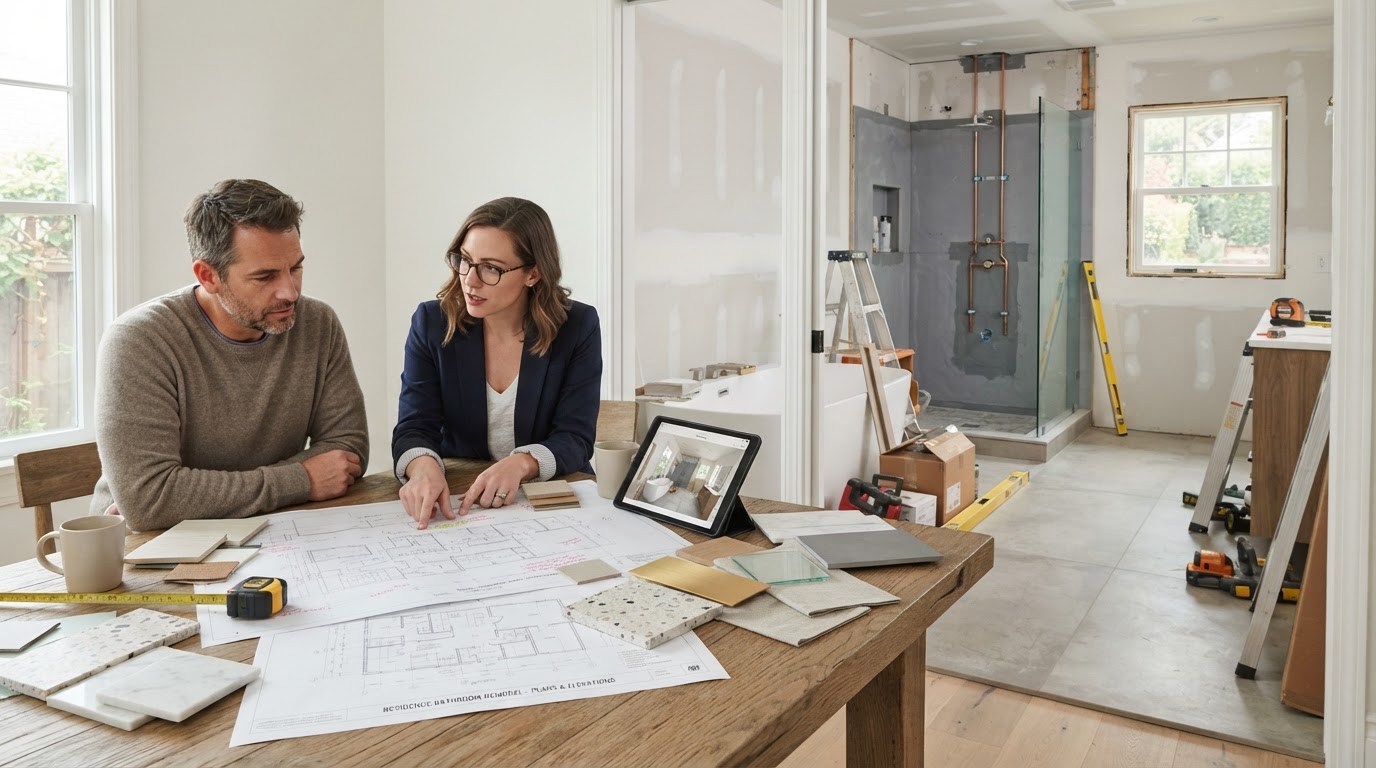
A well-planned bathroom remodel starts long before demolition.
The 15-Step Bathroom Remodeling Planning Checklist
Here's the process we'll cover:
Let's break down each step.
1. Define Why You're Remodeling
Before thinking about materials, ask yourself: Why does this bathroom need to change?
Your answer will influence almost every decision that follows. Maybe the bathroom is simply outdated. Maybe the shower is too small. Maybe there's not enough storage. Maybe the vanity doesn't work for two people. Maybe the layout wastes valuable space.
Maybe you're dealing with:
Or perhaps you simply want a bathroom that feels more like a retreat. There's no wrong answer. But you should know your primary reason for remodeling before you start designing.
Try completing this sentence: "After this remodel, I want my bathroom to ______." Your answer becomes the foundation for the project.
2. Identify Your Must-Haves
One of the easiest ways to lose control of a remodeling budget is to treat every idea as equally important. Instead, divide your ideas into three categories.
Must-Haves
These are non-negotiable.
- • Larger shower
- • Double vanity
- • Better storage
- • New flooring
- • Improved lighting
Nice-to-Haves
These would be great, but aren't essential.
- • Freestanding tub
- • Heated floors
- • Decorative niche
- • Accent wall
Luxury Upgrades
Features you would consider if the budget allows.
- • Premium stone
- • Specialty plumbing fixtures
- • Custom cabinetry
- • Advanced lighting
- • Smart-home features
This simple exercise can make the design process much easier.
3. Establish Your Bathroom Remodeling Budget
Your budget should be established before you start falling in love with specific products. Why? Because bathroom materials can vary enormously in price. A vanity might cost one amount at a big-box retailer and several times more when custom-designed.
The same is true for tile, countertops, faucets, shower systems, bathtubs, lighting, mirrors, and glass. But materials aren't the only cost. Your remodeling budget also needs to account for:
That's why a bathroom remodel estimate should clearly define what is included. Venguard emphasizes detailed estimating and walking clients through the numbers before construction begins.
For a deeper discussion of pricing, see our Bathroom Remodeling Cost Guide for Orange County & Los Angeles.
4. Evaluate Your Existing Bathroom
Before designing your dream bathroom, understand what you're working with. Look closely at:
Walls
Are there cracks, moisture issues, or signs of previous repairs?
Flooring
Is the subfloor solid?
Plumbing
Are pipes outdated or showing signs of problems?
Electrical
Are outlets and lighting adequate?
Ventilation
Does the bathroom have proper exhaust ventilation?
Shower
Is the existing waterproofing still reliable?
Cabinets
Can they be reused, or are they beyond their useful life?
Windows
Are they appropriately located and protected from moisture?
This is where professional site evaluation becomes valuable. Venguard's process specifically includes a site walkthrough, measurements, and discovery to understand existing conditions before the project is fully planned.
5. Decide Whether to Change the Layout
This is one of the biggest decisions in your renovation. Ask: Does the current layout work?
If it does, keeping the existing locations may simplify the project. But if the bathroom has always felt awkward, remodeling is an opportunity to fix it. You might:
A good layout can make a bathroom feel significantly larger without actually increasing its square footage.
6. Create a Functional Floor Plan
Don't start with tile. Start with space planning. Think about:
You should be able to move comfortably through the bathroom. This is particularly important in smaller bathrooms. A beautiful bathroom that is difficult to use isn't a successful remodel.
7. Choose Your Design Direction
Now you can start thinking about aesthetics. Some popular design directions include:
Modern
Clean lines, minimal details, neutral colors.
Contemporary
Current finishes combined with sleek forms and layered textures.
Transitional
A balance between traditional details and modern simplicity.
Organic / Natural
Stone, warm wood tones, natural textures, and softer colors.
Luxury / Spa-Inspired
Large-format tile, premium fixtures, frameless glass, sophisticated lighting, and carefully selected materials.
You don't necessarily need to choose one exact style. Instead, create a design language. For example: Warm modern bathroom with natural stone, soft neutral colors, brushed metal fixtures, and light oak cabinetry. That's much more useful than simply saying: "I want a nice bathroom."
8. Select Major Materials Before Construction
Material selection should happen early. Your selections may include:
Flooring
- • Porcelain
- • Ceramic
- • Natural stone
- • Large-format tile
Shower
- • Wall tile
- • Shower floor
- • Accent tile
- • Niche material
Vanity
- • Stock
- • Semi-custom
- • Custom
Countertop
- • Quartz
- • Marble
- • Granite
- • Porcelain
- • Other stone surfaces
Hardware
- • Chrome
- • Brushed nickel
- • Brass
- • Matte black
- • Other finishes
Fixtures
- • Faucets
- • Showerheads
- • Tub fillers
- • Toilets
Venguard's design process includes material and finish selection covering flooring, tile, countertops, cabinetry, fixtures, paint colors, hardware, and other finishes.
9. Plan Your Bathroom Lighting
Lighting is one of the most overlooked parts of bathroom remodeling. Don't rely on one ceiling fixture. Think in layers.
Ambient Lighting
General illumination throughout the bathroom.
Task Lighting
Especially important around the vanity.
Accent Lighting
Used to highlight tile, architecture, shelving, and niches.
Shower Lighting
Appropriate illumination inside the shower area.
Decorative Lighting
Sconces, pendants, or other statement fixtures.
A good lighting plan can make the bathroom feel larger, brighter, more luxurious, and more functional. It can also dramatically improve the way the materials look.
10. Plan Plumbing Fixtures Carefully
Plumbing fixtures are both functional and visual design elements. Think about:
Vanity
Single or double sink?
Shower
One showerhead or multiple?
Tub
Freestanding or built-in?
Toilet
Standard or specialty configuration?
Controls
Where should valves and controls be positioned?
The important thing is to make decisions before the plumbing rough-in. Moving a fixture after construction has started can be far more expensive than deciding its location during design.
11. Determine Permitting Requirements
This is an important step for homeowners in Southern California. Depending on the scope and location of the project, permits and inspections may apply to work such as:
Orange County and Los Angeles encompass many different jurisdictions. That means homeowners should not assume that the requirements for one city automatically apply to another.
Your contractor should determine what permits are required, who submits them, who coordinates inspections, when work can begin, and which construction stages require inspection. Venguard includes planning and permitting as part of its design-build workflow.
12. Choose the Right Bathroom Remodeling Contractor
This may be the most important decision you make. A bathroom remodel involves too many specialized tasks to treat contractor selection casually. Look for a contractor who can demonstrate:
Experience
Do they regularly complete bathroom renovations?
Licensing and Insurance
Are they properly qualified and insured?
Communication
Will you know what's happening throughout the project?
Detailed Estimates
Can they clearly explain the scope and pricing?
Project Management
Who coordinates the trades?
Permitting
Who handles the required approvals?
Portfolio
Can you see completed bathroom projects?
Warranty
What happens after construction?
Venguard's contractor-selection guide recommends homeowners verify credentials, compare detailed estimates, understand permits and contracts, evaluate communication, and review project-management and warranty practices.
Venguard also showcases bathroom projects including walk-in showers, dual vanities, marble showers, freestanding tub suites, and other bathroom renovations in its portfolio.
13. Finalize the Scope and Estimate
Once the design is established, the project should have a clear scope. The estimate should ideally make it possible to understand:
Avoid vague proposals. You don't want to discover halfway through construction that something you assumed was included actually wasn't.
14. Prepare for Construction
Once the project is approved, it's time to prepare your home. Before demolition:
Clear the Bathroom
Remove personal belongings.
Protect Nearby Areas
Construction traffic can affect adjacent rooms.
Establish Access
Determine how workers and materials will enter the home.
Plan for Dust
Ask about dust-control procedures.
Plan for Bathroom Access
If this is your only bathroom, determine where you'll shower and use the restroom during construction.
Confirm Material Deliveries
Major materials should be ordered and scheduled appropriately.
Understand Communication
Know who to contact when you have questions.
Venguard's process includes a dedicated project manager, project-management tools, communication throughout the build, and organized payment milestones.
15. Complete the Final Walkthrough
The project isn't finished simply because the major construction is complete. The final walkthrough matters.
Walk through the bathroom and inspect:
Test what can be tested. Open the drawers. Turn on the faucets. Check the shower. Test the lighting. Look closely at the finishes.
Venguard's completion process includes a final walkthrough, finishing touches, and warranty/support after the project is completed.
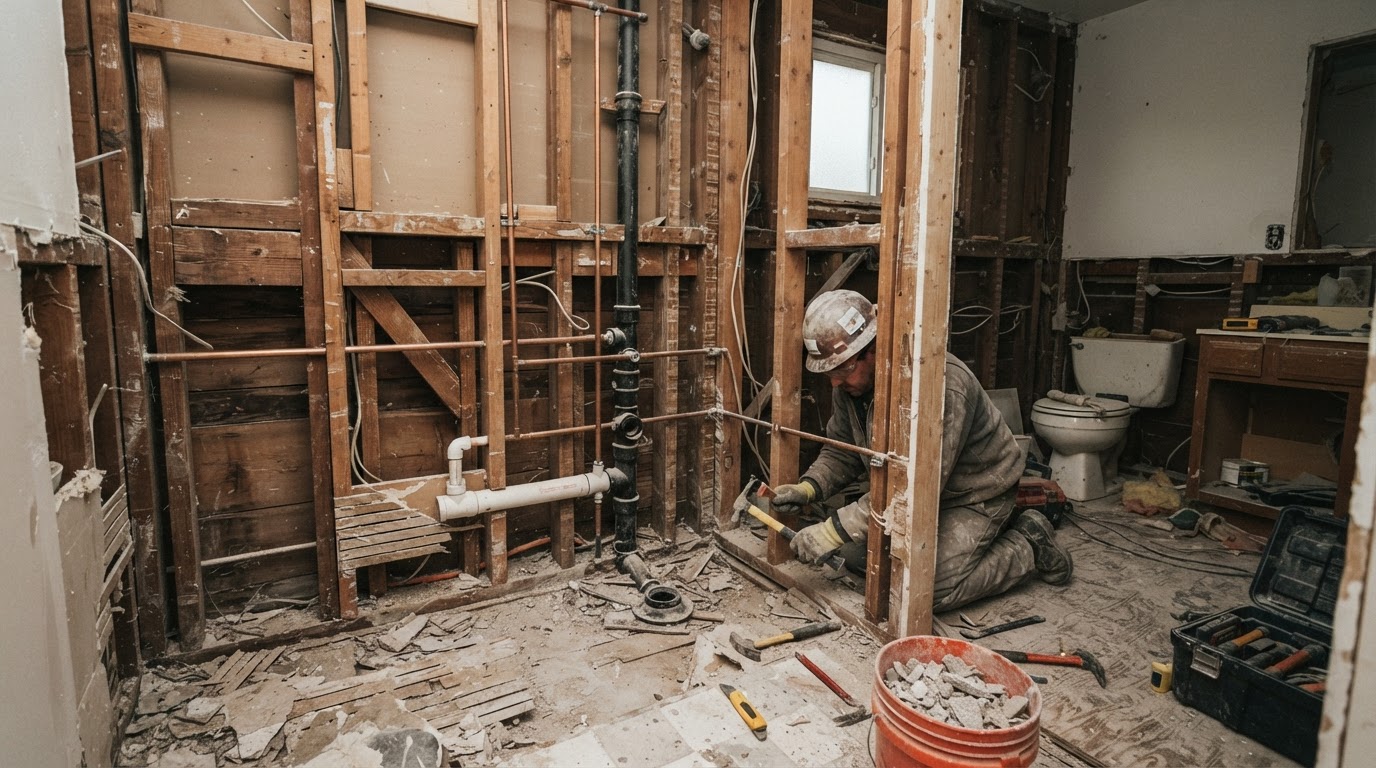
Proper planning prevents costly surprises during demolition.
Bathroom Remodeling Checklist
Before construction begins, you should ideally have answers to all of these:
Planning
- ☐ Why am I remodeling?
- ☐ What are my must-haves?
- ☐ What are my nice-to-haves?
- ☐ What is my budget?
- ☐ What is my desired timeline?
Layout
- ☐ Is the existing layout working?
- ☐ Am I moving plumbing?
- ☐ Is there enough storage?
- ☐ Is the shower large enough?
- ☐ Is there enough clearance?
Design
- ☐ Tile selected
- ☐ Vanity selected
- ☐ Countertop selected
- ☐ Fixtures selected
- ☐ Lighting selected
- ☐ Hardware selected
- ☐ Mirror selected
- ☐ Paint selected
Construction
- ☐ Contractor selected
- ☐ Scope finalized
- ☐ Estimate reviewed
- ☐ Contract reviewed
- ☐ Permits identified
- ☐ Materials ordered
- ☐ Construction schedule discussed
How Much Should You Budget for Unexpected Problems?
Even with excellent planning, remodeling can reveal conditions that weren't visible before demolition. For example:
This is one reason you shouldn't plan your budget down to the last dollar. A responsible remodeling plan should account for the possibility of unforeseen conditions. Your contractor should also have a clear process for documenting and approving changes.
How to Avoid Bathroom Remodeling Mistakes
Don't Start Demolition Before the Design Is Ready
Demolition creates momentum. But if you haven't finalized what comes next, you're creating unnecessary uncertainty.
Don't Buy Everything Yourself Without Coordination
You may find a beautiful faucet online. But does it work with the plumbing? Is it the correct valve? Is it compatible with the sink? Is it available when needed? Material selection should be coordinated with the overall design and construction plan.
Don't Ignore Ventilation
Bathrooms produce substantial moisture. Proper ventilation should be considered during planning.
Don't Choose Materials Based Only on Appearance
Ask: Will this material perform well in this environment? Bathrooms experience moisture, water, cleaning products, temperature changes, and daily wear. Beauty matters. Performance matters too.
Don't Treat Waterproofing as an Upgrade
Waterproofing isn't a decorative option. It's part of the construction system that protects wet areas.
Bathroom Remodel Planning in Orange County
Orange County homeowners have a wide range of properties and remodeling needs. Venguard identifies Irvine, Newport Beach, Costa Mesa, Huntington Beach, Anaheim, Santa Ana, Laguna Beach, Mission Viejo, Tustin, and Lake Forest among its service areas.
Whether you're remodeling an older home or upgrading a newer property, the planning process should begin with the actual conditions of your home. That means measuring the space, evaluating the existing infrastructure, understanding the desired scope, and identifying local requirements before construction.
Bathroom Remodel Planning in Los Angeles
Los Angeles homeowners face the same fundamental planning questions:
But the specific requirements can vary depending on the property and jurisdiction. That's why a professional site evaluation is valuable before committing to a final plan. Venguard serves Los Angeles and surrounding Southern California communities.
Why Planning Matters More Than Picking the Perfect Tile
It's easy to think a bathroom remodel is primarily about design. But design is only one part. A successful renovation has to bring together:
Design + Function + Construction + Budget + Schedule
If one of those pieces isn't properly planned, the others can suffer:
- • A beautiful design that exceeds the budget doesn't work.
- • A low-cost remodel with poor waterproofing doesn't work.
- • A great design with an unrealistic schedule doesn't work.
- • A well-built bathroom with a poor layout doesn't work.
The best projects bring everything together.
Why Venguard Uses a Design-Build Process
Venguard's process is structured around a single workflow rather than leaving homeowners to coordinate every part themselves. The process includes:
Plan → Design → Build → Manage → Completion
Planning Stage
Consultation, site walkthrough, measurements, and discovery.
Design Stage
Estimating, design development, and material selection.
Build Stage
Communication, trade coordination, materials, inspections, and site oversight.
Project Management
Dedicated project manager, project-management tools, and payment milestones.
Completion Stage
Final walkthrough, finishing touches, and warranty/support.
That's particularly valuable for bathroom remodeling because the project requires coordination between multiple specialized trades.
Frequently Asked Questions
How do I start planning a bathroom remodel?
Start by identifying why you want to remodel, establishing your priorities and budget, evaluating the existing bathroom, and determining whether the layout needs to change. From there, work with a qualified remodeling professional to develop the design, scope, estimate, and construction plan.
What should I choose first when remodeling a bathroom?
Start with the layout and function, not the decorative finishes. Once the layout is established, you can select materials, fixtures, lighting, cabinetry, and other finishes around the design.
How much should I budget for a bathroom remodel?
The cost depends on the size of the bathroom, scope of work, materials, labor, plumbing, electrical, layout changes, permits, and construction conditions. A cosmetic update can be very different from a full custom renovation. See our complete Bathroom Remodeling Cost Guide for a deeper breakdown.
Should I change the layout of my bathroom?
If the current layout works well, keeping it may simplify the renovation. If the bathroom has poor circulation, insufficient storage, an undersized shower, or an inefficient arrangement, changing the layout may provide a much better result.
What bathroom materials should I select first?
Major selections such as tile, vanity, countertop, plumbing fixtures, and lighting should be coordinated early because availability and compatibility can affect the construction schedule.
Do bathroom remodels require permits?
Permit requirements depend on the work being performed and the local jurisdiction. Plumbing, electrical, structural modifications, and other regulated work may require permits and inspections.
How long does it take to plan a bathroom remodel?
There isn't a universal planning timeline. A straightforward renovation with minimal design changes may be planned relatively quickly, while a custom bathroom involving layout changes, detailed design, specialty materials, and permitting requires more preparation. Read our related guide on how long a bathroom remodel takes.
Should I hire a designer or a remodeling contractor first?
For a design-build company, both functions can be coordinated within one process. This can help connect the design decisions to actual construction requirements, pricing, materials, and scheduling.
How do I choose a bathroom remodeling contractor in Orange County?
Look for appropriate licensing and insurance, relevant bathroom experience, a strong portfolio, clear estimates, communication systems, project management, permit knowledge, and a documented warranty or post-project support process.
What should be included in a bathroom remodeling estimate?
The estimate should clearly define the scope of work, materials, labor, demolition, installation, plumbing, electrical work, permits where applicable, and any exclusions. It should also explain how changes or unforeseen conditions will be handled.
Can I stay in my home during a bathroom remodel?
Often, yes. However, the level of disruption depends on the bathroom being renovated, the number of bathrooms in the home, construction access, and the extent of demolition.
What is the biggest bathroom remodeling mistake?
Starting construction without adequately planning the scope, layout, materials, budget, and construction sequence. Changes made after construction begins can be more expensive and disruptive than decisions made during the planning stage.
Final Thoughts
A successful bathroom remodel doesn't begin with demolition. It begins with a plan.
Before the first tile is removed, you should understand:
The more clearly these questions are answered before construction begins, the fewer surprises you're likely to encounter. And that's exactly why the planning stage deserves as much attention as the finished design.
Venguard Construction's approach is built around this principle: start with consultation and discovery, develop the design and estimate, coordinate planning and permitting, manage construction, and finish with a final walkthrough and ongoing support.
For homeowners throughout Orange County, Los Angeles, and surrounding Southern California communities, the goal isn't simply to build a beautiful bathroom. It's to create a space that is thoughtfully planned, professionally built, and designed around the way you actually live.
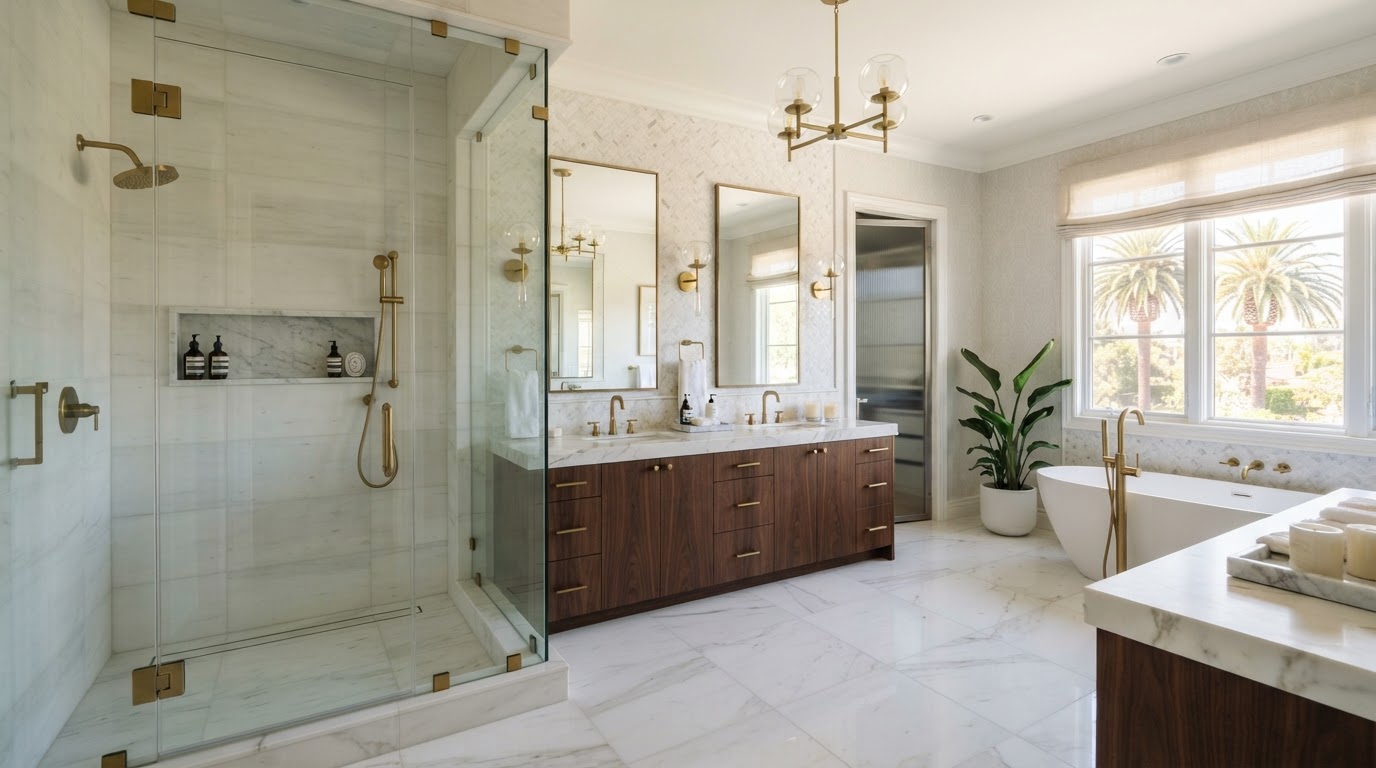
A thoughtfully planned bathroom becomes a space you'll enjoy for years.
Ready to Start Planning Your Bathroom Remodel?
If you're still in the research stage, that's okay. You don't need to have every tile, fixture, or finish selected before talking to a remodeling professional. Start with your space, your goals, and your priorities. Venguard Construction offers a complimentary consultation where homeowners can discuss their project, goals, budget, timeline, and next steps.
Get Your Free Bathroom Remodeling Consultation