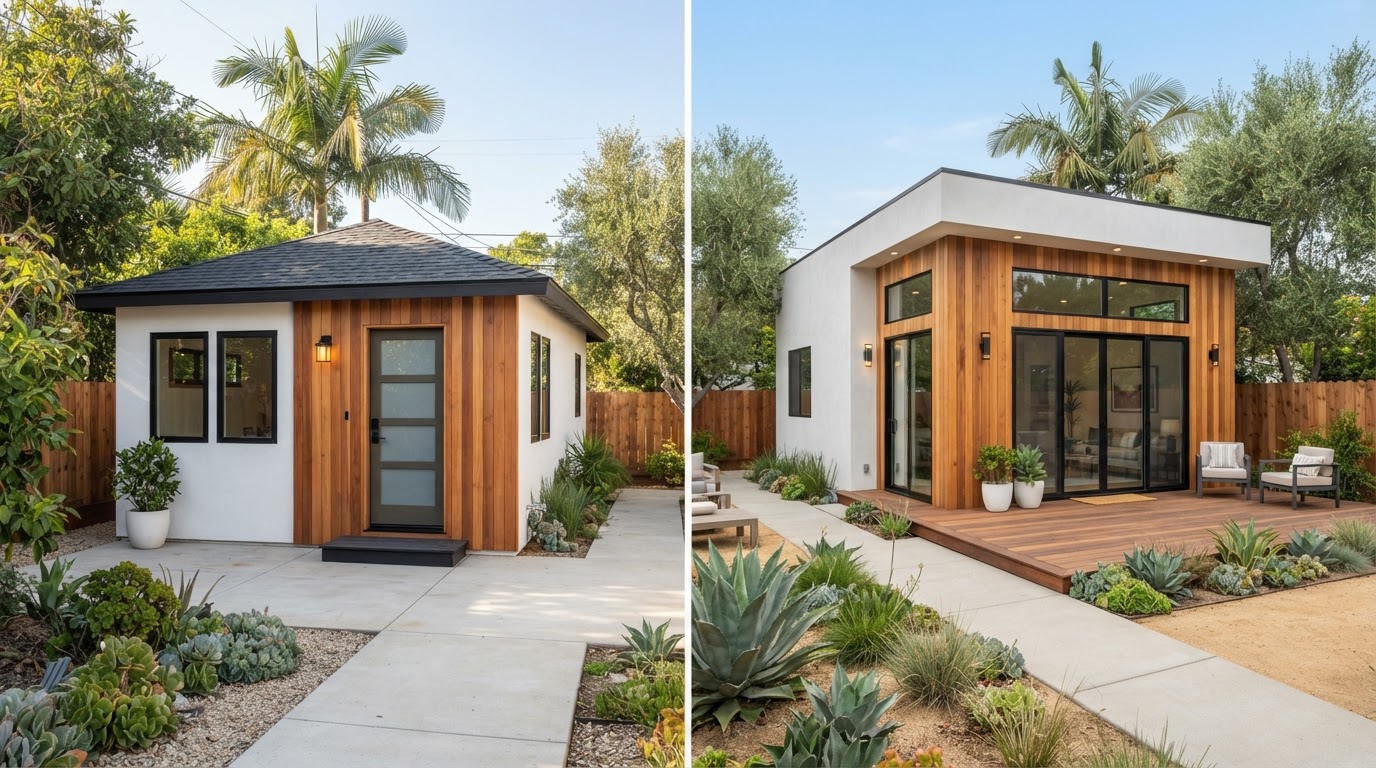
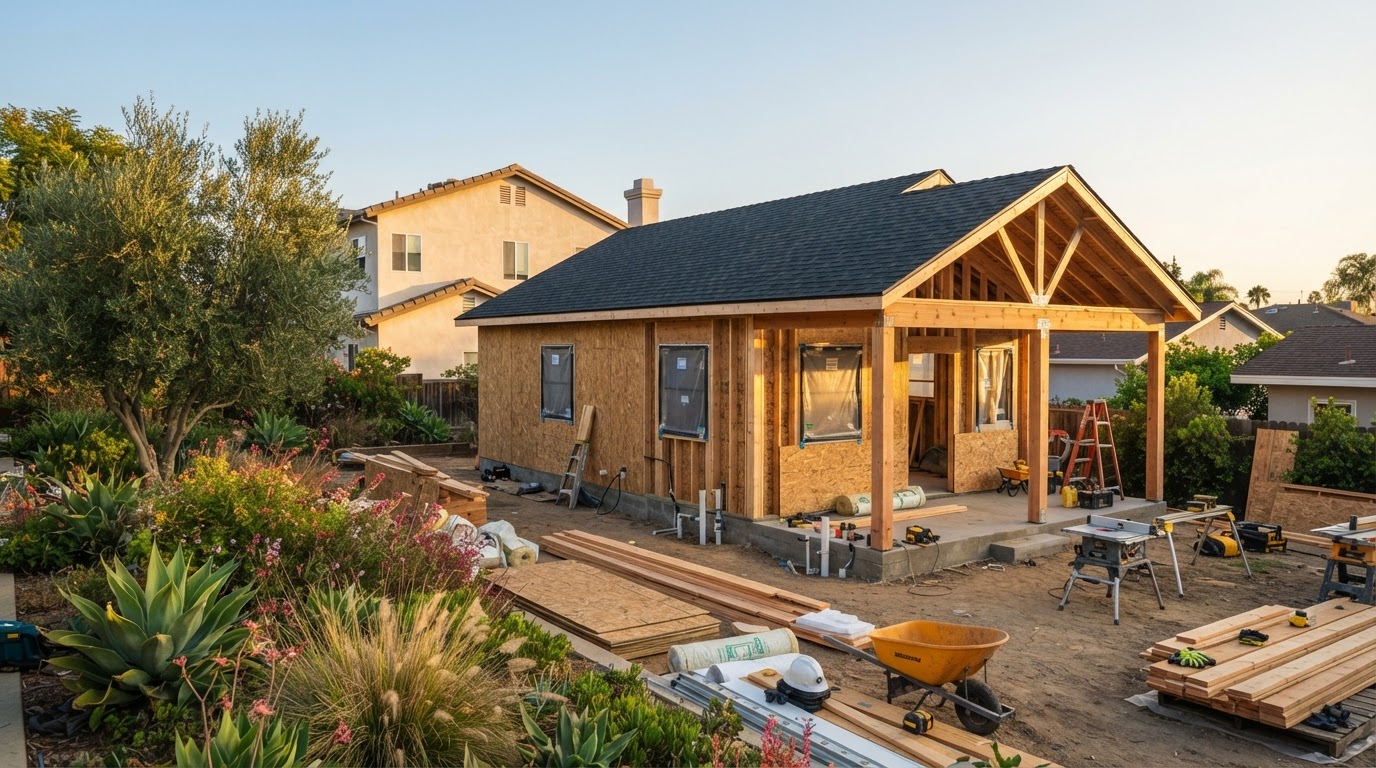
Building an accessory dwelling unit (ADU) can be an exciting way to create additional living space, accommodate family members, or generate rental income. But before construction begins, one of the most important decisions you’ll make is signing the right construction contract.
A well-written ADU construction contract establishes what your contractor will build, what materials will be used, how much the project will cost, when payments are due, who will obtain permits, and how unexpected changes will be handled.
Without these details, even a promising project can become stressful. Homeowners may face unexpected charges, disagreements about materials, construction delays, incomplete work, or disputes over responsibility for permits and inspections.
These risks matter in Orange County and Los Angeles, where ADU projects can involve existing garages, tight side yards, utility upgrades, engineering requirements, and city-specific approval processes.
The goal is not simply to find the lowest bid. It’s to understand exactly what you’re agreeing to—and how your contract protects both your investment and your expectations. This guide explains what California homeowners should review before signing an ADU construction agreement in 2026, including payment rules, change orders, warranties, contractor verification, and common warning signs.
Important: This article provides general educational information, not legal advice. Contract requirements can vary with the project and transaction. Have a qualified California construction attorney review a contract when the scope, financing, or legal risks warrant it.
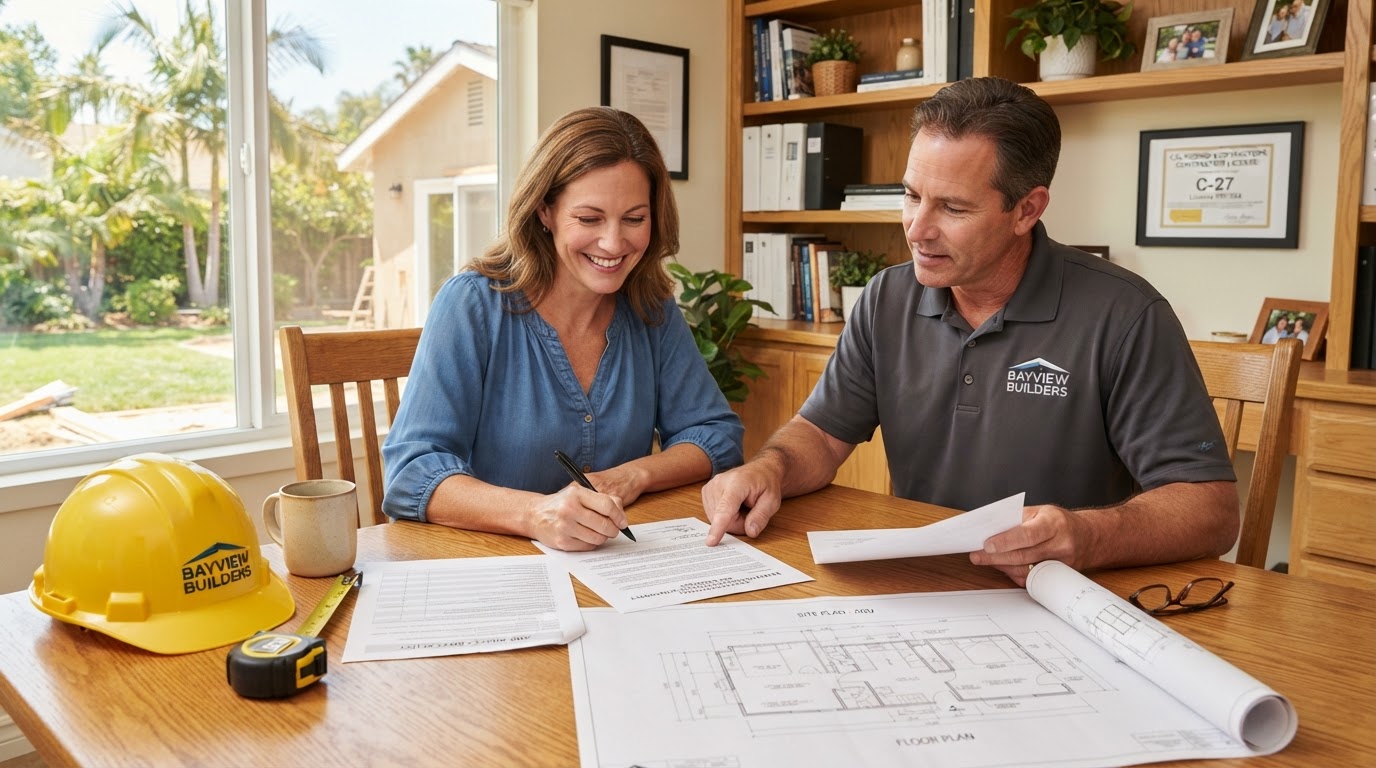
A clear contract defines the scope, price, payment schedule, and responsibilities—before the first shovel enters the ground.
1. Why Your ADU Construction Contract Matters
An ADU project typically involves several connected stages: site evaluation and feasibility, architectural design and engineering, permit applications and plan review, site preparation and foundation work, framing and building-envelope construction, plumbing, electrical, and HVAC installation, insulation, drywall, finishes, and fixtures, and inspections, corrections, and final approvals.
A contract should define which of these services are included, which are excluded, and who is responsible for each task. For example, one contractor’s proposal may include architectural plans, engineering, permit coordination, construction, and final inspections. Another may price only the construction work after plans and permits have already been obtained. Both proposals might use the phrase “complete ADU construction,” but they may not represent the same scope.
That is why homeowners should compare the written details—not just the headline price. A good contract helps answer five essential questions:
- What exactly am I getting?
- What is the total agreed price, and what could change it?
- When can the contractor request payment?
- Who is responsible for permits, scheduling, and inspections?
- What happens if the project changes, is delayed, or has defects?
2. Verify the Contractor Before Signing
Before reviewing payment schedules or negotiating finishes, verify the contractor’s identity, license, qualifications, and insurance.
Check the California contractor license
Use the California Contractors State License Board (CSLB) website to verify the contractor’s license status. Confirm that the license is active and in good standing, the business name matches the name on the proposal and contract, the license classification is appropriate for the work being contracted, the listed business address and contact information are consistent, and any disclosed disciplinary history or other relevant license information has been reviewed. The contractor’s bond and workers’ compensation information should also be current where required. Do not rely only on a license number printed on a business card, website, vehicle, or proposal. Verify it directly with the CSLB License Check.
For a complex ADU project, ask who will handle the different trades, such as electrical, plumbing, and HVAC, and confirm the appropriate licensing arrangements for that work.
Verify insurance
Ask for current insurance documentation and verify it with the insurance carrier or agent when appropriate. Pay particular attention to workers’ compensation insurance—California generally requires employers to maintain workers’ compensation coverage for employees, subject to applicable statutory rules and exceptions—and commercial general liability insurance. Do not assume a contractor’s license bond is the same as comprehensive liability insurance. These serve different purposes. For official guidance, see the CSLB guide to finding the right contractor.
Ask for relevant ADU experience
A contractor who primarily handles cosmetic renovations may not have the same experience as a team that regularly manages detached ADUs, garage conversions, foundations, utility connections, and municipal inspections. Ask for examples of comparable completed projects and, where possible, request references from homeowners whose projects involved a similar ADU type, site condition, and scope.
Useful questions include:
- Have you completed projects in my city or jurisdiction?
- Have you handled garage conversions and detached ADUs?
- Who coordinates the architect, engineer, and subcontractors?
- Who communicates with the building department?
- How are schedule changes and cost overruns handled?
- Can I speak with previous clients about their experience?
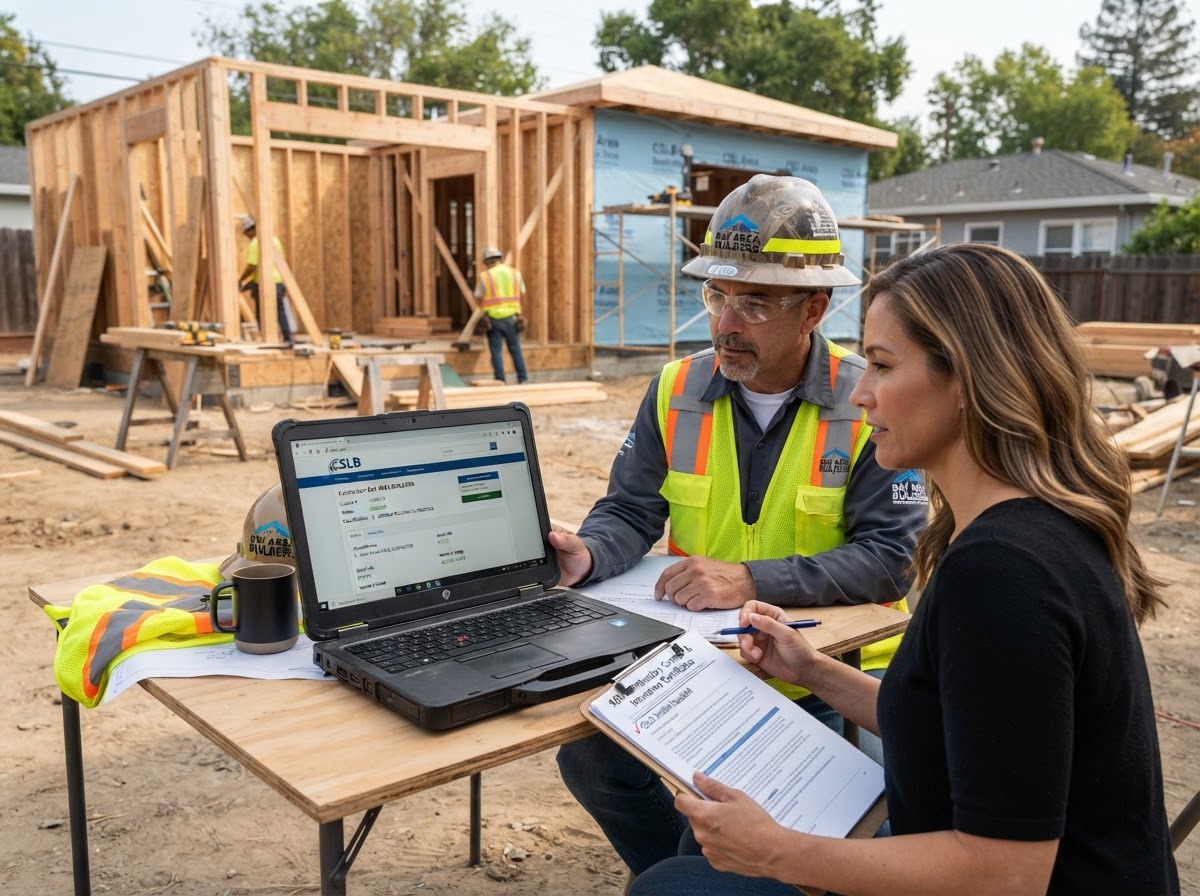
Verify the license, bond, and insurance directly with the CSLB—not from a business card or proposal alone.
3. What Should an ADU Construction Contract Include?
California generally requires written contracts for home improvement projects exceeding $500 in combined labor and materials costs. The CSLB identifies the work description, materials, contract price, payment schedule, start and completion dates, permit responsibilities, and other required disclosures as important contract elements. Review the applicable statutory requirements rather than relying on a generic one-page estimate. For official guidance, see the CSLB’s explanation of what is a contract. Use the following checklist when reviewing an ADU construction agreement.
| Contract section | What to look for |
|---|---|
| Parties and license | Correct legal business name, address, license number, and owner information |
| Scope of work | Detailed description of construction tasks and deliverables |
| Plans and specifications | Identified architectural drawings, engineering plans, and approved revisions |
| Materials and finishes | Product types, brands or model numbers where applicable, finish allowances, and substitutions |
| Contract price | Clear total price and explanation of what is included or excluded |
| Payment schedule | Amount and milestone for each payment, consistent with California law |
| Project dates | Start date, completion date, and applicable delay provisions |
| Permits and inspections | Clear allocation of responsibility and included fees |
| Change orders | Written approval process for additional or revised work |
| Site protection | Dust control, protection of the existing home, access, and cleanup |
| Subcontractors | Clear responsibility for subcontractor management and relevant disclosures |
| Warranties | Written workmanship warranty and applicable manufacturer warranties |
| Lien protection | Required notices and a process for obtaining appropriate lien releases |
| Dispute resolution | Applicable notice, negotiation, mediation, arbitration, or litigation provisions |
| Cancellation rights | Applicable statutory notices and cancellation terms |
The exact requirements depend on the contract type and circumstances. Ask a California construction attorney to review unusual clauses, especially those that shift significant risk to the homeowner.
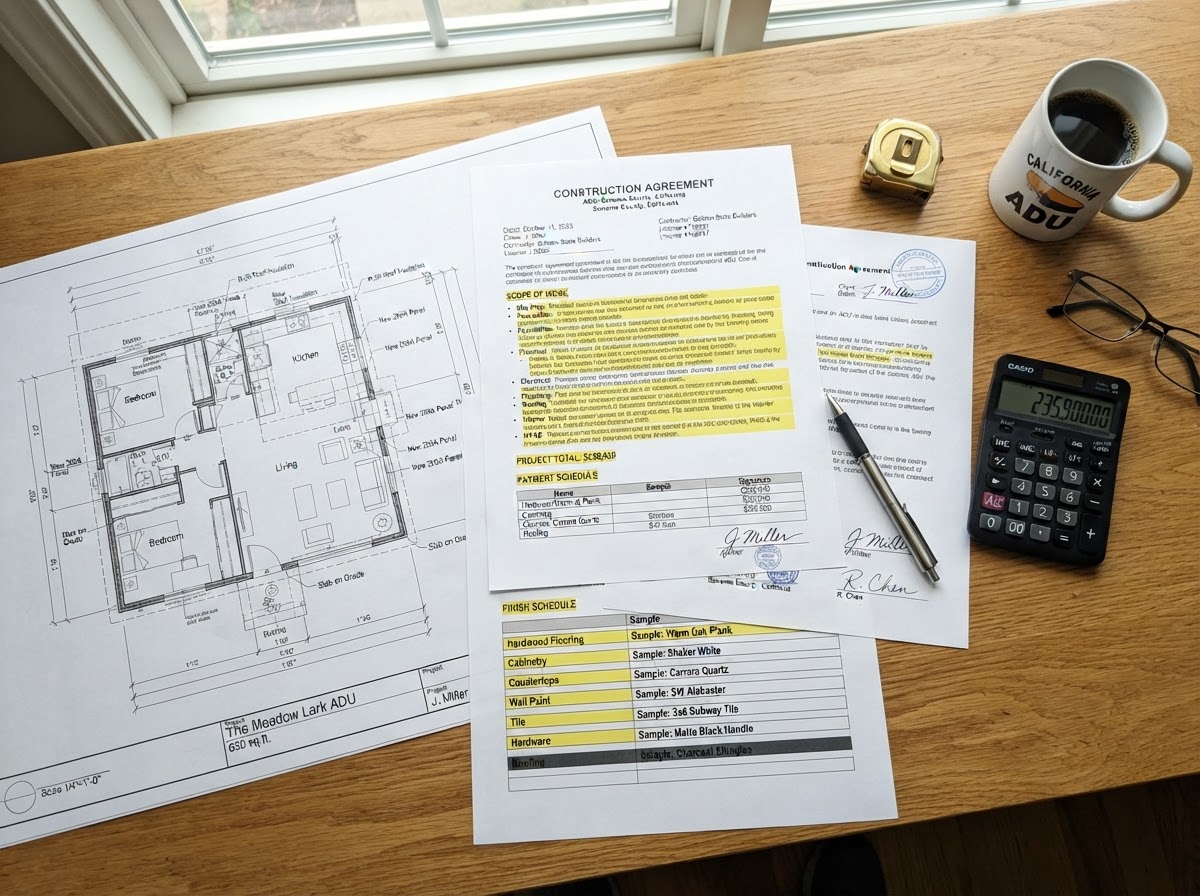
A specific scope of work—tied to the plans—prevents most construction disputes before they start.
4. Make the Scope of Work Specific
One of the most common sources of construction disputes is a scope of work that is too vague. Statements such as “build a 600-square-foot ADU,” “complete all interior finishes,” or “provide a turnkey unit” do not necessarily explain every included task. Your agreement should identify the work the contractor is promising to perform and connect it to the applicable plans and specifications.
Site preparation and foundation
Confirm whether the price includes:
- Surveying or layout, if required
- Clearing and demolition
- Excavation and grading
- Soil-related work or special foundation requirements
- Foundation and concrete work
- Drainage improvements
- Protection of existing landscaping and structures
Some of these items may be excluded or dependent on site conditions. The contract should say so clearly.
Framing and exterior construction
Identify the agreed construction method, structural scope, roofing, exterior cladding, windows, doors, waterproofing, and other components specified in the plans. If the project includes a garage conversion, confirm how existing framing, the garage door opening, slab, walls, and roof will be evaluated and addressed.
Plumbing, electrical, and HVAC
Clarify the planned work for water and sewer connections, electrical service, circuits, fixtures, heating and cooling, ventilation, and any required upgrades to existing systems. Utility connections and upgrades can create substantial costs. Confirm whether the contract includes them, includes only an allowance, or excludes them.
Interior finishes and appliances
Define the expected quality and selection of flooring, cabinetry, countertops, lighting, plumbing fixtures, paint, doors, trim, and appliances. For example, “kitchen cabinets included” is less informative than identifying the cabinet type, finish level, approximate configuration, and allowance for the selection.
Cleanup and project closeout
Confirm who is responsible for:
- Routine debris removal
- Final construction cleanup
- Removal of temporary facilities
- Repair of damage caused by construction
- Final walkthrough and correction of agreed deficiencies
- Delivery of applicable warranties and product information
- Final inspection coordination and closeout documentation
Also clarify what “completion” means under the agreement. Practical completion, final building inspection, and delivery of all closeout documents may not occur on exactly the same day.
5. Review the Price, Allowances, and Exclusions
A contract price is meaningful only when you understand what it covers. An estimate that looks lower at first may exclude engineering, permit fees, utility upgrades, appliances, landscaping repairs, or other necessary work. Another contractor may include many of these items in a more comprehensive proposal.
Understand fixed-price and allowance items
A fixed-price item generally has an agreed price for a defined scope. An allowance is a budget placeholder for something that has not yet been fully selected or priced. For example, a proposal might include an allowance for flooring or kitchen appliances. If the homeowner selects products that cost more than the allowance, the contract should explain how the difference is calculated and approved.
For every allowance, ask:
- What amount is included?
- Does it cover materials only or materials and installation?
- Are delivery, taxes, and handling included?
- What happens if the selected product costs less?
- How are upgrades approved and documented?
Identify exclusions
Ask the contractor to list significant exclusions explicitly. Depending on the project, exclusions might include architectural or engineering fees, city permit and plan-check fees, utility-company charges, sewer lateral or electrical service upgrades, unforeseen underground conditions, major landscaping or hardscape restoration, appliances or specialty fixtures, or financing fees and other third-party costs.
An exclusion is not automatically a problem. An undisclosed exclusion is. The homeowner should know whether the quoted amount represents the full expected project budget or only the contractor’s portion of the work. For a deeper cost-planning discussion, see the companion ADU cost guide for Orange County and Los Angeles.
6. California ADU Down-Payment and Progress-Payment Rules
Payment terms deserve special attention because a homeowner may commit a substantial amount of money before construction is complete. Under California’s home improvement contract rules, the standard maximum down payment is $1,000 or 10% of the contract price, whichever is less. The standard rule does not permit a larger down payment merely because a contractor needs money for special-order materials.
There is a narrow statutory exception for certain contractors with a qualifying blanket performance and payment bond on file with the CSLB. Homeowners should independently verify any claim that this exception applies. For standard contracts, progress payments generally cannot exceed the value of work performed or materials delivered, subject to the applicable statutory rules. The written payment schedule should describe the work, materials, or services associated with each payment. Official resources include the CSLB Terms of Agreement and the 2026 Contractor Law Book.
How should ADU progress payments be structured?
A sensible payment schedule ties each payment to clearly defined, verifiable progress and complies with California law. Possible construction milestones include the following, but these are examples, not a legally approved payment schedule. The contract must specify actual amounts and descriptions, and each payment must comply with the applicable law. Do not simply divide the total price into arbitrary percentages or pay ahead of the work.
| Milestone example | What the homeowner should verify |
|---|---|
| Site preparation and foundation | Contracted site work and foundation scope has been performed |
| Framing and structural work | Agreed framing and structural work is complete to the specified milestone |
| Roofing, windows, and exterior enclosure | Contracted components have been installed or delivered as permitted by the payment terms |
| Rough plumbing, electrical, and HVAC | The contracted rough-in work has been performed, with applicable inspections coordinated |
| Insulation and drywall | The agreed work has been completed to the milestone |
| Cabinets, finishes, and fixtures | Specified installation work has been completed as agreed |
| Final work and closeout | Remaining contract obligations, corrections, and agreed documentation have been addressed |
Red flags in payment requests
Be cautious if a contractor:
- Requests a large upfront payment without a verified legal basis.
- Demands payment for work that has not been performed and materials that have not been delivered.
- Uses vague milestones such as “phase two” without explaining the work involved.
- Pressures you to pay in cash without appropriate records.
- Refuses to explain how progress payments are calculated.
- Requests payment for unapproved changes.
Keep copies of invoices, receipts, payment confirmations, and signed change orders. For substantial projects, consider having an attorney review the payment schedule before you sign.
7. Change Orders: How to Control Unexpected Costs
ADU projects can uncover conditions that were not visible during the initial site evaluation. Homeowners may also change their minds about finishes, fixtures, layout, or equipment. Not every change is avoidable, but the process for approving changes should be clear.
California’s home improvement contract rules generally require changes to be documented in a written change order signed by the customer and contractor before the changed work begins. The change order should identify the revised scope, price adjustment, and effect on the progress-payment schedule or completion date. See the CSLB’s sample home improvement contract for an example of change-order language.
What should a change order include?
Every change order should identify:
- The original scope: What the existing agreement requires.
- The requested change: Exactly what will be added, removed, or substituted.
- The price adjustment: The amount added to or deducted from the contract.
- The schedule impact: Whether the completion date or payment milestones change.
- The material impact: Any revised product, finish, or equipment specification.
- Authorization: The required signatures and approval date.
Avoid relying on verbal promises or informal text messages as a substitute for the formal process required by the contract and applicable law.
What if hidden conditions are discovered?
Suppose a garage conversion reveals water damage, inadequate existing electrical capacity, or a slab condition that requires further work. Ask the contractor to document the finding, explain the proposed solution, provide the cost and schedule impact, and obtain the required written authorization before proceeding with the additional work. A well-managed project does not promise that nothing unexpected will happen. It gives both parties a transparent process for dealing with it.
8. Permits, Inspections, and Final Approval
An ADU contract should clearly identify who is responsible for permit applications, plan revisions, fees, inspections, corrections, and coordination with the local building department. This is particularly important because requirements can differ between cities and unincorporated areas in Orange County and Los Angeles County.
Your contract should answer:
- Who prepares and submits the permit application?
- Who pays permit and plan-check fees?
- Who coordinates with the architect and engineer?
- Who responds to plan-review comments?
- Who schedules required inspections?
- Who handles correction notices?
- What happens if the approved plans need revisions?
- Who coordinates final inspection and closeout?
The agreement should also explain how delays caused by agency review, utility providers, the owner, or unforeseen conditions affect the schedule. Do not assume that “permit included” means all fees, revisions, engineering work, and utility approvals are covered. Ask for the precise scope. For further guidance, read the related ADU construction timeline guide.
Don’t confuse a contractor’s promise with government approval
A contractor may manage the process, but the relevant authority determines whether the project meets applicable approval requirements. Before treating the ADU as ready for occupancy or rental, confirm the required final inspections and approvals for the specific project. A contractual completion date is not a substitute for required governmental approval.
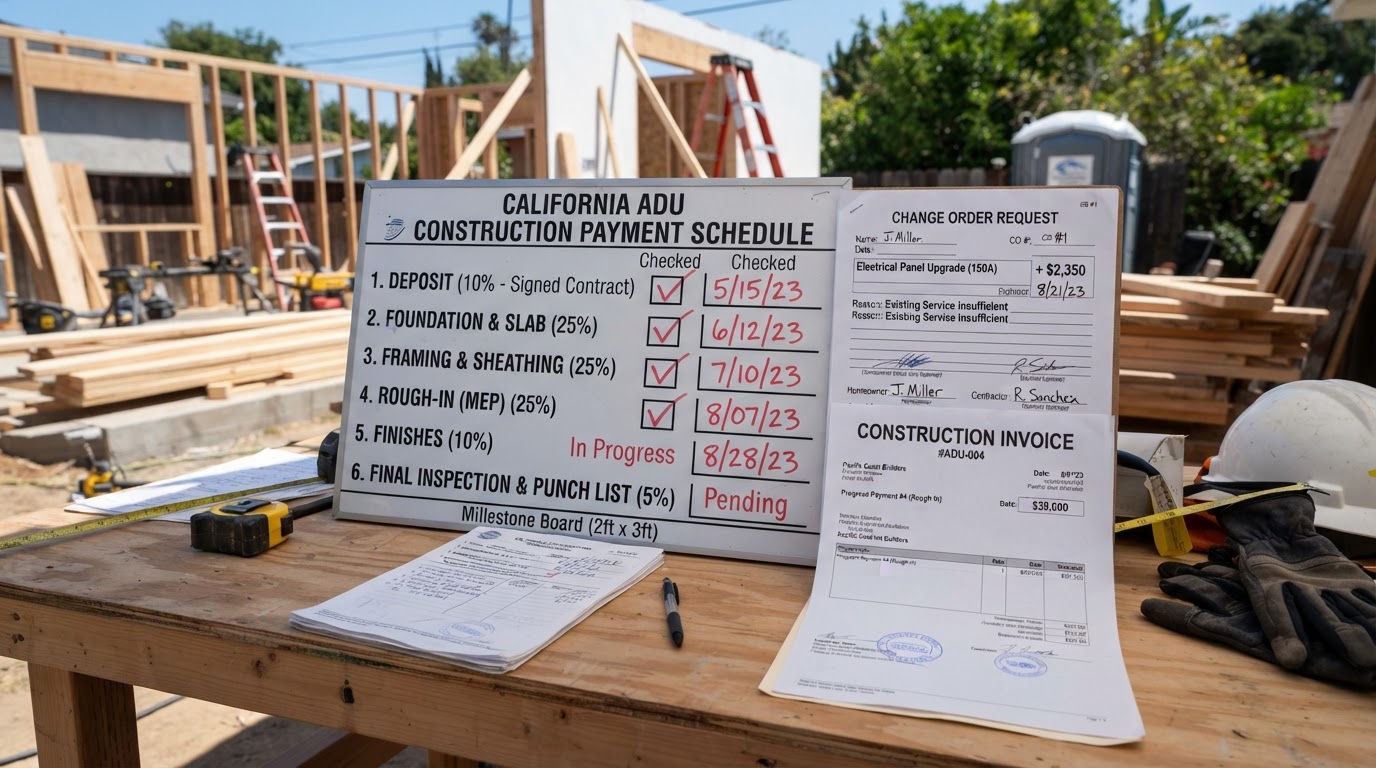
Progress payments should track actual, verifiable construction milestones—not arbitrary percentages of the total price.
9. Construction Schedule, Delays, and Communication
A contract should provide a start date and completion date as required by applicable California law, along with clear provisions governing the schedule. For an ADU, the timeline may depend on design completion, permit issuance, material availability, site conditions, subcontractor scheduling, inspections, and utility work.
Look for these schedule provisions
- The anticipated start date and completion date
- Work phases or major milestones
- The conditions required before work can begin
- How weather or unforeseen site conditions affect the schedule
- How permit or utility delays are handled
- How owner-requested changes affect completion
- How the contractor communicates delays
- How schedule revisions are documented
A contractor should not promise a guaranteed completion date without explaining the assumptions behind it. At the same time, a contract that allows unlimited delays without meaningful notice or accountability deserves careful review.
Establish a communication routine
Ask who your primary contact will be and how often you can expect project updates. For example, the project team might provide a weekly update covering completed work, upcoming activities, outstanding selections, inspection status, open decisions, and schedule risks. The precise routine can vary, but the contract or project procedures should make it clear how decisions will be communicated and documented.
10. Warranties and Defect Corrections
Before signing, ask the contractor to explain the warranties that apply to the completed ADU. A warranty may cover certain workmanship defects for a defined period, while individual products and equipment may have separate manufacturer warranties. These protections are not necessarily identical.
Questions to ask about workmanship warranties
- What workmanship warranty is provided?
- When does the warranty period begin?
- Which items and types of defects are covered?
- What exclusions apply?
- How should a warranty claim be submitted?
- How quickly will the contractor respond?
- Who is responsible for manufacturer warranty registration?
- What happens if the contractor uses a subcontractor for the affected work?
Make sure any warranty offered by the contractor is documented in writing.
Understand the difference between a warranty and legal rights
A written warranty is important, but it does not necessarily define or eliminate every legal right or remedy that may apply to construction defects. California construction and warranty law can be complex. The contract should not be treated as a substitute for understanding the applicable statutory rights, deadlines, and procedures. Ask a qualified attorney about any clause that appears to waive broad rights, shorten important deadlines, or restrict remedies in a way you do not understand.
11. Mechanics’ Liens and Lien Releases
A homeowner can pay a general contractor and still face a potential lien claim if a subcontractor, laborer, or supplier who has lien rights is not paid. That is why payment records and lien-release procedures matter. The CSLB explains how to prevent a mechanics lien and that paying the direct contractor alone does not guarantee all other claimants have been paid.
Conditional versus unconditional releases
These documents serve different purposes.
- Conditional waiver and release: Generally used when payment has not yet been received. Its effectiveness depends on the conditions specified in the applicable form, including actual payment.
- Unconditional waiver and release: Generally used when the claimant confirms that the specified payment has been received. Do not request or sign an unconditional release that inaccurately states payment has occurred.
Use the appropriate statutory form for the relevant progress or final payment, and make sure it identifies the claimant and payment period correctly. See the CSLB’s conditional and unconditional waiver and release forms.
Practical lien-protection steps
- Keep a record of payments and invoices.
- Request appropriate conditional releases before making applicable payments.
- Obtain the corresponding unconditional releases after payment.
- Confirm that releases come from the actual claimant or an authorized representative.
- Keep records of subcontractors and suppliers where appropriate.
- Follow the CSLB’s guidance on required notices and lien prevention.
Do not assume that a generic statement from the general contractor automatically releases every subcontractor’s or supplier’s lien rights.
12. Subcontractors and Responsibility for the Work
ADU projects commonly require several specialized trades. The contract should make it clear who manages them and how responsibility is allocated. Ask the contractor:
- Which work will be subcontracted?
- How will subcontractors be selected and supervised?
- Who coordinates their schedules?
- Who verifies that applicable licensing requirements are met?
- How are subcontractor payments and lien releases managed?
- Who is responsible for resolving coordination problems between trades?
Also ask whether subcontractor information can be provided upon request and what disclosures the contract must contain under current California law. The goal is not necessarily to avoid subcontractors. It is to make sure that the project has clear management, accountability, and communication.
13. Contractor Red Flags: When to Pause Before Signing
A low price or polished sales presentation does not guarantee a successful project. Watch for the following warning signs.
- Refuses a detailed written contract. A vague estimate makes it difficult to determine what the contractor has agreed to deliver. Ask for the full written agreement and supporting scope documents before committing.
- Demands an excessive down payment. For a standard California home improvement contract, the down payment generally cannot exceed $1,000 or 10% of the contract price, whichever is less. Be skeptical of claims that special-order materials automatically justify a larger down payment. Verify any claimed statutory exception independently with the CSLB.
- Asks you to pay ahead of progress. Payments should follow the applicable legal requirements and the agreed payment schedule. Do not pay for work that has not been performed or materials that have not been delivered merely because the contractor says the money is urgently needed.
- Promises permits or approvals without explaining the process. Ask who will submit the application, address plan-review comments, coordinate inspections, and obtain required approvals. No contractor should be treated as the final authority on whether a government agency will approve a project.
- Price is dramatically lower than competing proposals. A lower bid may be legitimate, but it deserves a closer comparison. Check whether the proposal excludes engineering, permits, utility upgrades, finish materials, site restoration, or other substantial costs.
- Pressures you to sign immediately. Take time to read the agreement, compare proposals, and ask questions. A contractor should be able to explain the scope, payment terms, and exclusions without pressuring you to ignore unresolved concerns.
- Refuses to document changes. If a contractor wants to proceed with additional work without following the applicable written change-order process, pause and resolve the issue before authorizing the change.
- Will not explain insurance or licensing. Verify the license and request appropriate insurance documentation. If the contractor avoids reasonable questions about these matters, consider another qualified bidder.
- Promises an unrealistic schedule. Ask for the assumptions behind the promised completion date, including permits, material lead times, inspections, and utility coordination.
- Dismisses lien releases and payment records. A professional payment process should be documented. Keep receipts and follow the CSLB’s guidance on lien prevention and releases.
If you encounter serious concerns, consult the CSLB or a qualified attorney before proceeding.
14. What About Cancellation Rights?
California provides cancellation rights for certain home improvement contracts, but the applicable period and conditions depend on the contract and how the transaction was made. The CSLB’s consumer guidance describes a general three-day cancellation period for qualifying home improvement contracts, with a five-day period for qualifying senior consumers aged 65 or older. Certain transactions have different rules or exceptions.
As of the date of this article, proposed legislation has also addressed extending some cancellation periods. Do not assume a proposal has become law without checking its current status and the rules that apply to your transaction. Before signing, review the cancellation notice included in the contract, the method and deadline for giving notice, and any applicable exceptions. For official guidance, see the CSLB’s cancellation warnings and exceptions. If you believe you need to cancel, get advice promptly and follow the applicable written-notice requirements. Do not rely on a verbal conversation alone.
15. How to Compare ADU Construction Proposals
When comparing contractors in Orange County or Los Angeles, create a side-by-side comparison that evaluates scope and risk, not just price. Request comparable proposals based on the same plans and specifications whenever possible. If one contractor proposes a different construction method or scope, identify those differences before deciding which proposal offers better value. A slightly higher bid may be more economical if it includes important work that another proposal excludes. Conversely, a high price does not automatically mean better workmanship or stronger project management.
| Comparison item | Contractor A | Contractor B | Contractor C |
|---|---|---|---|
| License verified | |||
| Comparable ADU projects | |||
| Plans and engineering included | |||
| Permit coordination included | |||
| Permit fees included | |||
| Utility work clearly defined | |||
| Materials and finish allowances specified | |||
| Exclusions clearly listed | |||
| Legal payment schedule provided | |||
| Change-order process documented | |||
| Workmanship warranty documented | |||
| Insurance reviewed | |||
| References checked | |||
| Schedule and delay terms explained | |||
| Lien-release process addressed |
16. A Practical Pre-Signing Checklist for California ADU Homeowners
Before signing an ADU construction contract, confirm that you can answer the following questions.
Contractor verification
- I verified the contractor’s license directly with the CSLB.
- I reviewed the contractor’s relevant qualifications and available license information.
- I checked appropriate insurance documentation.
- I reviewed comparable project references.
Contract scope and pricing
- The written scope describes the work to be performed.
- The plans and specifications are identified.
- Materials, finishes, and allowances are understandable.
- The total price and significant exclusions are clear.
- Permit fees and utility costs are addressed.
Payment and change management
- The down payment complies with applicable California rules.
- The progress-payment schedule is detailed and lawful.
- Payments are tied to actual work or delivered materials as required.
- The change-order process is documented.
- The contract explains how approved changes affect cost and schedule.
Project management and protection
- Start and completion dates are included as required.
- Permit and inspection responsibilities are assigned.
- Delay provisions are understandable.
- The workmanship warranty and product warranties are documented.
- Lien-release procedures are addressed.
- Required notices and cancellation information are included.
- I have a complete copy of the agreement signed by both parties.
If important items remain unclear, ask for clarification in writing before signing.
17. Frequently Asked Questions About ADU Construction Contracts in California
Is a written contract required to build an ADU in California?+
California generally requires a written home improvement contract when the combined labor and materials cost exceeds $500. ADU construction contracts should clearly document the work, materials, price, payment schedule, dates, permit responsibilities, and other applicable statutory requirements.
How much can an ADU contractor ask for as a down payment?+
Under the standard California home improvement contract rule, the maximum down payment is $1,000 or 10% of the contract price, whichever is less. A narrow exception exists for certain contractors with a qualifying blanket performance and payment bond on file with the CSLB. Confirm the current law and any claimed exception before paying.
Can a contractor require full payment before construction starts?+
Not under the standard home improvement contract payment rules. The standard down-payment limit applies, and progress payments generally cannot exceed the value of work performed or materials delivered. A qualifying statutory exception may apply in limited circumstances, so verify any claim of an exception directly with the CSLB.
Should change orders be in writing?+
Yes. California home improvement contract rules generally require changes to be documented in a written change order signed by the customer and contractor before the changed work begins. The document should specify the revised work, price adjustment, and effect on the schedule or payment milestones.
Who should obtain ADU permits?+
The contract should clearly state who is responsible for preparing and submitting permit applications, paying fees, coordinating plan revisions, and scheduling inspections. Homeowners should not assume these services are included unless the agreement says so.
Do I need lien releases when building an ADU?+
Lien releases can help homeowners track whether contractors, subcontractors, and suppliers have been paid. Follow the CSLB's guidance on the appropriate conditional and unconditional releases for progress and final payments.
What should I do if my ADU contractor asks for more money?+
Review the contract, payment schedule, invoices, and any signed change orders. Determine whether the request is for completed work, delivered materials, or an approved change and whether it complies with applicable law. If the request appears improper or the dispute is substantial, consult the CSLB or a qualified California construction attorney before paying.
How can I avoid unexpected ADU construction costs?+
Use detailed plans, compare proposals with matching scopes, identify exclusions, understand allowances, investigate site conditions, and require written approval of changes. Maintain a separate contingency budget for legitimate unforeseen expenses, but do not treat a contingency as permission for undocumented charges.
Should I choose the cheapest ADU contractor?+
Not automatically. Compare licensing, relevant experience, scope, materials, exclusions, payment terms, warranties, references, and project management. The best proposal is the one that offers suitable value and clearly defines the contractor's obligations, not necessarily the lowest initial price.
What should homeowners in Orange County and Los Angeles know before signing?+
Confirm which city or county has jurisdiction over the property and make sure the agreement addresses the applicable permit process, site conditions, utility work, inspections, and local coordination requirements. Requirements and costs can differ between jurisdictions, so avoid relying on assumptions drawn from another city's project.
Conclusion: A Clear Contract Is the Foundation of a Better ADU Project
A successful ADU project starts before the first shovel enters the ground. It begins with a clear scope, a realistic budget, verified contractor credentials, lawful payment terms, and a shared understanding of responsibilities. For homeowners in Orange County and Los Angeles, reviewing the construction agreement carefully can help reduce avoidable misunderstandings and make it easier to manage decisions throughout the project.
Before signing, take the time to compare proposals, confirm the contractor’s license and insurance, understand the payment schedule, and document how changes will be handled. If any clause creates significant uncertainty, obtain professional advice rather than relying on assumptions.
Venguard Construction helps homeowners explore renovation and construction solutions with an emphasis on communication, craftsmanship, and a well-managed process. Planning an ADU or other home improvement project in Southern California? Visit Venguard Construction to learn more about the company’s services and request a consultation to discuss your project goals.