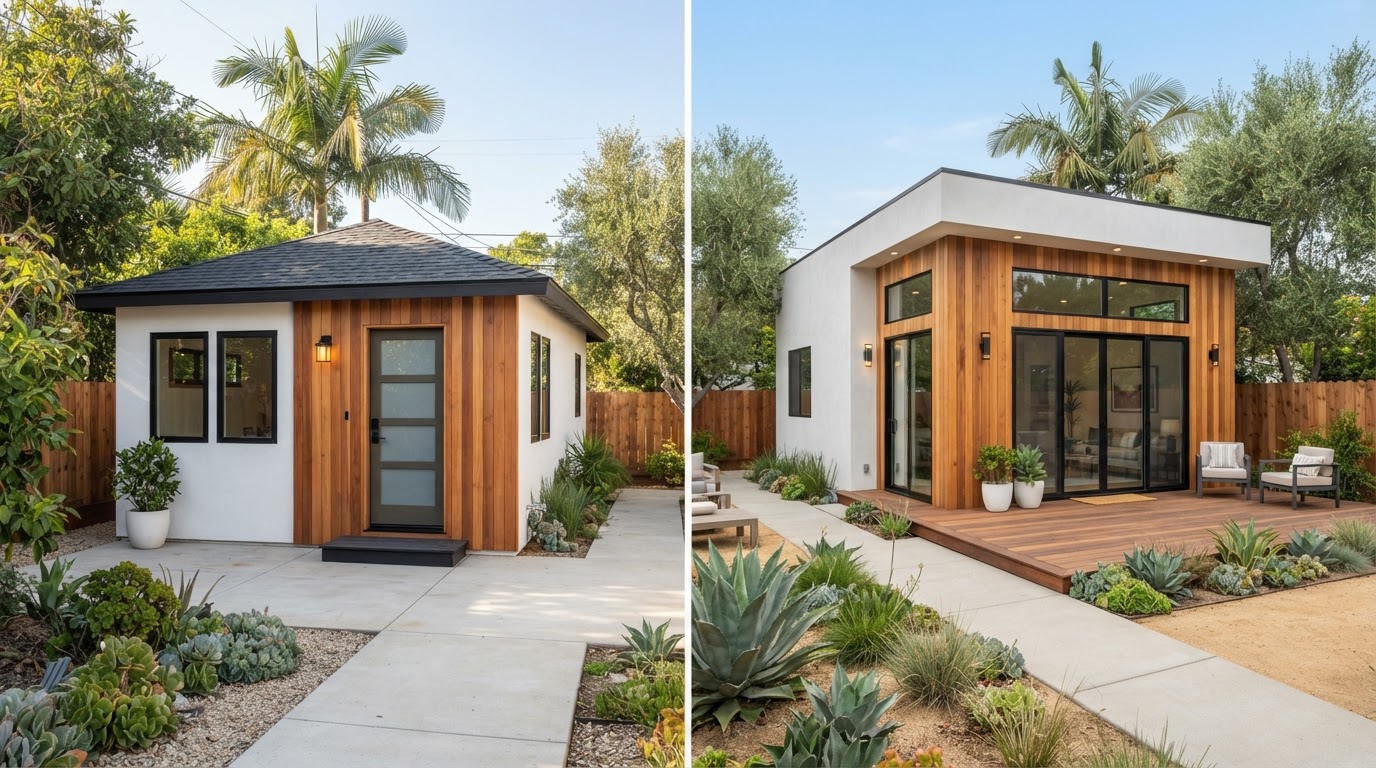
Building an accessory dwelling unit (ADU) can create additional living space, accommodate family members, or provide potential rental income. For homeowners in Orange County and Los Angeles, however, the first major challenge is often figuring out how to pay for the project.
An ADU may require funding for architectural design, engineering, permits, site preparation, utility connections, construction, interior finishes, and unexpected expenses. Even when the project appears financially attractive, the wrong financing structure can put pressure on a household’s monthly budget.
The good news is that homeowners may have several ways to finance an ADU. Depending on their circumstances, these can include paying with cash or savings, borrowing against existing home equity, using a home equity line of credit (HELOC), refinancing an existing mortgage, applying for a renovation mortgage, exploring construction-specific financing, or checking whether a state or local assistance program is available.
There is no universally best option. The right choice depends on the homeowner’s available equity, credit profile, income, existing mortgage, project budget, construction schedule, and ability to handle additional debt.
This guide explains the main ADU financing options, how they differ, what costs to budget for, and which questions to ask before committing to a project. Financial and lending information in this article is educational, not personalized financial, legal, or tax advice. Loan availability, interest rates, eligibility rules, and assistance programs can change. Verify current terms with the lender or administering agency.
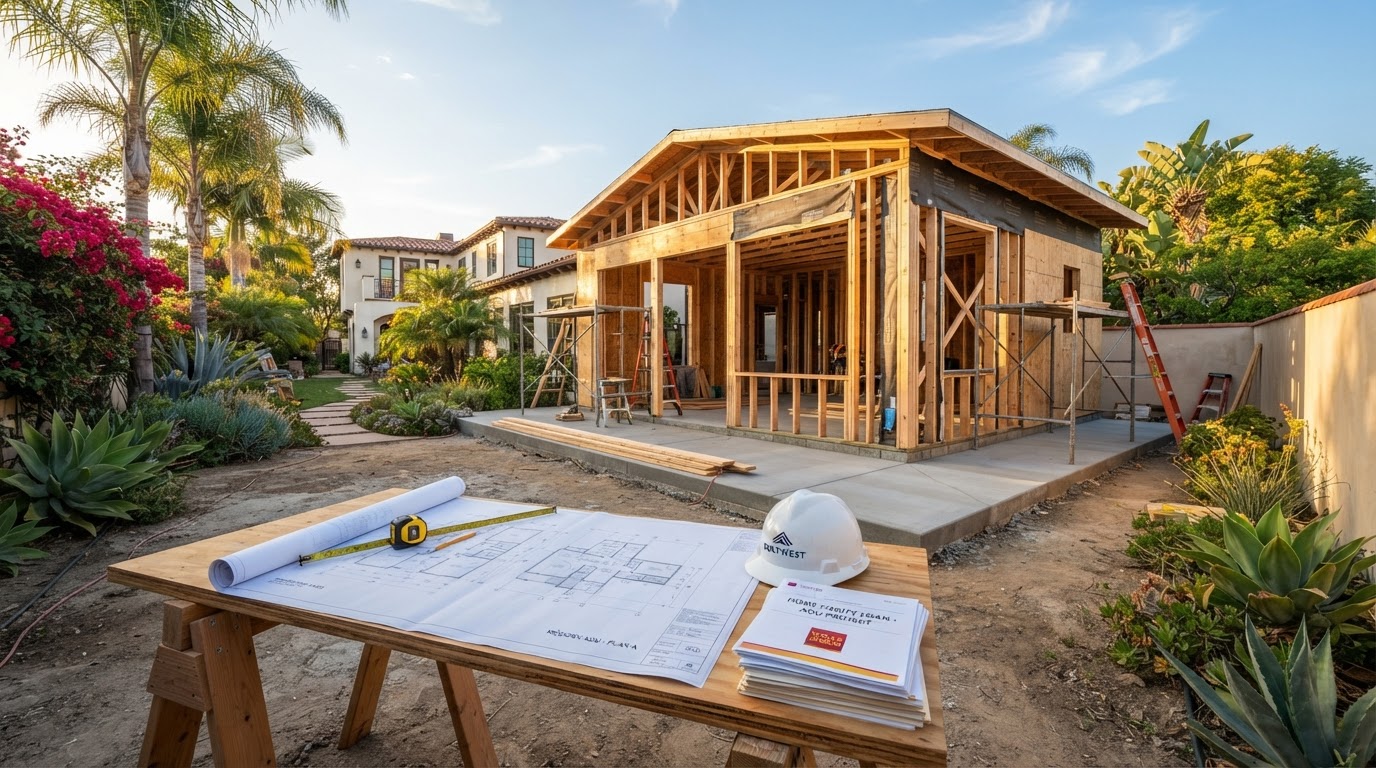
Financing an ADU starts with a complete project budget—not just the construction estimate.
1. How Much Money Do You Need to Finance an ADU?
Before comparing loan products, establish a realistic project budget. The amount you need to borrow may be substantially different from the construction estimate alone. An ADU budget can include feasibility and site evaluation, design and engineering, permits and approvals, site preparation, foundation and structure, utilities, interior finishes, exterior improvements, financing costs, and a contingency reserve.
| Expense category | What it may cover |
|---|---|
| Feasibility and site evaluation | Initial property review, measurements, and investigation of site constraints |
| Design and engineering | Floor plans, architectural work, structural engineering, and other required plans |
| Permits and approvals | Application fees, plan review, and applicable agency charges |
| Site preparation | Demolition, grading, excavation, drainage, and access work |
| Foundation and structure | Foundation, framing, roofing, and exterior construction |
| Utilities | Electrical, plumbing, sewer, water, and other required service work |
| Interior finishes | Cabinets, flooring, fixtures, painting, appliances, and finishes |
| Exterior improvements | Walkways, landscaping, fencing, and other site work |
| Financing costs | Loan fees, appraisal, closing costs, and interest during construction |
| Contingency reserve | Funds for unforeseen conditions, price changes, or approved scope adjustments |
The costs will depend on whether you are converting a garage, adding an attached ADU, or building a detached unit. An existing garage may reduce some new-construction requirements, but structural upgrades, insulation, utilities, and other conversion work can change the budget. A detached ADU may offer more design flexibility but require more site work and new construction.
Build a complete budget before applying for financing
Ask your design and construction team to clarify what the estimate includes and excludes. Find out whether design, engineering, permitting, utility work, landscaping, and finish selections are included. Also ask how changes are priced and how construction payments are scheduled.
Useful starting formula: Total funding requirement = Project costs + Financing costs + Contingency − Funds available from savings or other sources.
The contingency should reflect the complexity and uncertainty of the project. It is not a substitute for a detailed estimate, and it should not be treated as money available for optional upgrades. For detailed planning estimates, read our related ADU cost guide for Orange County and Los Angeles.
2. ADU Financing Options at a Glance
The following table compares common funding approaches. Actual terms, eligibility, and availability depend on the lender and the borrower’s circumstances.
| Financing option | How it works | Potential advantage | Main consideration |
|---|---|---|---|
| Cash or savings | Pay project costs without borrowing | No loan interest or new monthly debt payments | Uses capital that may be needed elsewhere |
| Home equity loan | Borrow a lump sum secured by home equity | Often offers a predictable repayment structure | Adds debt secured by the home |
| HELOC | Borrow as needed up to an approved credit limit | Can provide flexibility for staged expenses | Often has a variable rate and changing payments |
| Cash-out refinance | Replace an existing mortgage with a larger one and receive cash | May consolidate financing into one mortgage | May change the rate, term, and costs on the entire mortgage |
| Renovation mortgage | Finance eligible improvements through a qualifying mortgage product | May coordinate eligible renovation costs with mortgage financing | Eligibility, appraisal, contractor, and draw requirements can be complex |
| Construction loan | Finance construction through an approved lending arrangement | May align funding with construction stages | Specialized underwriting and disbursement requirements |
| Assistance or grant program | Receive qualifying assistance under program rules | May reduce eligible project expenses | Funding, income, occupancy, and other restrictions may apply |
Some homeowners combine funding sources. For example, they may use savings for design and early project expenses and borrow for construction. Any combined approach should be reviewed carefully so that the total repayment obligations remain manageable.
3. Using a Home Equity Loan to Build an ADU
A home equity loan allows a homeowner to borrow a specific amount against the equity in an existing property. Equity is generally the difference between the property’s value and the amount owed on secured loans against it. A lender will determine how much, if any, equity can be borrowed against after considering its underwriting requirements.
With a typical home equity loan, the borrower receives the funds as a lump sum and repays the loan according to the agreed terms. The interest rate may be fixed or adjustable, depending on the product. The Consumer Financial Protection Bureau explains the difference between home equity loans and HELOCs in its guide to home equity loans and lines of credit.
When might a home equity loan make sense?
A home equity loan may be worth investigating when:
- You have sufficient equity and qualify for the amount required.
- The project budget is reasonably well defined.
- You prefer to receive a lump sum rather than draw funds repeatedly.
- The repayment structure fits your household budget.
- You understand the risks of borrowing against your home.
Potential benefits
- Predictable funding. Receiving a lump sum can simplify planning when the financing amount is established.
- Repayment clarity. A fixed-rate product, when available, can make principal and interest payments more predictable.
- Separate loan structure. You may retain your existing first mortgage rather than replace it.
Potential drawbacks
A home equity loan adds a financial obligation secured by your property. You will generally need to make payments on both the original mortgage and the new loan if the existing mortgage remains in place. The loan may also involve appraisal, title, origination, or closing costs. Most importantly, falling behind on a loan secured by your home can put the property at risk.
Practical tip: Request a written loan estimate or equivalent disclosure and compare the total cost, not only the advertised interest rate or monthly payment.
4. Using a HELOC for ADU Construction
A home equity line of credit (HELOC) is a revolving credit line secured by home equity. Rather than receiving the entire approved amount at once, the borrower can generally draw funds as needed during the permitted draw period, subject to the agreement. This structure may be attractive for a project with staged payments, but it requires careful cash-flow planning.
How a HELOC works
A lender approves a credit limit based on its underwriting requirements. During the draw period, the borrower can access funds within that limit. The repayment structure depends on the specific agreement. HELOCs often have variable interest rates. Payments may change as rates or outstanding balances change, and payments can increase when the loan enters its repayment period. The CFPB’s HELOC guide explains these features and highlights the risks of borrowing against a home.
Why homeowners consider a HELOC
A HELOC can be useful when project expenses occur in stages. Instead of borrowing the full approved amount immediately, the homeowner may draw funds as eligible expenses arise. For example, the project may require separate payments for design, permitting, construction milestones, and approved changes. A credit line can offer flexibility if its draw rules and timing match those expenses.
However, do not assume that a HELOC automatically supports contractor payments or construction draws in the way a dedicated construction loan might. Confirm the lender’s rules before choosing it for a build.
What to evaluate before using a HELOC
- Is the interest rate fixed or variable?
- What fees apply to opening, maintaining, or closing the line?
- Is there a minimum draw or minimum balance?
- How long is the draw period?
- When does the repayment period begin?
- How will payments change if interest rates rise?
- Could the lender restrict further borrowing under the contract?
- Can you afford the payments if the ADU is delayed or remains vacant?
A HELOC may be a practical option for some homeowners, but flexibility does not mean low risk. Because the debt is secured by the home, borrowing should be based on a repayment plan that works even if the ADU does not generate the expected income.

A HELOC or home equity loan uses your home as collateral—compare total cost and repayment risk before borrowing.
5. Cash-Out Refinancing to Finance an ADU
A cash-out refinance replaces an existing mortgage with a new mortgage that is larger than the amount needed to pay off the old loan and applicable transaction costs. The borrower receives the eligible difference as cash. This can provide funds for an ADU, but the decision affects the mortgage on the primary residence—not just the construction budget.
When might cash-out refinancing be worth considering?
It may be worth exploring when the homeowner qualifies for suitable terms and wants to combine the existing mortgage and new borrowing into one mortgage arrangement. However, whether it is attractive depends on the existing loan’s interest rate, remaining term, current market offers, closing costs, and the borrower’s financial situation.
Questions to ask
- Will the new mortgage rate be higher? If your existing mortgage has a comparatively low rate, refinancing the entire balance into a higher-rate loan could increase long-term borrowing costs.
- What are the closing costs? Include lender fees, appraisal costs, and other applicable expenses in the comparison.
- Will the loan term change? A longer term can reduce scheduled monthly payments in some cases but may increase total interest paid over time.
- How much cash will actually be available? The final amount depends on the new loan amount, the existing mortgage payoff, transaction costs, equity requirements, and underwriting.
- Will the project create a comfortable repayment plan? Avoid relying on optimistic rent estimates to justify a mortgage that would otherwise be difficult to afford.
Cash-out refinancing is not automatically better than a home equity loan or HELOC. Compare the total cost of each option over the period you expect to hold the loan and property.
6. Renovation Mortgages and ADU Financing Programs
Certain mortgage products can incorporate eligible renovation or ADU costs into a qualifying mortgage transaction. One example is Fannie Mae’s HomeStyle Renovation mortgage, which can finance eligible improvements through a qualifying purchase or refinance transaction. Fannie Mae’s official HomeStyle Renovation information specifically identifies accessory dwelling units as a potential project type.
Fannie Mae also provides an ADU financing overview describing how ADUs may be addressed through eligible mortgage products, including renovation and construction-to-permanent financing in applicable circumstances. These are examples of financing frameworks, not guarantees that a specific homeowner or project qualifies. Participating lenders apply program rules, underwriting requirements, property eligibility, appraisal requirements, and other conditions.
What is a renovation mortgage?
A renovation mortgage is a qualifying mortgage product that allows eligible improvement costs to be included in the financing structure. Depending on the product and transaction, the lender may require approved plans, contractor documentation, an appraisal reflecting the completed project, and controls over the disbursement of renovation funds. This can be useful when the project is being financed as part of a home purchase or an eligible refinance. It may be less straightforward for a homeowner who simply wants a separate loan for an ADU on an existing property.
What is construction-to-permanent financing?
Construction-to-permanent financing is designed to fund an eligible construction project and then transition into permanent mortgage financing according to the loan terms. The details vary by lender and product. Ask how funds are released, whether payments during construction differ from payments after completion, and what documentation is required before each disbursement.
Questions for a renovation or construction lender
- Does the product specifically permit the proposed ADU project?
- Is the property and intended occupancy eligible?
- Must the loan be associated with a purchase or refinance?
- What plans, permits, contractor qualifications, and estimates are required?
- Is an as-completed appraisal required?
- How are construction funds disbursed?
- Who approves changes to the scope or budget?
- What happens if construction takes longer than planned?
- What fees and contingency requirements apply?
- What are the final repayment terms?
If you are comparing loan products, ask the lender to explain the entire process from application through final construction sign-off, not just the initial interest rate.
7. Are There ADU Grants or Financial Assistance Programs in California?
California homeowners may also investigate public assistance programs. These programs are different from ordinary loans and may have specific eligibility criteria, funding limits, application windows, and requirements related to affordability or occupancy. The California Department of Housing and Community Development maintains a Funding for Homeowners page that identifies ADU-related assistance programs and other funding resources.
The CalHFA ADU Grant Program
California HCD’s funding page describes the CalHFA ADU Grant Program as providing up to $40,000 in assistance to reimburse qualifying predevelopment costs associated with building and occupying an ADU.
Important: Do not assume the program is currently accepting applications, that funds remain available, or that a new applicant qualifies. Program availability and terms can change. Confirm the current status, eligible costs, application process, and any lender or program-participation requirements directly through the official program resources before including assistance in your budget.
Other public and local programs
HCD also lists other programs that may provide funding or support for qualifying ADU projects in particular areas. Some are geographically limited or tied to affordability, income, or other requirements. A program available in one California city or county may not be available in Orange County or Los Angeles. Check the current official resources for the jurisdiction where the property is located.
How to evaluate an assistance program
Before relying on a grant or loan program, confirm:
- Whether applications are open
- Whether the property location is eligible
- Whether household income limits apply
- Whether the ADU must be rented at an affordable rate
- Whether owner occupancy is required
- Which predevelopment or construction costs are eligible
- Whether funds are grants, reimbursable assistance, deferred loans, or forgivable loans
- Whether the homeowner must use a specific lender, contractor, or program administrator
- Whether the assistance can be combined with other financing
Do not subtract potential grant funds from the project budget until eligibility and funding are confirmed in writing. If assistance is reimbursement-based, you may need to pay eligible costs first and wait for reimbursement.
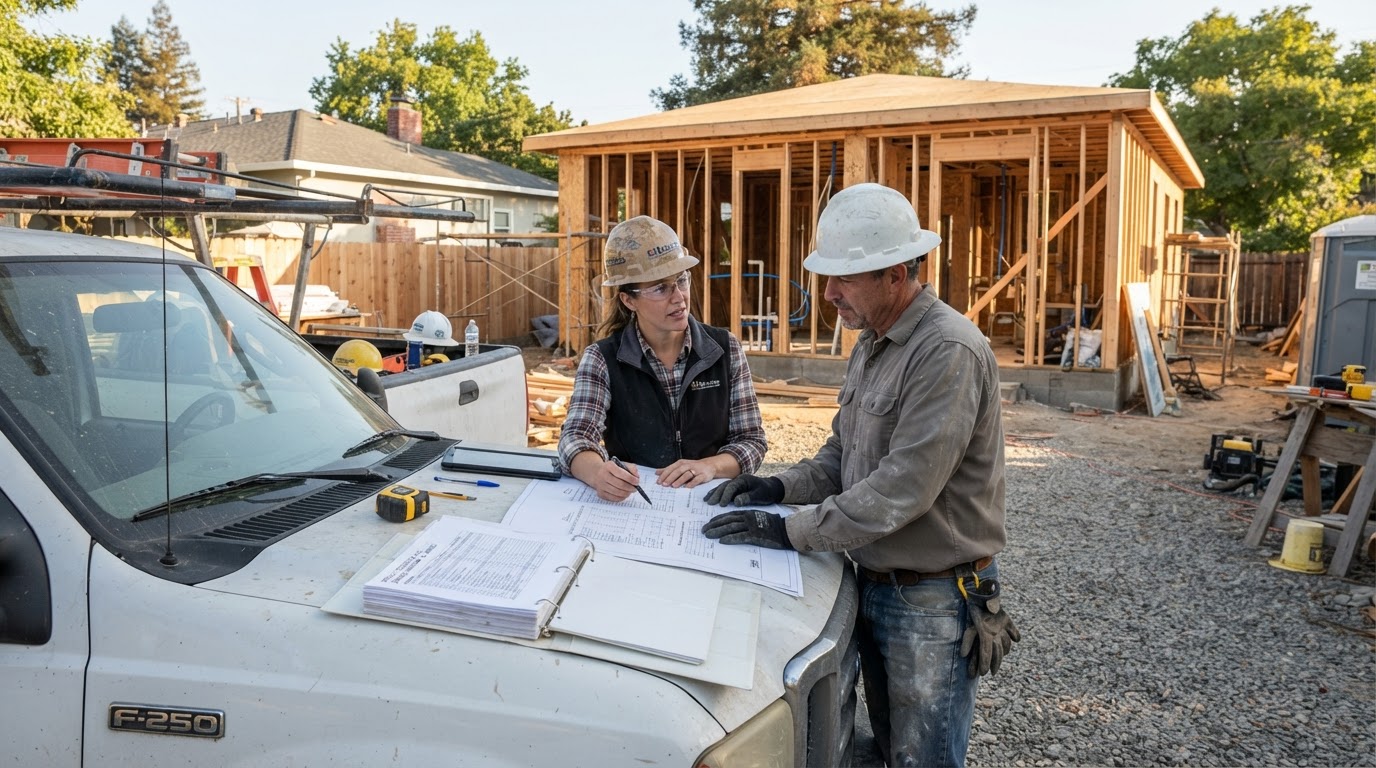
Construction loans and renovation mortgages often release funds in stages tied to inspections and milestones.
8. Can You Finance an ADU With Cash or Savings?
Paying with cash avoids borrowing costs, but it is not automatically the best financial choice. Using savings may preserve a simpler ownership structure and eliminate additional loan payments. On the other hand, spending a large portion of available cash on an ADU can reduce the funds available for emergencies, retirement, other investments, or household expenses.
Potential advantages
- No additional loan interest
- No lender underwriting or construction-loan approval process
- No new secured debt payment
- Greater flexibility over the project’s funding schedule, subject to contractor terms
Potential disadvantages
- Less liquid cash available for emergencies
- Capital tied up in an improvement that may take time to recover financially
- Less flexibility if construction costs increase
- Opportunity cost compared with other uses of the money
Before paying entirely in cash, decide how much of your savings should remain available after the project. Maintain a reasonable reserve for household needs and unforeseen expenses, rather than committing every available dollar to construction. You can also compare a partial-cash approach with financing the remaining amount. The right balance depends on your household’s cash reserves, borrowing terms, and risk tolerance.
9. Personal Loans and Other Borrowing Options
Some homeowners consider personal loans or other unsecured financing when they do not want to borrow against home equity. These products may be available for certain uses, but they can have different interest rates, repayment periods, borrowing limits, and approval requirements. They may also be unsuitable for a large construction budget.
Before using an unsecured loan for an ADU, check whether the lender permits the intended use and whether the repayment period aligns with the project’s expected benefits. Be cautious about combining multiple high-payment loans to cover a construction project. Several smaller loans can create a larger monthly burden than a single, properly structured financing arrangement.
Compare the annual percentage rate (APR), fees, monthly payment, repayment term, and total amount repaid. Avoid making the decision based only on how quickly funds can be approved.
10. How Much Should You Borrow for an ADU?
The amount to borrow should be based on the complete project budget and a realistic repayment plan—not simply the maximum amount a lender offers. Start with the expected project cost. Subtract the cash you can comfortably contribute without compromising your reserves. Then consider financing fees, contingency, and any verified assistance.
Illustrative example
Suppose the initial project budget is $250,000. You plan to contribute $50,000 from savings and are evaluating financing for the remainder.
| Budget item | Illustrative amount |
|---|---|
| Estimated project cost | $250,000 |
| Cash contribution | −$50,000 |
| Initial financing requirement | $200,000 |
| Additional financing fees and contingency | To be estimated |
| Potential verified assistance | Deduct only after eligibility and funding are confirmed |
The $200,000 figure is only the initial funding gap. It is not a recommended loan amount. The final requirement could be higher after financing costs and contingency, or lower if the project scope changes or eligible assistance is confirmed.
Why the contingency matters
ADU construction can uncover conditions that were not obvious during early planning. The property may require additional utility work, structural upgrades, drainage improvements, or other changes. A contingency reserve can help absorb approved unexpected expenses without forcing the homeowner to seek expensive emergency borrowing. Its appropriate size depends on project complexity, estimate quality, site conditions, and lender requirements.
Ask your design and construction team to identify the major uncertainties and explain how change orders will be priced and approved. For a related discussion of project timelines and the phases that affect cost, read our ADU construction timeline guide.
11. How to Compare ADU Financing Offers
Do not compare financing options by interest rate alone. The total cost depends on fees, repayment structure, loan term, how funds are disbursed, and whether the existing mortgage changes. Use this checklist when reviewing offers.
Interest rate and APR
Compare the stated interest rate and APR where available. Understand whether the rate is fixed or variable and what could cause it to change.
Upfront fees
Ask about application fees, origination fees, appraisal costs, title charges, closing costs, and other lender expenses.
Monthly payments
Calculate the payments under realistic scenarios. For a variable-rate product, ask the lender to illustrate how payments could change if rates increase.
Draw and disbursement rules
If the project will be paid in stages, confirm when funds are available and whether the lender controls or approves disbursements.
Repayment term
Understand when repayment begins, how long it lasts, and whether the payment can increase at a particular stage.
Early repayment and closing conditions
Ask about prepayment penalties, line-closure fees, restrictions, and the consequences of refinancing or selling the property.
Risk to your home
For secured financing, understand what happens if payments are missed. The CFPB warns that failing to repay a home equity loan or HELOC can put the home at risk. Review the agency’s guidance before committing to either option.
A simple comparison table
| Question | Offer A | Offer B |
|---|---|---|
| Interest rate and APR | ||
| Fixed or variable rate | ||
| Upfront fees | ||
| Expected monthly payment | ||
| Total repayment under stated assumptions | ||
| Draw or construction disbursement rules | ||
| Repayment term | ||
| Prepayment or closing fees | ||
| Collateral and default risks |
Ask each lender for comparable written figures using the same proposed borrowing amount and assumptions. That makes it easier to compare the offers on equal terms.
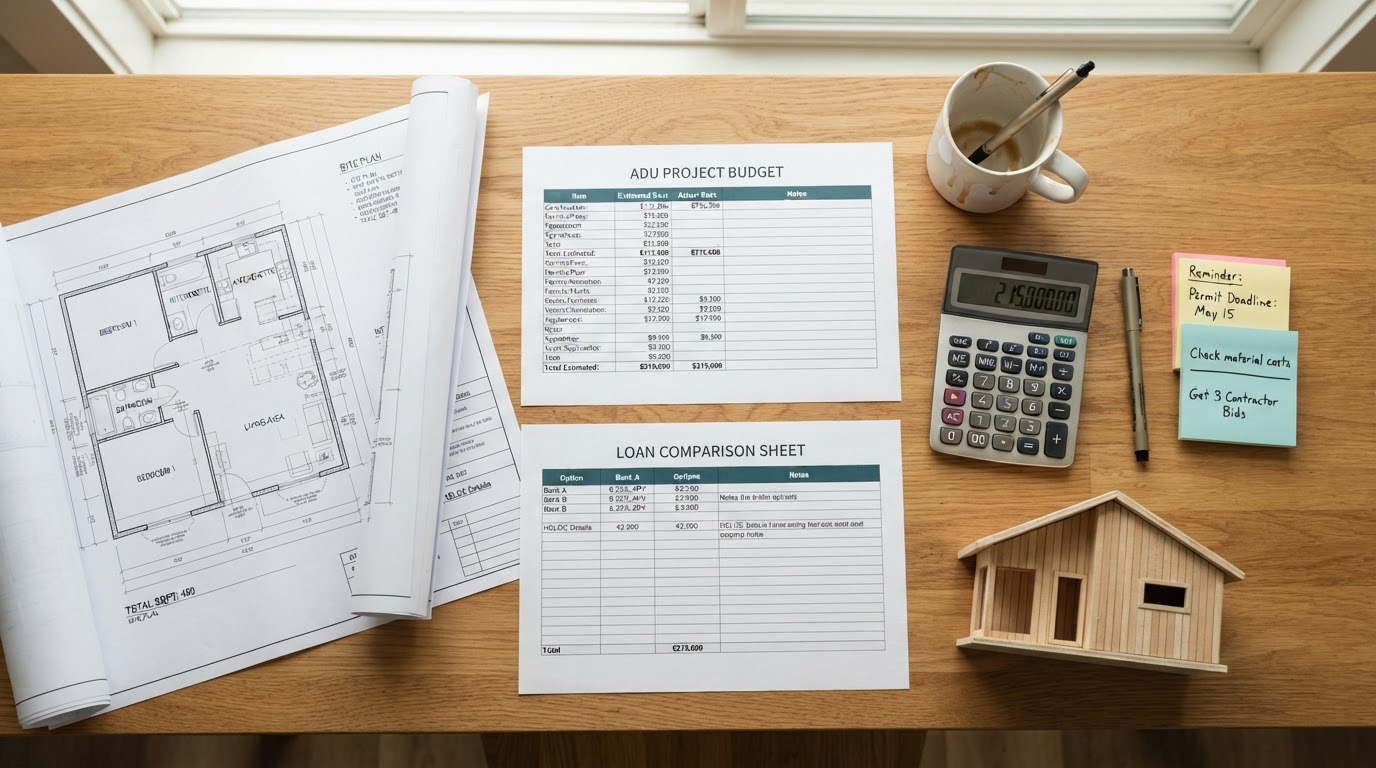
Compare APR, fees, draw rules, and repayment risk—not just the advertised interest rate.
12. How Rental Income Fits Into an ADU Financing Decision
Some homeowners expect rental income to help pay the loan. This can be a reasonable part of the financial plan, but it should not be the only basis for deciding whether the project is affordable. A completed ADU may take time to rent. The property may need final approvals, tenant preparation, marketing, or repairs before the first payment arrives.
Even after a tenant moves in, rental income is not the same as profit. Operating expenses, vacancies, insurance, maintenance, management, and financing payments reduce the cash available to the owner.
Calculate the project in three stages
Stage 1: Before construction. Estimate the complete project cost, available cash, required borrowing, and the payments that may begin during construction.
Stage 2: During construction. Plan for scheduled contractor payments, loan disbursements, interest where applicable, and the possibility of delays or approved changes.
Stage 3: After completion. Estimate achievable rent using local comparable properties. Subtract vacancy, operating expenses, maintenance reserves, and debt service to estimate cash flow.
For a detailed discussion of rental yield and operating costs, read our related ADU rental income and ROI guide.
Stress-test the financial plan
Before proceeding, consider what happens if:
- Construction costs rise
- Completion is delayed
- The interest rate increases on a variable-rate loan
- Rent is lower than expected
- The unit remains vacant for a period
- A major repair is needed
- Household income changes
A project is more financially resilient when the homeowner can manage these situations without relying entirely on rental income.
13. A Step-by-Step ADU Financing Plan
A structured process can help you compare options before committing to a design or construction contract.
- Define the purpose of the ADU. Decide whether the unit will primarily serve family, provide long-term rental income, or support another use. The intended use influences the layout, project scope, and financial analysis.
- Evaluate the property. Review the available space, existing structures, utilities, access, and potential site constraints. A garage conversion and a detached ADU can have different construction and financing requirements.
- Establish a preliminary budget. Include design, engineering, permits, construction, utility work, finishes, financing costs, and a contingency reserve.
- Review your financial position. Determine how much cash you can contribute while preserving household reserves. Review existing mortgage obligations, available equity, income, credit profile, and other debts.
- Compare multiple financing structures. Request information from lenders about suitable home equity products, renovation mortgages, and construction financing. If you are considering cash-out refinancing, compare it with keeping the existing mortgage and adding a separate loan.
- Verify assistance programs. Review official state and local resources. Confirm eligibility and current availability before relying on any potential grant or assistance.
- Coordinate financing with the project schedule. Ask how the loan funds will be made available, what documents the lender needs, and how contractor payments will be handled.
- Review the complete repayment plan. Calculate the expected monthly payments and total borrowing costs. Test the plan against lower rent, construction delays, higher expenses, and changes in household income.
- Finalize the project scope. Before signing the construction agreement, understand the included work, exclusions, payment milestones, change-order process, and responsibilities for permits and approvals.
- Proceed only when the plan is workable. The goal is not merely to obtain financing. It is to finance a project that fits the property, household finances, and intended use without creating an unacceptable level of risk.
14. Planning an ADU in Orange County or Los Angeles?
For Southern California homeowners, ADU financing works best when it is coordinated with the actual property and construction plan. A feasibility review can help identify site constraints. A floor-plan discussion can establish whether a studio, one-bedroom, or two-bedroom layout makes sense. A detailed estimate can then help you determine the likely funding requirement before comparing loan products.
Venguard Construction serves homeowners throughout Southern California, including Orange County and Los Angeles. If you are considering an ADU, begin by understanding the property’s conditions, the intended use, and the complete project scope. Visit Venguard Construction to learn more about the company and request a consultation. Before choosing a loan, establish the project budget and confirm how the funds will be used. Financing should support a well-planned project, not force the project into a budget or repayment structure that does not work for your household.
Frequently Asked Questions About ADU Financing in California
What is the best way to finance an ADU in California?+
There is no single best option for every homeowner. Cash, home equity loans, HELOCs, cash-out refinancing, renovation mortgages, and construction financing may be worth evaluating depending on available equity, income, credit, project scope, and loan terms. Compare total costs and repayment risks before choosing.
Can I use a HELOC to build an ADU?+
A HELOC may be usable for an ADU project if the lender's terms permit the intended expenses and the borrower qualifies. It can provide access to funds as needed, but it often has a variable interest rate and is secured by the home. Confirm the draw and repayment rules before relying on it for construction payments.
Is a home equity loan better than a HELOC for ADU construction?+
A home equity loan generally provides a lump sum, while a HELOC generally allows borrowing within an approved credit limit during a draw period. Which is better depends on the project budget, payment schedule, rate structure, fees, and the homeowner's preference for predictable or flexible borrowing.
Can I refinance my mortgage to pay for an ADU?+
A cash-out refinance may allow a qualifying homeowner to replace an existing mortgage with a larger one and receive eligible proceeds. However, refinancing may change the interest rate, loan term, closing costs, and payment on the entire mortgage. Compare it with keeping the existing mortgage and using a separate loan.
Are there ADU grants in California?+
California HCD lists ADU-related assistance resources, including the CalHFA ADU Grant Program. The official funding page describes assistance of up to $40,000 for qualifying predevelopment costs. Current application status, eligibility, and available funds must be verified directly before assuming that assistance can be obtained.
Can rental income help me qualify for an ADU loan?+
It depends on the lender and loan product. Some eligible mortgage programs may consider rental income under specific underwriting rules, while other products may rely on different income calculations. Ask the lender how projected or existing rental income is treated and what documentation is required.
Should I pay cash or finance an ADU?+
Paying cash avoids additional loan interest but reduces available savings. Financing preserves some cash but creates repayment obligations and potentially puts the property at risk if the debt is secured by the home. Compare the complete financial impact and maintain a reasonable reserve for emergencies.
How much should I borrow for an ADU?+
Start with a complete project budget, subtract the cash you can comfortably contribute, and account for financing costs and contingency. Do not borrow the maximum amount available solely because a lender approves it. The final amount should fit both the construction plan and a realistic repayment strategy.
Can I use a construction loan for a detached ADU?+
Some lenders offer construction-specific financing or qualifying construction-to-permanent products that may accommodate an ADU project. Eligibility depends on the product, property, borrower, project documents, and lender requirements. Confirm how the loan handles construction draws, inspections, changes, and final conversion to permanent financing.
What happens if my ADU costs more than expected?+
The response depends on the loan structure, remaining funds, contract terms, and the nature of the additional work. A contingency reserve can reduce the need for emergency borrowing. Before construction begins, clarify how changes are approved and priced and whether additional funds would require new underwriting.
Plan Your ADU Financing with Venguard Construction
An ADU is more than a construction project—it is a financial decision that depends on a complete budget, the right financing structure, and a repayment plan that works for your household. Venguard Construction serves homeowners throughout Orange County and Los Angeles with a focus on craftsmanship, clear communication, and coordinated project delivery.
If you’re considering an ADU, contact Venguard Construction to learn more about the company and request a consultation. Start by discussing your property, intended use, and budget so a project-specific assessment can identify the next steps and a more realistic financing picture.