For homeowners in Orange County and Los Angeles, an accessory dwelling unit (ADU) can offer more than additional living space. It may provide rental income, create a separate home for family members, improve the flexibility of a property, or support a long-term housing strategy.
However, building an ADU is a significant investment. Construction costs, permitting, financing, insurance, maintenance, vacancy, and local rental conditions all influence whether the project makes financial sense.
The important question is not simply, “How much rent can my ADU generate?” It is: How much income could the ADU realistically produce after expenses, and how does that income compare with the total cost of building and operating it?
An ADU that generates $2,500 per month in rent does not necessarily produce $30,000 in annual profit. That figure represents gross rental income before vacancies, repairs, utilities, insurance, property-related costs, financing, and taxes.
This guide explains how to evaluate ADU rental income and return on investment (ROI) in California, with a focus on Orange County and Los Angeles. It includes illustrative rental estimates, a sample financial calculation, common expenses, and practical questions to answer before construction begins. All financial examples are for planning purposes. Actual rents, costs, and returns depend on the property, location, design, market conditions, financing, and management approach.
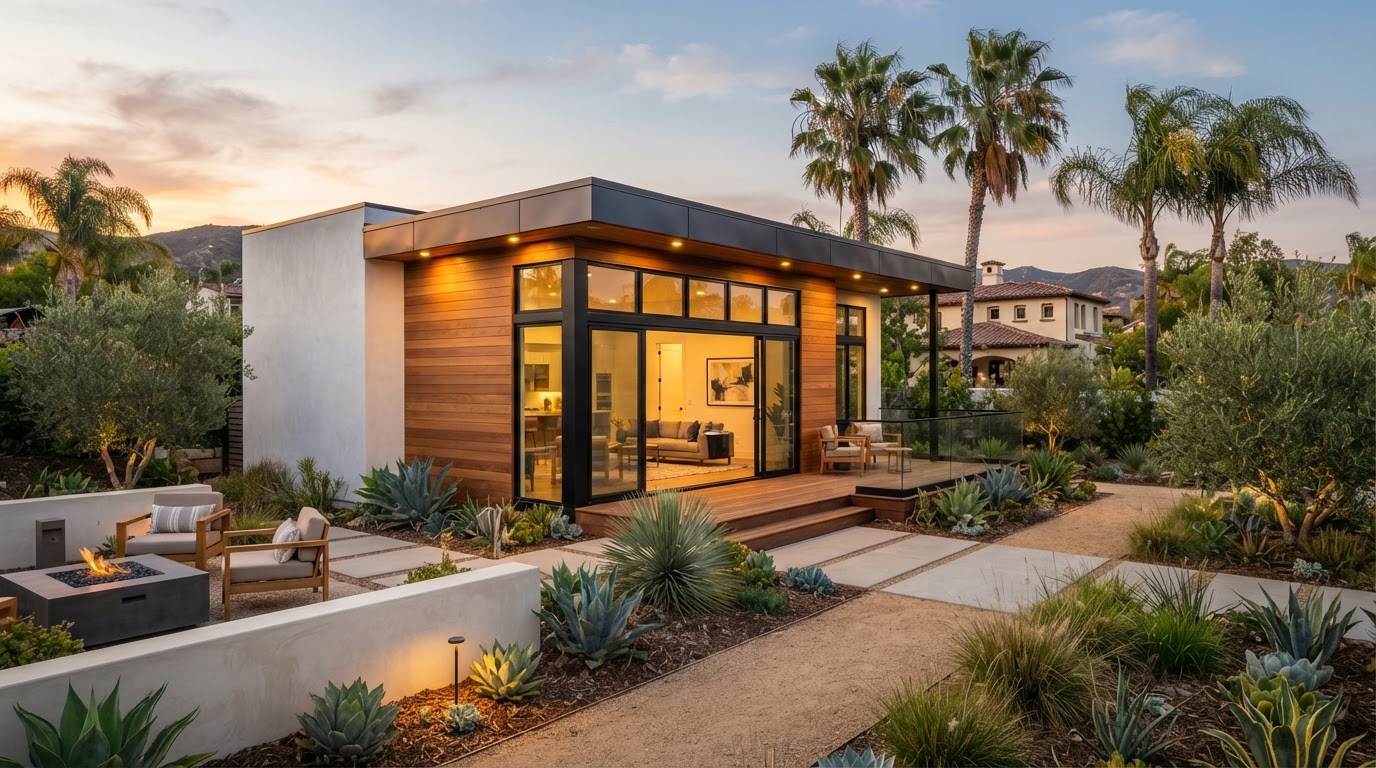
An ADU can generate rental income, but the real question is how much income remains after vacancy, expenses, financing, and taxes.
1. How Much Rental Income Can an ADU Generate in Orange County and Los Angeles?
ADU rental income varies significantly by city, neighborhood, unit size, privacy, condition, parking, amenities, and proximity to employment centers and transportation. A compact studio in an inland neighborhood may command a very different rent from a newly built one-bedroom ADU in a desirable coastal community. Even two units of similar size can attract different tenants and rental rates. The following ranges are illustrative screening estimates, not verified market averages or guaranteed achievable rents. Homeowners should validate them against comparable, currently available rental listings in the specific neighborhood.
| ADU configuration | Illustrative monthly rent | Illustrative annual gross rent |
|---|---|---|
| Studio or compact garage conversion | $1,500–$2,200 | $18,000–$26,400 |
| One-bedroom ADU | $1,800–$2,800 | $21,600–$33,600 |
| Two-bedroom ADU | $2,400–$3,500 | $28,800–$42,000 |
| Premium unit in a desirable location | Potentially higher | Depends on comparable rentals |
These are broad planning ranges for the Southern California market, not city-specific rent quotations. A particular property may fall below or above them. Homeowners should independently verify the assumptions using current local listings and actual rental comparables.
What influences ADU rental rates?
- Location. Neighborhood demand, proximity to employment, universities, healthcare facilities, shopping, and transit can influence rent.
- Unit size and layout. A separate bedroom may appeal to renters who need more privacy than a studio offers. Additional square footage only helps when it improves usability.
- Privacy. A detached unit with its own entrance and clearly defined outdoor space may appeal to tenants who value separation from the primary residence.
- Condition and finishes. Durable flooring, good lighting, modern fixtures, effective ventilation, and a well-maintained interior can support a stronger rental presentation.
- Parking and access. Parking availability and the route to the entrance can affect tenant interest, although the importance varies by neighborhood.
- Utilities and amenities. In-unit laundry, internet availability, heating and cooling, storage, and outdoor space may influence the attractiveness of a rental.
- Rental terms. Monthly rent, lease length, furnishing, included utilities, and applicable local restrictions all affect the financial model.
How to estimate rent for your property
Instead of relying on a broad regional estimate, research comparable properties in the same neighborhood:
- Identify at least three to five reasonably comparable rentals.
- Match the unit type, bedroom count, approximate size, and condition.
- Check whether utilities, parking, laundry, or furnishings are included.
- Distinguish advertised asking rents from rents actually achieved.
- Consider how long comparable properties remain listed.
- Use a conservative estimate when calculating your expected return.
A rental estimate based on the specific property is more useful than a high rent figure taken from a different city or a premium property with features your ADU will not have.
2. What Is ADU ROI?
Return on investment measures how much a project earns relative to the amount invested. For rental property owners, it is important to distinguish between gross rental yield, operating income, cash flow, and the longer-term return from owning the property.
Gross rental yield
Gross rental yield compares annual scheduled rent with the total project cost.
Formula: Gross rental yield = Annual scheduled rent ÷ Total project cost × 100
For example, suppose an ADU costs $250,000 to build and is expected to rent for $2,200 per month. Annual scheduled rent: $2,200 × 12 = $26,400. Gross rental yield: $26,400 ÷ $250,000 × 100 = 10.56%. This is a gross yield of approximately 10.6%. It is not a net return because it does not account for vacancy, operating expenses, financing, or taxes.
Net operating income
Net operating income (NOI) estimates rental income after vacancy and ordinary operating expenses, before debt service and income taxes. A simplified formula is: NOI = Effective rental income − Operating expenses. Operating expenses may include repairs, maintenance, insurance, owner-paid utilities, management, and other property-related costs. Whether a particular expense belongs in the calculation depends on how the property and ADU are structured.
Net operating yield
Net operating yield compares annual NOI with the total project cost: Net operating yield = Annual NOI ÷ Total project cost × 100. This is generally more informative than gross rental yield when comparing two possible ADU projects.
Cash-on-cash return
If you finance the project, cash-on-cash return compares annual pre-tax cash flow with the actual cash invested: Cash-on-cash return = Annual pre-tax cash flow ÷ Cash invested × 100. This measure accounts for debt payments through the cash-flow calculation. It can help evaluate a financed project, but it should be calculated using realistic loan terms and all relevant upfront expenses.
No single metric captures the entire investment. A sound analysis considers operating income, financing, future repairs, the owner’s objectives, and the property’s potential value over time.
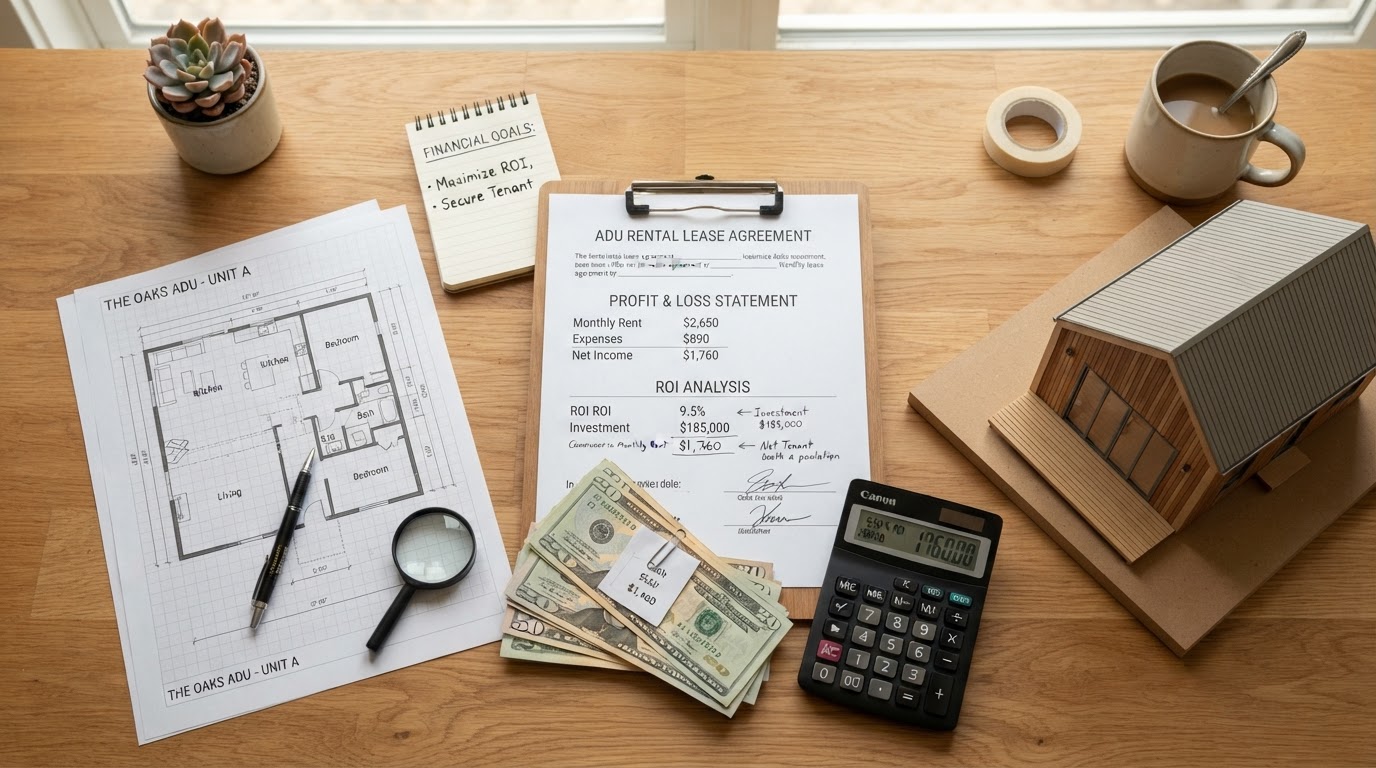
Distinguish gross rental yield, net operating income, and cash flow before treating a monthly rent figure as profit.
3. ADU ROI Example: A $250,000 Project
Consider a hypothetical detached ADU built for a total project cost of $250,000. Assume it rents for $2,200 per month and is used as a long-term rental. The example below illustrates how gross income changes after vacancy and operating expenses.
| Financial item | Illustrative annual amount |
|---|---|
| Scheduled rent ($2,200 × 12) | $26,400 |
| Vacancy and collection allowance (5%) | −$1,320 |
| Effective rental income | $25,080 |
| Operating expenses allowance | −$6,000 |
| Estimated net operating income | $19,080 |
| Total project cost | $250,000 |
| Gross rental yield | 10.56% |
| Net operating yield | 7.63% |
In this example, the ADU generates $26,400 in scheduled annual rent but approximately $19,080 in annual NOI before financing and income taxes. The 5% vacancy allowance and $6,000 operating-expense allowance are hypothetical assumptions, not measured averages. Actual expenses may be substantially different, particularly if the owner pays utilities, uses a property manager, experiences significant repairs, or has higher insurance costs.
What does the example tell us?
The gross yield looks stronger than the net operating yield because expenses reduce the amount available to the owner. The example also illustrates why a rental-income estimate should not be presented as guaranteed profit. A homeowner who finances the ADU must subtract debt payments to estimate cash flow. An owner paying cash will still need to account for operating expenses, future repairs, and the opportunity cost of the capital invested.
What about the payback period?
A simple payback calculation divides the project cost by annual NOI: $250,000 ÷ $19,080 ≈ 13.1 years. This means approximately 13.1 years under the example’s assumed annual NOI, if that income remains constant and is available to recover the initial project cost. It is not a full investment forecast. It excludes financing, income taxes, changes in expenses, rent changes, future capital improvements, property appreciation, and the potential value added to the primary residence. Those factors can materially change the actual outcome.
4. The Expenses That Can Reduce ADU Rental Profit
A reliable financial model includes more than construction and rent. The recurring expenses and the occasional large repair can make a substantial difference over the life of the ADU.
Vacancy and tenant turnover
An ADU may sit vacant between tenants. Owners may also need to spend money cleaning, repairing, or preparing the unit before the next occupant moves in. Use a vacancy allowance that reflects local demand, the expected lease structure, and the owner’s tolerance for risk. Do not assume that a unit will be occupied every day of every year.
Repairs and routine maintenance
Common expenses can include plumbing repairs, appliance replacement, paint, flooring repairs, pest control, landscaping, and general wear and tear. A new ADU may initially need less maintenance than an older property, but that does not eliminate future repairs. Set aside money regularly rather than treating every repair as an unexpected event.
Insurance
The existing homeowner’s insurance policy may need to be reviewed when an ADU is added or rented. Coverage, premiums, liability exposure, and insurer requirements vary. Contact the insurer before construction or rental use to understand how the ADU should be disclosed and insured.
Utilities
Electricity, gas, water, sewer, and internet arrangements depend on the property and the lease. Some ADUs have separate metering; others share services with the main residence. If utilities are included in the rent, estimate the likely cost and make sure the lease clearly explains the arrangement. Avoid assuming that the tenant will pay all utility expenses unless the setup and agreement support that arrangement.
Property management
Some owners manage the ADU themselves. Others hire a professional to handle marketing, tenant screening, lease administration, rent collection, inspections, and maintenance coordination. Self-management can reduce direct management expenses, but it requires time and consistent attention to applicable landlord responsibilities.
Taxes and professional fees
Rental income may have income-tax implications. The tax treatment of expenses, depreciation, financing, and improvements depends on the owner’s circumstances. Property tax assessments or other property-related costs may also change when an ADU is built. Do not assume that every ADU triggers a reassessment of the entire property, or that no reassessment will occur. Ask the relevant county assessor or a qualified tax professional how the rules apply to the specific project.
Capital improvements
Some expenses are larger and less frequent than routine maintenance. Examples include major appliance replacement, roof repairs, exterior repainting, and substantial plumbing or electrical work. Create a separate reserve for future capital improvements. A financial model that assumes no major repairs over many years is unlikely to reflect the full cost of ownership.
5. How ADU Construction Cost Affects ROI
Two homeowners may earn similar rents but experience very different returns because their project costs differ. Suppose two properties each generate $24,000 in scheduled annual rent. One owner spends $200,000 on the ADU, while the other spends $300,000.
| Metric | Project A | Project B |
|---|---|---|
| Total project cost | $200,000 | $300,000 |
| Scheduled annual rent | $24,000 | $24,000 |
| Gross rental yield | 12.0% | 8.0% |
This simplified comparison shows how a higher initial cost reduces gross yield when rental income is unchanged. However, the cheapest project is not automatically the best investment. A poorly designed unit may attract fewer qualified tenants, require more maintenance, or fail to meet the owner’s long-term objectives. The goal is to control unnecessary costs while preserving the features that make the ADU functional, durable, and appealing to the intended occupant.
Where should homeowners focus?
- Choose an appropriate size. Building more square footage than the intended occupants need can increase costs without producing proportional rental income.
- Keep the design efficient. A practical footprint and well-coordinated kitchen, bathroom, and utility locations may reduce complexity, depending on the site.
- Evaluate garage conversion opportunities carefully. An existing structure can sometimes reduce the amount of new construction, but structural upgrades, insulation, foundations, utilities, and other work can change the economics.
- Select durable finishes. Low upfront cost is not always the lowest long-term cost. Materials should suit the expected occupancy and maintenance requirements.
- Clarify the full project scope. Ask which design, engineering, permitting, site work, utility work, inspections, and finishing costs are included in the estimate.
For a more detailed cost breakdown, read our related ADU cost guide for Orange County and Los Angeles.
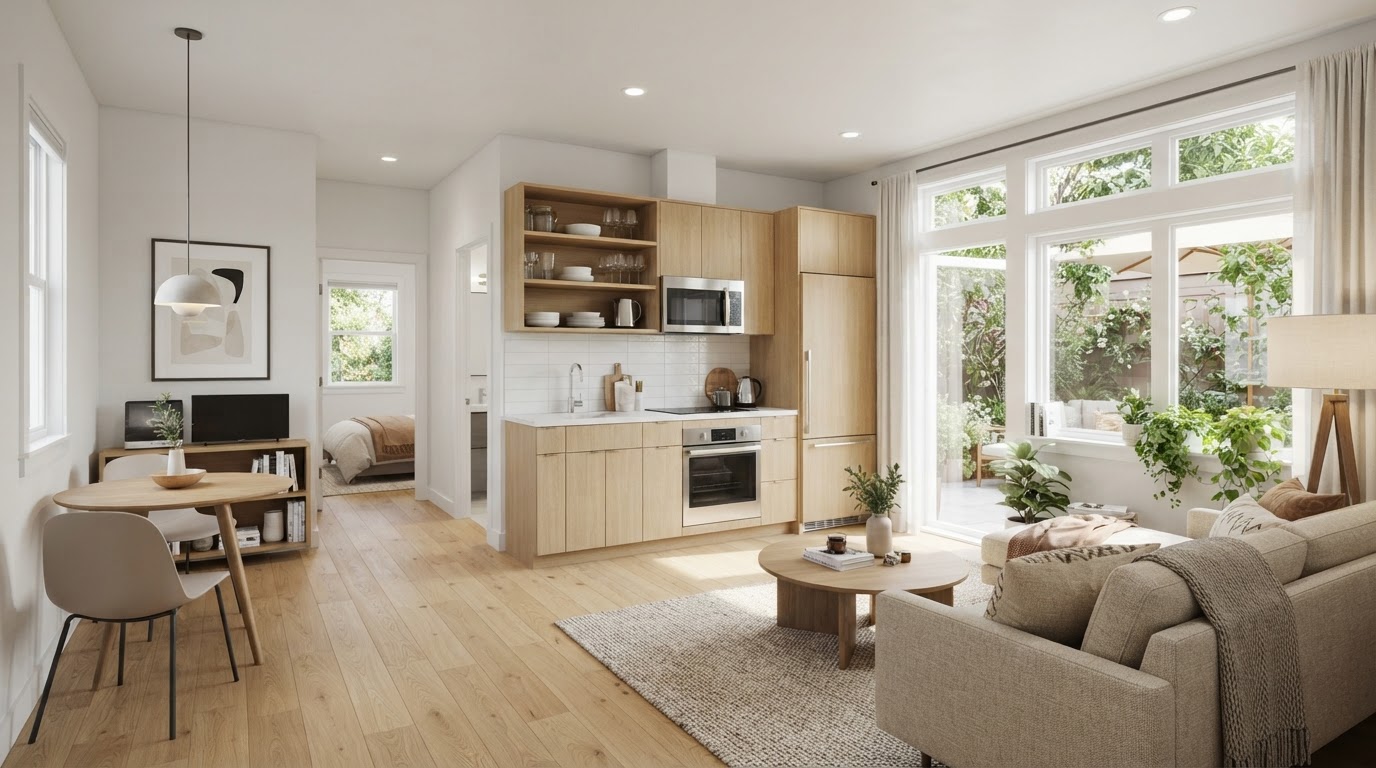
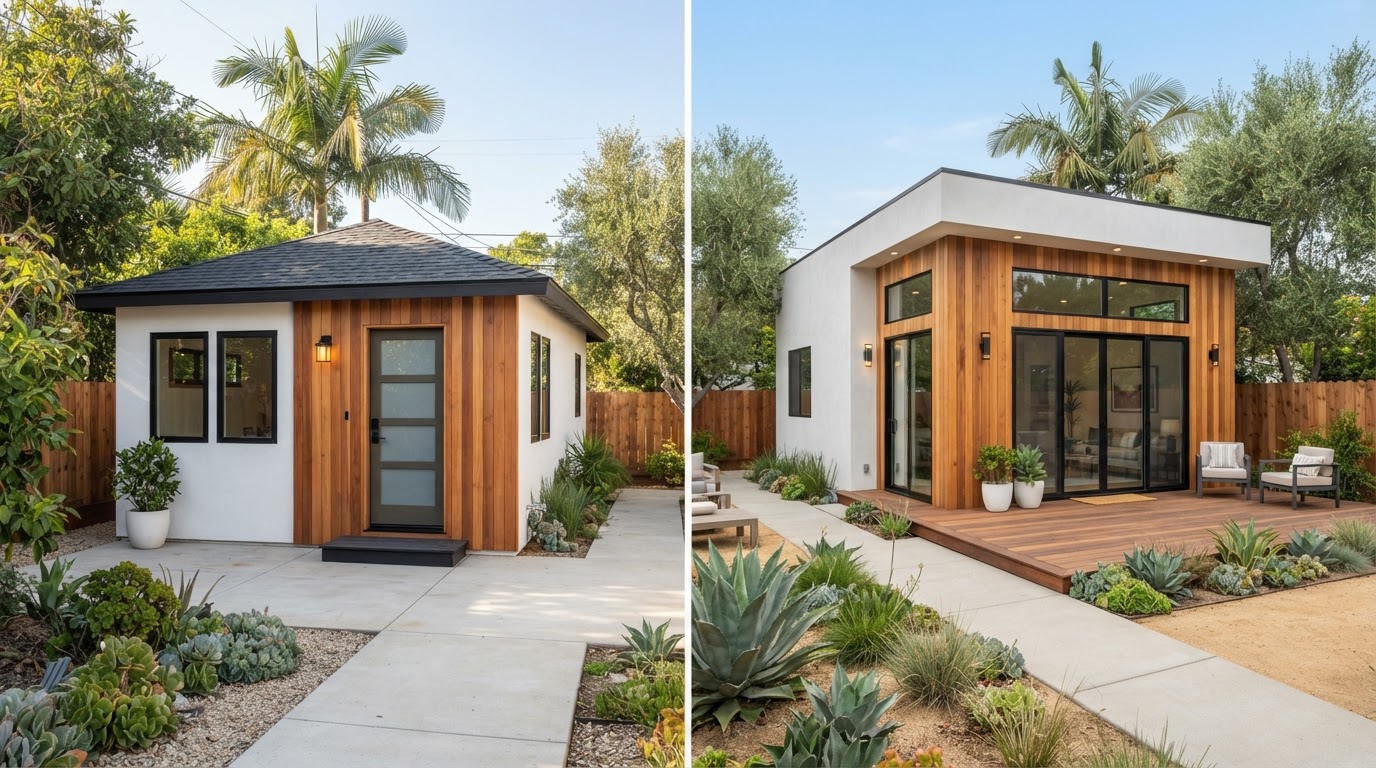
A well-designed one-bedroom ADU can attract quality long-term tenants, but construction cost directly affects the return on investment.
6. Garage Conversion vs. Detached ADU: Which Has Better Rental ROI?
A garage conversion may have a lower initial cost than a detached ADU, but that is not guaranteed. The existing garage’s condition and the work required to make it suitable for residential use can have a major impact on the budget. A detached ADU may provide greater design flexibility and more separation from the primary residence, but it can require more new construction and site work.
| Consideration | Garage conversion | Detached ADU |
|---|---|---|
| Existing structure | Uses an existing garage, subject to evaluation and required upgrades | Requires a new building or a suitable separate structure |
| Design flexibility | Constrained by the existing footprint and structure | Often offers more flexibility in footprint and orientation |
| Privacy | Depends on location, entrance, and relationship to the main house | May provide more separation, depending on site layout |
| Initial cost | May be lower if the existing structure is suitable | May be higher because of new construction and site work |
| Rental potential | Depends on layout, location, condition, and tenant demand | Depends on layout, location, condition, and tenant demand |
| Main financial risk | Unexpected structural or conversion costs | Higher upfront investment and construction complexity |
The best choice is the one that meets the intended use and produces acceptable financial results under realistic assumptions. Do not compare only the advertised construction prices. Compare the full project budget, expected rent, operating expenses, financing, and long-term maintenance. For a deeper comparison, read our Garage Conversion vs. Detached ADU guide.
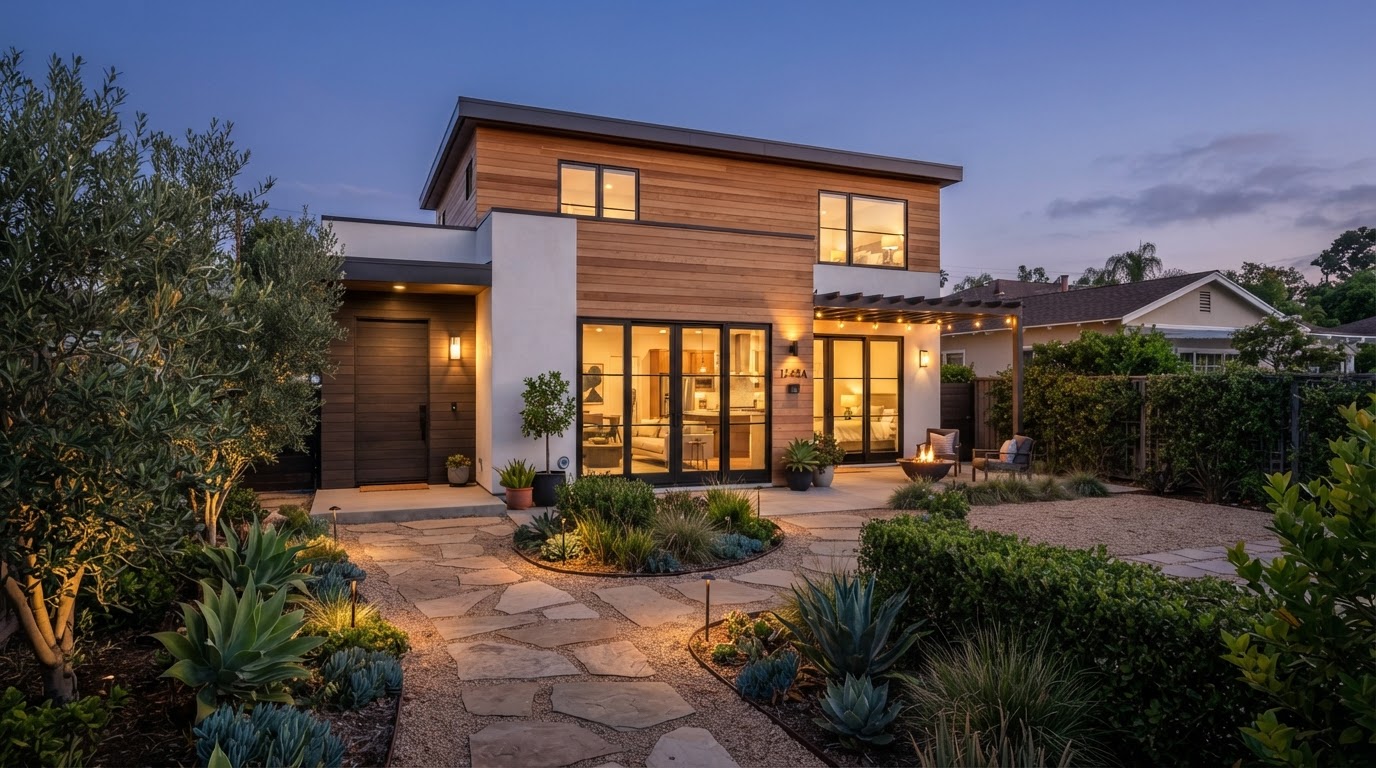
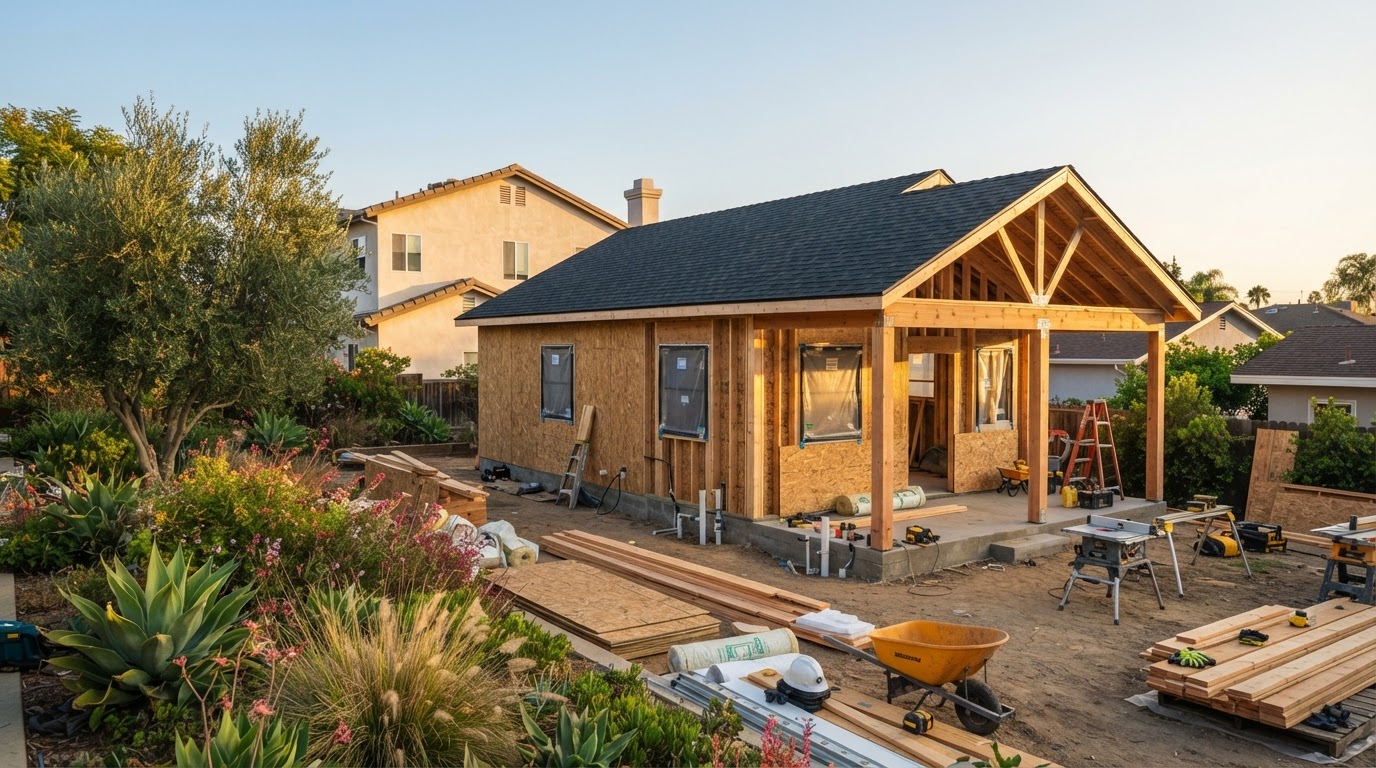
A detached two-bedroom ADU may command higher rent, but the larger upfront investment also affects the return.
7. Long-Term Rental vs. Short-Term Rental
Some homeowners consider renting their ADU to long-term occupants, while others investigate furnished or short-term rental models. These approaches have different financial and regulatory implications.
Long-term rental
A long-term rental typically offers a more predictable lease structure and less frequent turnover than a short-term accommodation model. Potential advantages include more predictable scheduled rent, less frequent cleaning and guest turnover, fewer day-to-day booking tasks, and a simpler operating model for some homeowners. The owner must still account for vacancy, repairs, tenant screening, lease administration, and applicable landlord-tenant requirements.
Short-term rental
A short-term rental model may appear attractive when nightly rates are high, but nightly prices alone do not determine profitability. The owner must consider occupancy, cleaning, platform fees, furnishings, supplies, guest communication, maintenance, and the time required to manage reservations. Local rules may also restrict or prohibit this use. Before assuming that an ADU can be operated as a vacation rental, confirm the applicable city or county rules, permit requirements, registration obligations, tax requirements, and any restrictions affecting the property.
Important: California’s current rules specifically prohibit JADUs from being used as short-term rentals. If rented, a JADU must be rented for a term longer than 30 days under the state-law changes effective January 1, 2026. Ordinary ADUs and short-term rentals must be evaluated under the applicable laws and local requirements. Review the California HCD ADU Handbook, updated March 2026, before relying on a rental strategy.
For many homeowners, a conventional long-term rental is a simpler starting point for financial modeling. The appropriate choice depends on local rules, the owner’s goals, and the actual economics of the property.
8. Financing an ADU: How Loan Payments Change the Numbers
If the ADU is financed, the project needs to be evaluated differently from one built entirely with cash. Loan payments reduce the cash available from rental operations. Interest rates, loan fees, repayment terms, and the amount borrowed can materially change the financial result. Consider the earlier example: annual scheduled rent of $26,400 and estimated annual NOI of $19,080. If annual debt service is $20,000, the example would produce approximately $920 in negative annual pre-tax cash flow before considering any other items not already included in the NOI estimate. If debt service is lower, the property could generate positive cash flow. If it is higher, the shortfall could increase. This example is not a loan quote or a prediction. It illustrates why an owner should calculate financing costs before deciding whether to build.
Questions to ask before financing
- How much cash is required upfront?
- What are the interest rate, fees, and repayment terms?
- Does the lender permit the proposed use of the funds?
- How will payments change if the loan has a variable interest rate?
- Can the owner comfortably cover the payments during a vacancy?
- Is there sufficient cash for unexpected repairs or construction overruns?
- What happens if the project takes longer than expected to complete?
Do not rely on projected rental income as the only source of funds for loan payments. A prudent plan includes enough financial flexibility to withstand delays and lower-than-expected rent.
9. Does Building an ADU Increase Property Value?
An ADU may improve a property’s appeal and potential value, but the amount of value added varies. Factors can include the local housing market, the ADU’s size and condition, legal status, quality of construction, rental demand, and how comparable properties are valued. An ADU can offer value in several ways: potential rental income, flexible living arrangements for relatives or guests, property appeal to future buyers, and long-term flexibility as household needs change.
However, homeowners should not assume that an ADU will increase property value by a specific percentage or that every dollar spent on construction will be recovered at resale. Before building primarily to increase resale value, consult a qualified local real estate professional or appraiser who understands how ADUs are valued in the property’s market. Also distinguish between an ADU’s potential contribution to property value and its ability to produce positive rental cash flow. A project can improve a property’s utility while still delivering a modest or negative short-term cash return.
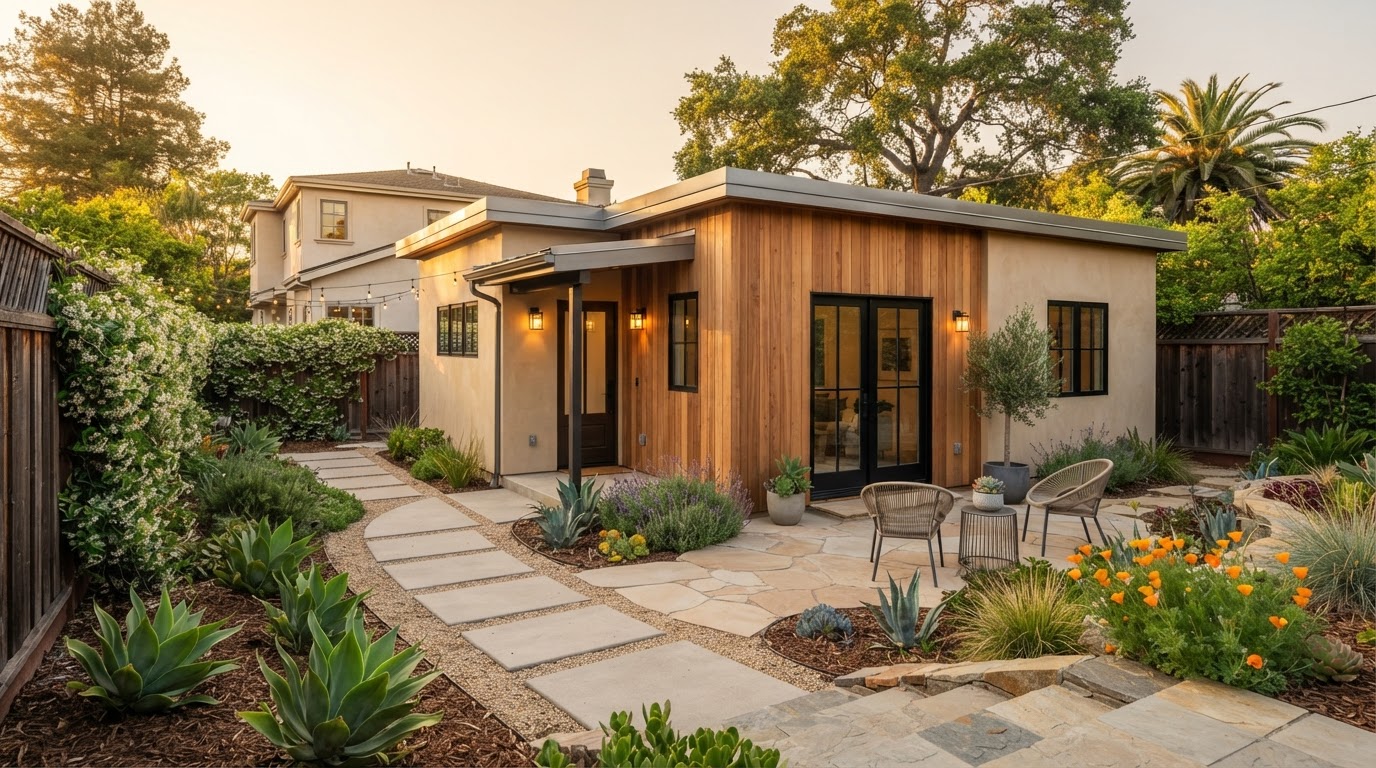
An ADU may add property value and flexibility, but the amount varies with market, legal status, construction quality, and rental demand.
10. California Rental Rules and Compliance Considerations
Rental income projections are only useful if the proposed use is legally permitted and the property can be operated in compliance with applicable requirements. California’s ADU framework has changed over time. The current state handbook should be reviewed alongside the requirements of the city or county that has jurisdiction over the property.
Before renting an ADU, confirm the following:
- Permits and final approvals: Verify that the unit has the required approvals for its intended residential use.
- Rental terms: Confirm whether the intended lease duration and rental arrangement are permitted.
- Local short-term rental rules: Do not assume that an ADU may be rented by the night or week.
- Lease and landlord-tenant obligations: Review the applicable requirements governing deposits, notices, habitability, and tenant rights.
- Insurance: Confirm coverage for the ADU and its rental use.
- Taxes: Understand the treatment of rental income, deductible expenses, and any relevant property-tax implications.
- Utilities and shared areas: Clearly define the use of shared facilities, parking, outdoor spaces, and utility arrangements.
- HOA or property restrictions: Review any applicable restrictions and obtain qualified advice when their effect is unclear.
For official state guidance, consult the California HCD ADU page and the March 2026 ADU Handbook. Local requirements can differ, so confirm the rules that apply to the specific property rather than relying solely on a general online article.
11. Common ADU Investment Mistakes
Mistake 1: Assuming rent will cover the construction cost quickly
A high monthly rent does not automatically translate into a short payback period. Vacancy, operating costs, financing, and repairs all affect the amount available to recover the initial investment.
Better approach: Calculate gross yield, NOI, and cash flow separately.
Mistake 2: Using premium rental comparables
A newly built coastal unit with private outdoor space and premium finishes may not be comparable to a compact garage conversion in another neighborhood.
Better approach: Use local comparables with similar layouts, condition, access, and amenities.
Mistake 3: Underestimating the total project cost
Homeowners may focus on construction while overlooking design, engineering, permits, utility work, site preparation, landscaping, financing, and contingency funds.
Better approach: Build a comprehensive budget and ask for a clearly defined project scope.
Mistake 4: Ignoring the cost of managing the unit
Self-management takes time, and professional management costs money. Both should be reflected in the owner's decision.
Better approach: Decide how the unit will be managed before estimating the net return.
Mistake 5: Assuming property appreciation is guaranteed
Property values can rise or fall. A future sale price should not be treated as certain income.
Better approach: Model rental performance separately from speculative appreciation.
Mistake 6: Choosing a layout based only on bedroom count
Adding another bedroom may increase potential rent in some markets, but it can also increase construction cost or reduce living comfort.
Better approach: Compare the expected rental income and complete project cost of alternative designs.
Mistake 7: Failing to plan for vacancies and repairs
Even a well-built ADU can experience vacancies, tenant turnover, and unexpected maintenance.
Better approach: Maintain a financial reserve and test the investment against less favorable conditions.
12. A Simple ADU ROI Planning Worksheet
Before requesting detailed construction proposals, create a preliminary financial model. Use these inputs to calculate gross yield, net operating income, cash flow, and cash-on-cash return.
| Input | Your estimate |
|---|---|
| Total design and construction budget | $________ |
| Additional project and financing costs | $________ |
| Expected monthly rent | $________ |
| Expected annual vacancy allowance | $________ |
| Annual insurance and operating costs | $________ |
| Annual maintenance and repair reserve | $________ |
| Annual management costs, if applicable | $________ |
| Annual financing payments | $________ |
| Other applicable annual costs | $________ |
Use these inputs to calculate:
- Scheduled annual rent — Monthly rent × 12
- Effective rental income — Scheduled annual rent − vacancy and collection losses
- Net operating income — Effective rental income − operating expenses
- Net operating yield — Annual NOI ÷ total project cost × 100
- Annual pre-tax cash flow — Annual NOI − annual debt service − other relevant cash expenses not already included
- Cash-on-cash return — Annual pre-tax cash flow ÷ actual cash invested × 100
Keep your assumptions visible. If the project only looks attractive when rent is unusually high, expenses are unusually low, or construction stays at the lowest possible estimate, the investment may be more exposed to risk than the headline figures suggest.
Test three scenarios
Instead of relying on a single forecast, calculate three versions of the project:
- Conservative: Lower rent, longer vacancy, higher expenses, and a construction contingency.
- Expected: Reasonable rent and expense assumptions supported by local research and a detailed project estimate.
- Optimistic: Stronger rental performance or lower costs, without assuming that favorable conditions are guaranteed.
The conservative scenario is particularly useful for evaluating whether the household can afford the project if the rental market weakens or unexpected costs arise.
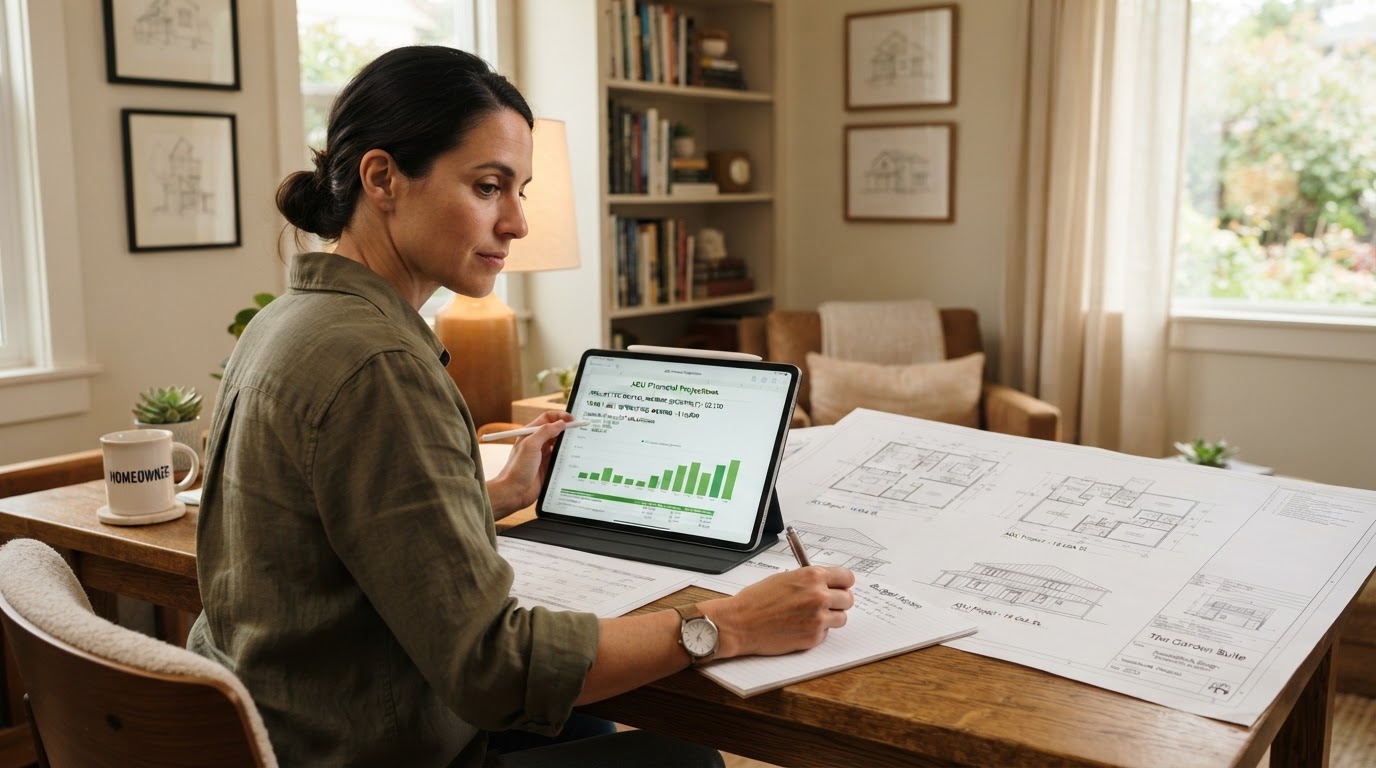
Test conservative, expected, and optimistic scenarios before relying on a single rental income forecast.
13. Is an ADU Worth Building for Rental Income?
An ADU may be worth considering when the property supports a suitable layout, local rental demand is strong enough, and the owner can fund the project without taking on unacceptable financial risk. It may be less attractive when the construction budget is high relative to achievable rent, the property requires extensive infrastructure work, financing is expensive, or the owner’s finances cannot comfortably absorb vacancies and repairs.
Before deciding, answer these questions:
- What is the realistic rental range for comparable units in the neighborhood?
- What is the complete project cost, including design, permits, utilities, and contingency?
- How much annual NOI could the ADU reasonably generate?
- What would cash flow look like after loan payments?
- Can the household cover costs during construction and vacancy?
- How will the unit be maintained and managed?
- Is the intended rental arrangement allowed?
- Would the project still make sense if rent or resale value is lower than expected?
The right answer is property-specific. A good investment decision comes from understanding both the potential income and the cost of achieving it.
14. Planning an ADU in Orange County or Los Angeles?
For homeowners in Orange County and Los Angeles, an ADU project starts with the property, not a rental-income promise. A site evaluation can help identify potential constraints. A design review can compare studio, one-bedroom, and two-bedroom options. A detailed estimate can help establish the likely upfront investment, while a realistic financial model can show how the project might perform under different rental and expense assumptions.
Venguard Construction serves homeowners throughout Southern California, including Orange County and Los Angeles. If you are considering an ADU, discuss the property’s conditions, your intended use, and your budget before committing to a final design or construction plan. Visit Venguard Construction to learn more about the company and request a consultation. Planning an ADU? Start by understanding the site, comparing layout options, and developing a complete project budget. A well-planned project should fit your property and your financial goals—not depend on an optimistic rental estimate.
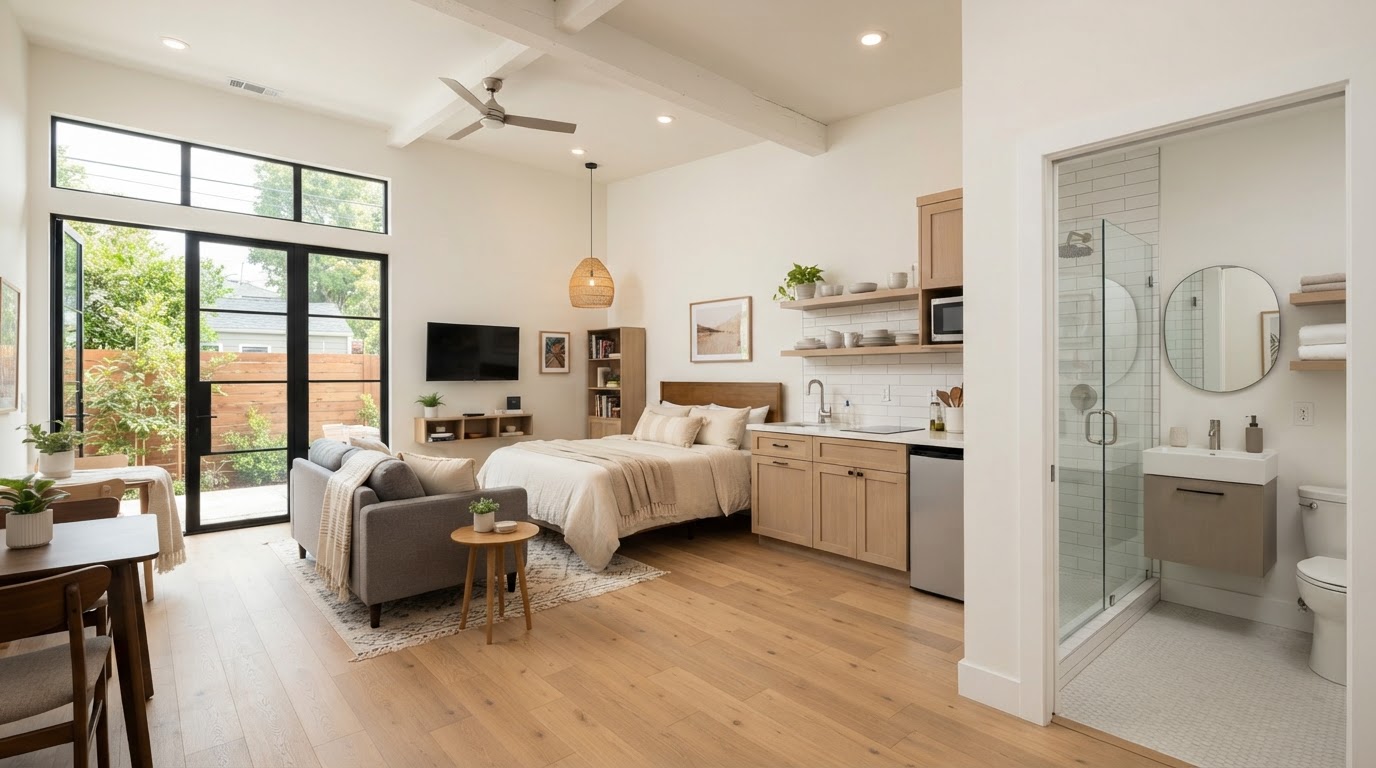
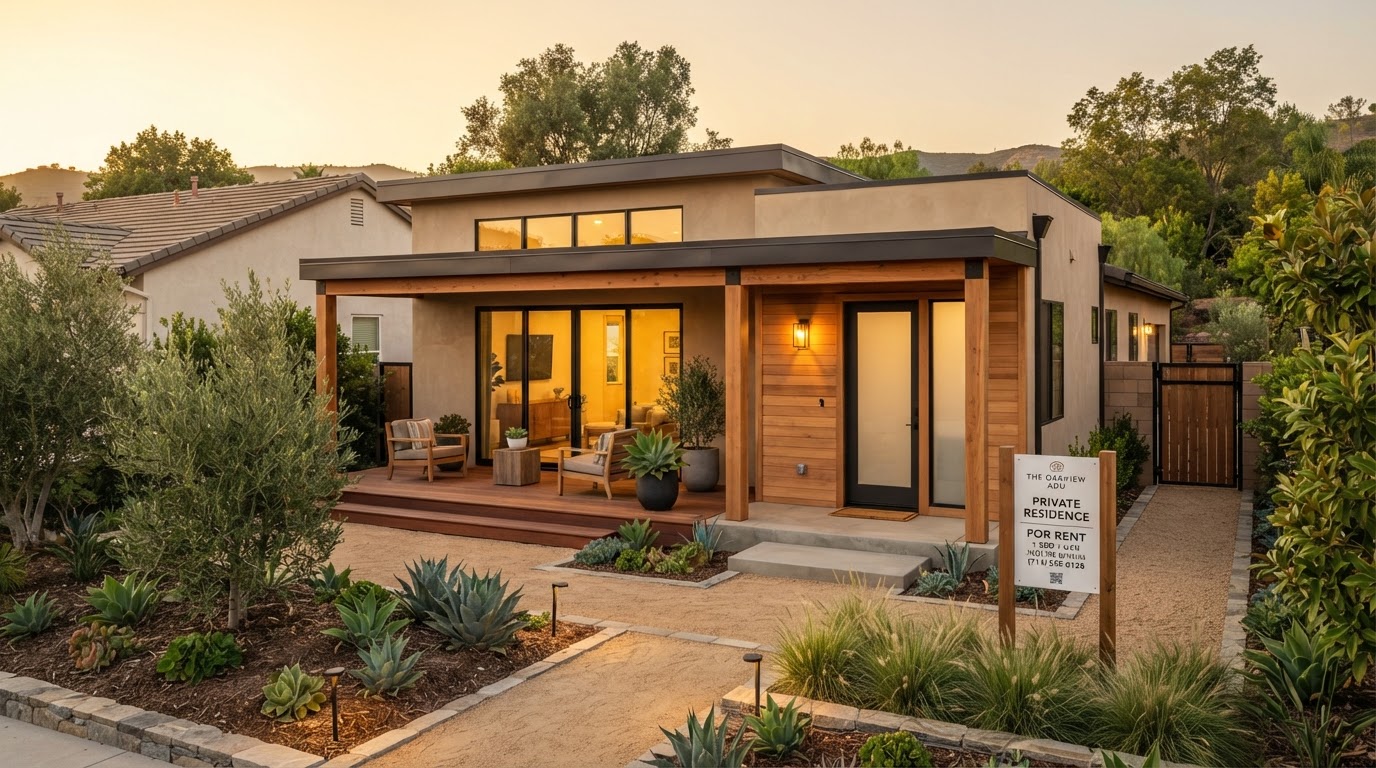
A garage conversion can produce rental income at a lower initial cost, but the full project budget and realistic rent should drive the decision.
Frequently Asked Questions About ADU Rental Income and ROI
How much rental income can an ADU generate in California?+
It depends on the location, size, condition, layout, privacy, amenities, and local rental demand. For preliminary planning, a compact studio might be evaluated against rents in the $1,500–$2,200 monthly range, while one-bedroom and two-bedroom units may command more in suitable markets. These are illustrative ranges, not guaranteed rents; verify comparable listings in the specific neighborhood.
What is a good ROI for an ADU?+
There is no single ROI percentage that makes every ADU a good investment. The appropriate return depends on the owner's goals, financing, project cost, risk tolerance, and alternatives for using the capital. Evaluate gross rental yield, net operating yield, cash flow, and cash-on-cash return rather than relying on one headline figure.
How long does it take for an ADU to pay for itself?+
The payback period depends on total project cost and the income available after expenses. Dividing project cost by annual NOI provides a simplified estimate, but it excludes financing and several other long-term factors. Use a detailed financial model rather than assuming a fixed number of years.
Is a garage conversion ADU more profitable than a detached ADU?+
A garage conversion may have a lower initial cost if the existing structure is suitable, but that is not guaranteed. A detached ADU may offer more design flexibility and privacy but can require greater upfront investment. Compare total costs and realistic rental income for both options.
Can I rent out my ADU if I do not live on the property?+
California state ADU law generally prohibits local agencies from imposing an owner-occupancy requirement on an ordinary ADU, subject to the details of applicable law and exceptions. JADUs have separate rules, including circumstances in which owner occupancy is required. Review the current HCD handbook and confirm how the rules apply to the specific unit and intended use.
Can I use my ADU as an Airbnb or short-term rental?+
Do not assume that short-term rental use is permitted. Local rules may restrict the activity, and JADUs are subject to a specific California restriction prohibiting short-term rental use. Confirm the current rules for the jurisdiction and property before building a financial model around nightly bookings.
What expenses should I include when calculating ADU ROI?+
Include vacancy, repairs, maintenance, insurance, owner-paid utilities, management, and other operating expenses. Also account separately for financing payments, taxes, initial project costs, and reserves for major future repairs. Make sure expenses are not accidentally counted twice.
Does an ADU increase property value?+
It may, but the amount varies with the local market, quality, legal status, rental potential, and comparable sales. Consult a qualified local real estate professional or appraiser rather than assuming a fixed increase in property value.
Is rental income from an ADU taxable?+
Rental income can have income-tax implications. The treatment of income, expenses, depreciation, and improvements depends on the owner's circumstances. Consult a qualified tax professional for advice specific to the property.
Should I build a larger ADU to earn more rent?+
Not necessarily. A larger unit may attract more rent in some markets, but it usually requires more investment. Compare the additional expected rental income with the additional construction and operating costs before choosing a larger design.
Plan Your ADU Investment with Venguard Construction
An ADU is more than a construction project—it is a financial decision that depends on realistic rent, complete project cost, operating expenses, financing, and the rules that govern rental use. Venguard Construction serves homeowners throughout Orange County and Los Angeles with a focus on craftsmanship, clear communication, and coordinated project delivery.
If you’re considering an ADU, contact Venguard Construction to learn more about the company and request a consultation. Start by discussing your property, intended use, and budget so a project-specific assessment can identify the next steps and a more realistic financial picture.