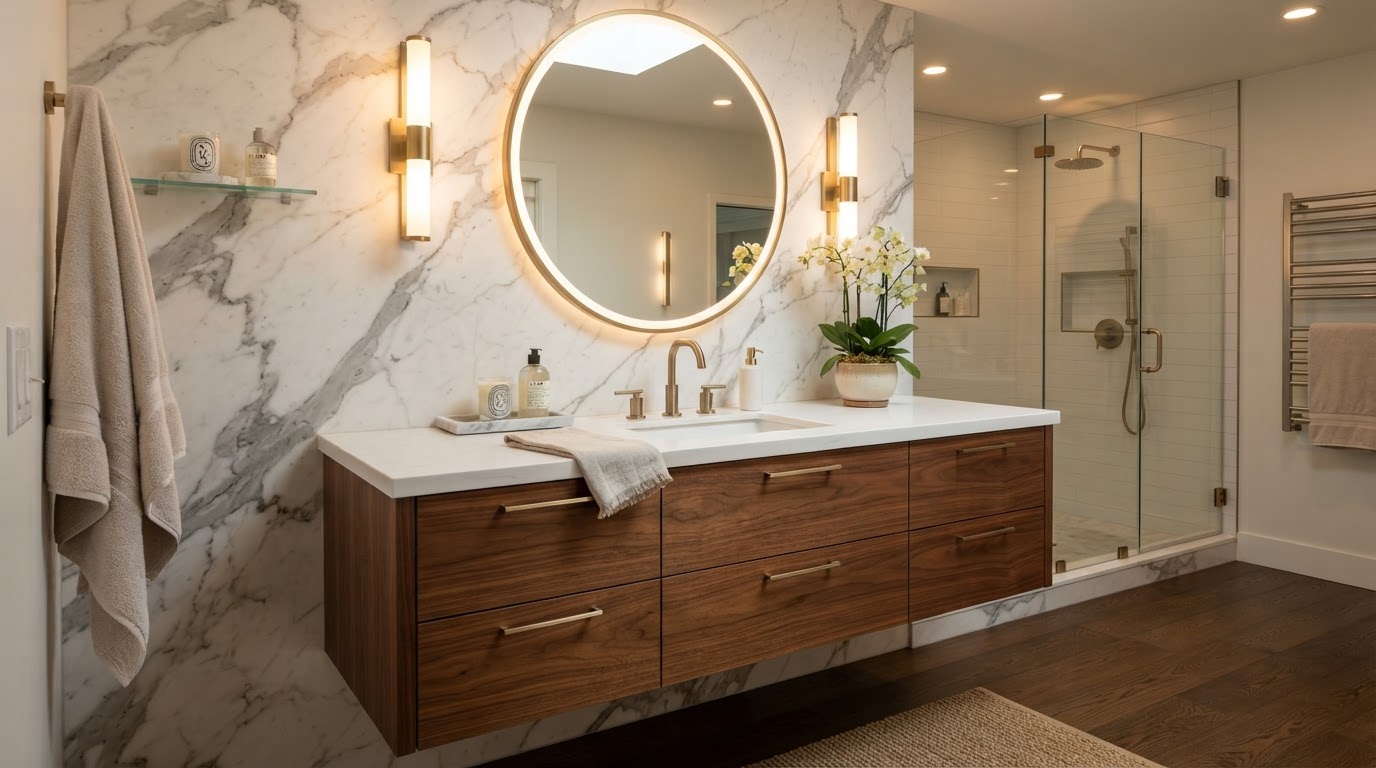
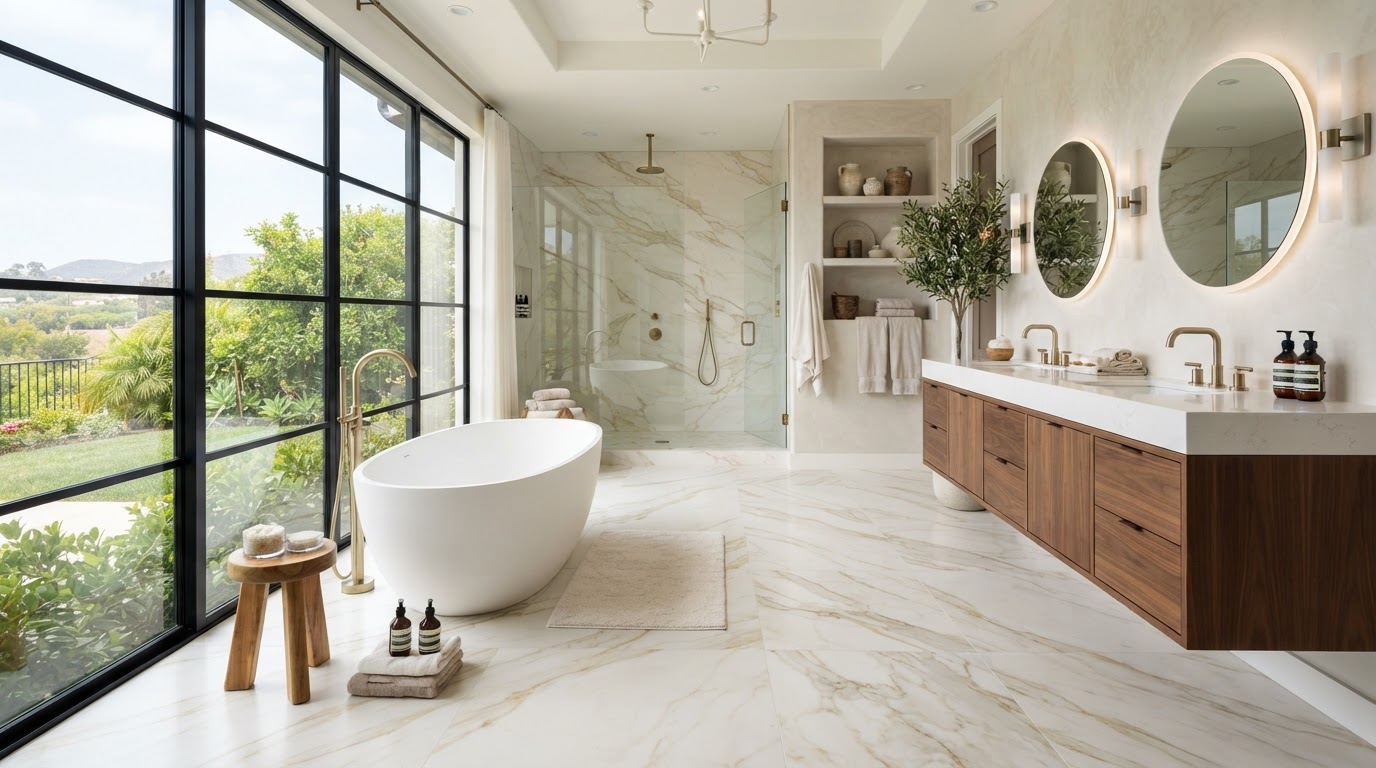
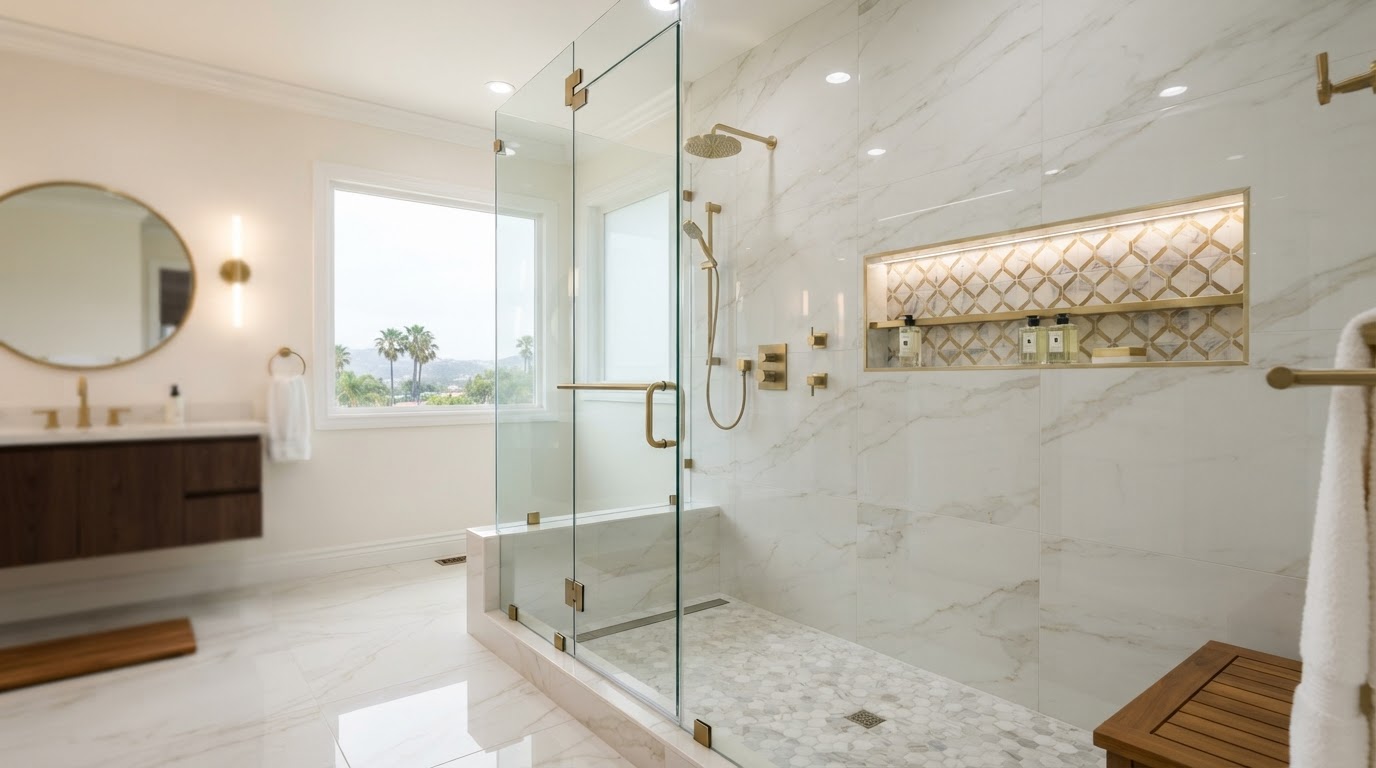
A shower niche is one of those bathroom features that looks simple but requires careful planning.
It can provide a convenient place for shampoo, conditioner, body wash, soap, razors, and other shower essentials while keeping the shower floor and corners free of clutter.
But a shower niche isn't just a decorative box built into the wall. It is part of the shower's wet-area construction. That means its location, dimensions, framing, waterproofing, slope, tile layout, and relationship to plumbing all need to be considered before installation.
A poorly planned niche can become an awkward storage space, interfere with plumbing, disrupt tile patterns, or—more seriously—create a waterproofing problem. A properly designed niche, on the other hand, can make a shower more functional while adding a custom, high-end appearance.
For homeowners planning a bathroom remodel in Orange County, Los Angeles, or surrounding Southern California communities, this guide explains everything you should know before adding a shower niche.
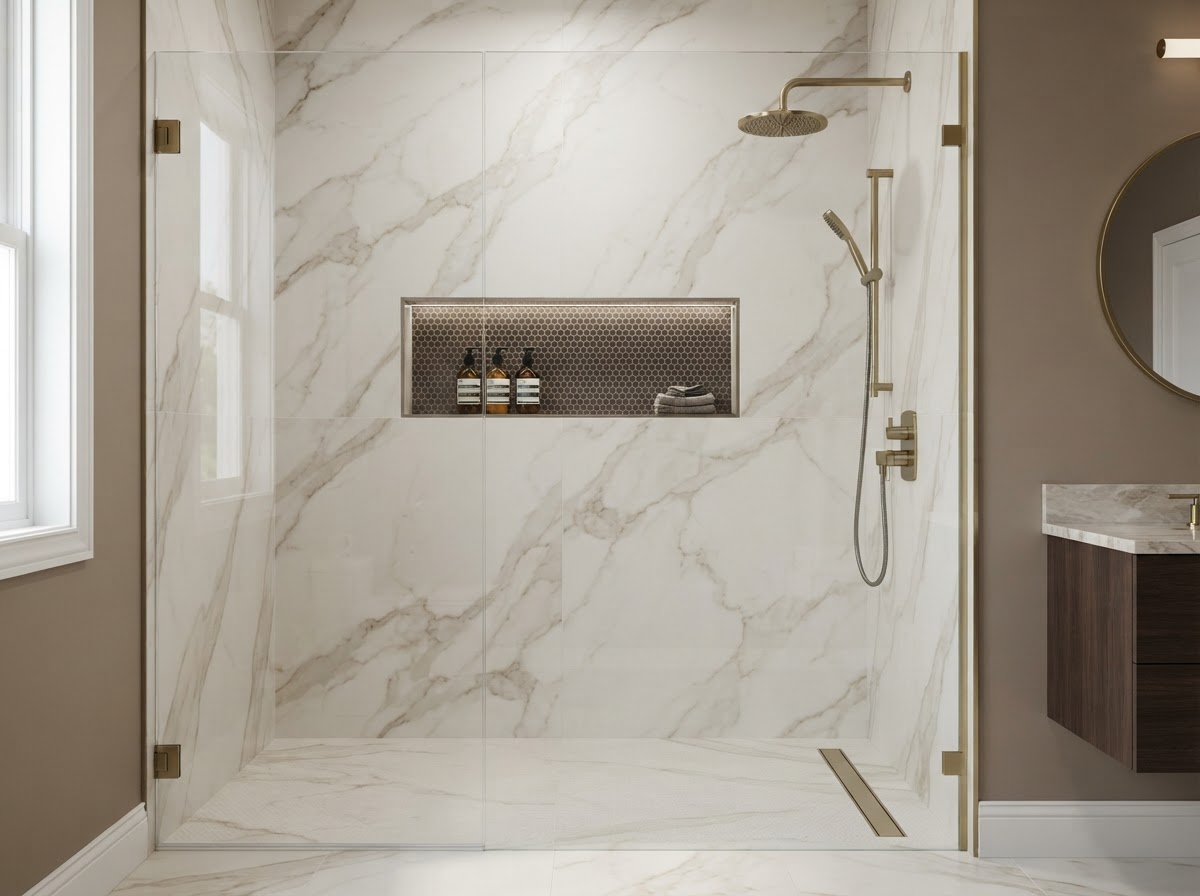
What Is a Shower Niche?
A shower niche is a recessed storage compartment built into a shower wall. Instead of having bottles sitting on the shower floor or hanging from an external caddy, the niche creates dedicated storage within the wall.
Shower niches can be:
- Horizontal
- Vertical
- Single-compartment
- Multi-compartment
- Full-width
- Small and compact
- Extra-large
- Custom-built
- Prefabricated
- Tiled
- Solid-surface finished
The design should be coordinated with the rest of the shower before the walls are closed and waterproofed.
Why Add a Shower Niche?
There are several reasons homeowners choose a built-in shower niche.
1. Better Shower Organization
A niche provides a dedicated place for everyday shower products. Instead of keeping bottles on the floor, on a corner shelf, on the shower curb, or on a hanging caddy, they can be stored inside the wall.
2. Cleaner Appearance
A properly designed niche can make a shower look more organized and intentional—especially valuable in modern bathrooms where homeowners want a clean, minimalist appearance.
3. Easier Access
A niche can place shower products within easy reach. Its height should be planned around the people who will use the shower.
4. Custom Design Opportunity
The niche can become an accent feature—using smaller mosaic niche tile against large-format wall tile, contrasting stone, decorative porcelain, matching trim, or solid-surface shelves. The result can be both functional and decorative.
Where Should a Shower Niche Be Located?
One of the most important decisions is placement. There is no single location that works for every shower. The niche should be positioned based on:
Best Shower Niche Placement
For many showers, the niche is positioned on a wall that is convenient to reach without standing directly under the shower stream. This can help reduce the amount of water constantly hitting the products. However, the best wall depends on the specific shower design. Before selecting a location, your contractor should inspect what is behind the wall.
Avoid Placing a Niche Where Plumbing Is Located
A shower wall may contain water supply lines, drain pipes, electrical wiring, ventilation components, and structural framing. A niche requires space inside the wall cavity. You should never assume that a wall is empty simply because it looks like the best location. Your contractor should determine whether the niche can be safely constructed there.
Can You Put a Niche on an Exterior Wall?
Sometimes, but it may require additional planning. Exterior walls can have insulation, vapor-control assemblies, structural framing, and weatherproofing components. Cutting deeply into an exterior wall can affect the building envelope. An interior wall is often easier for a recessed niche, but the specific construction must be evaluated.
Can a Shower Niche Go on a Plumbing Wall?
It depends on the plumbing configuration and wall depth. If supply lines or other components occupy the cavity, the niche may not have enough usable depth. Your contractor may recommend a shallower niche, a different wall, a surface-mounted shelf, a bump-out, or a different storage solution. Never sacrifice plumbing or structural requirements simply to achieve a particular niche location.
Standard Shower Niche Size
There is no single universal "standard" shower niche size. The appropriate dimensions depend on the shower, products being stored, wall construction, and design. Common residential niche configurations include:
Small Niche
Useful for bar soap, shampoo, conditioner, and minimal products.
Medium Niche
Useful for several bottles, soap, razors, and everyday shower products.
Large Horizontal Niche
Useful when multiple people share the shower or when homeowners want more storage.
Vertical Niche
Useful when wall space is narrow but vertical space is available.
How High & How Deep Should a Shower Niche Be?
Height
Niche height should be based on usability rather than a universal number. A niche that's too low can require unnecessary bending; one that's too high can be difficult to reach. Consider user height, children, older adults, accessibility requirements, shower controls, showerhead, and bench height. For a household with significantly different user heights, a larger niche or multiple storage zones may work better.
Depth
The niche should be deep enough to hold the products you intend to store without unnecessarily penetrating the wall cavity. Many shower products are relatively tall, so measure the actual bottles you use. Coordinate the finished dimensions with the tile thickness.
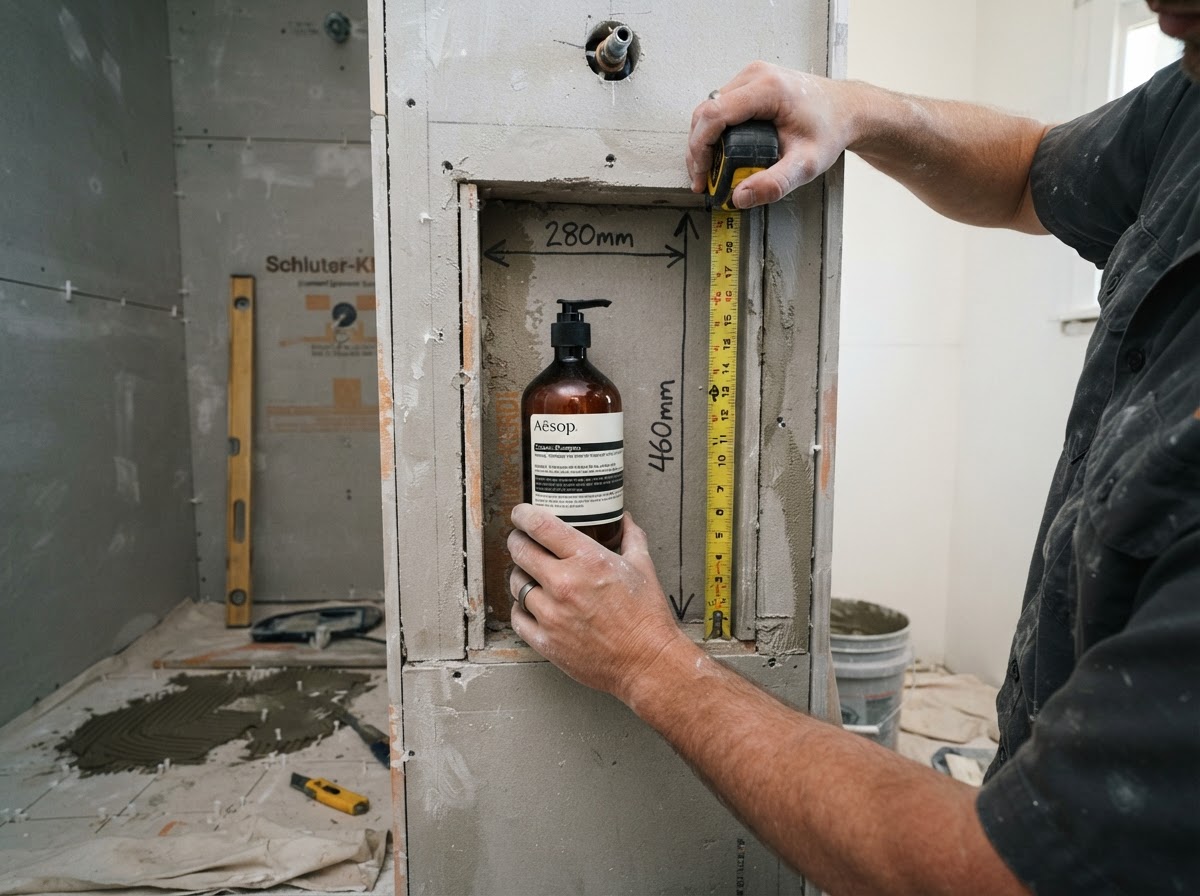
Measure your largest shower products before finalizing niche dimensions—designing around real bottles beats designing around a generic number.
Should a Shower Niche Have a Slope?
Yes. Horizontal surfaces inside a shower niche should be designed so that water doesn't sit on the shelf. The shelf should slope appropriately toward the shower area according to the construction system. This applies to bottom shelves, intermediate shelves, bench surfaces, and other horizontal ledges. The exact construction should follow the requirements of the waterproofing and tile system.
Why Does a Shower Niche Need Waterproofing?
A shower niche is a penetration into the shower wall. That makes waterproofing extremely important. The niche should be integrated into the shower's overall waterproofing system—back wall, side walls, top, bottom, corners, transitions, and penetrations. The waterproofing system should be continuous and compatible with the rest of the shower assembly. Read our complete bathroom waterproofing guide for more detail.
Is Tile Enough to Waterproof a Niche?
No. Tile and grout are the finished surfaces. They should not be treated as the primary waterproofing system. A niche needs an appropriate waterproofing assembly behind or integrated with the finished tile. This is especially important because niches contain multiple inside corners and transitions.
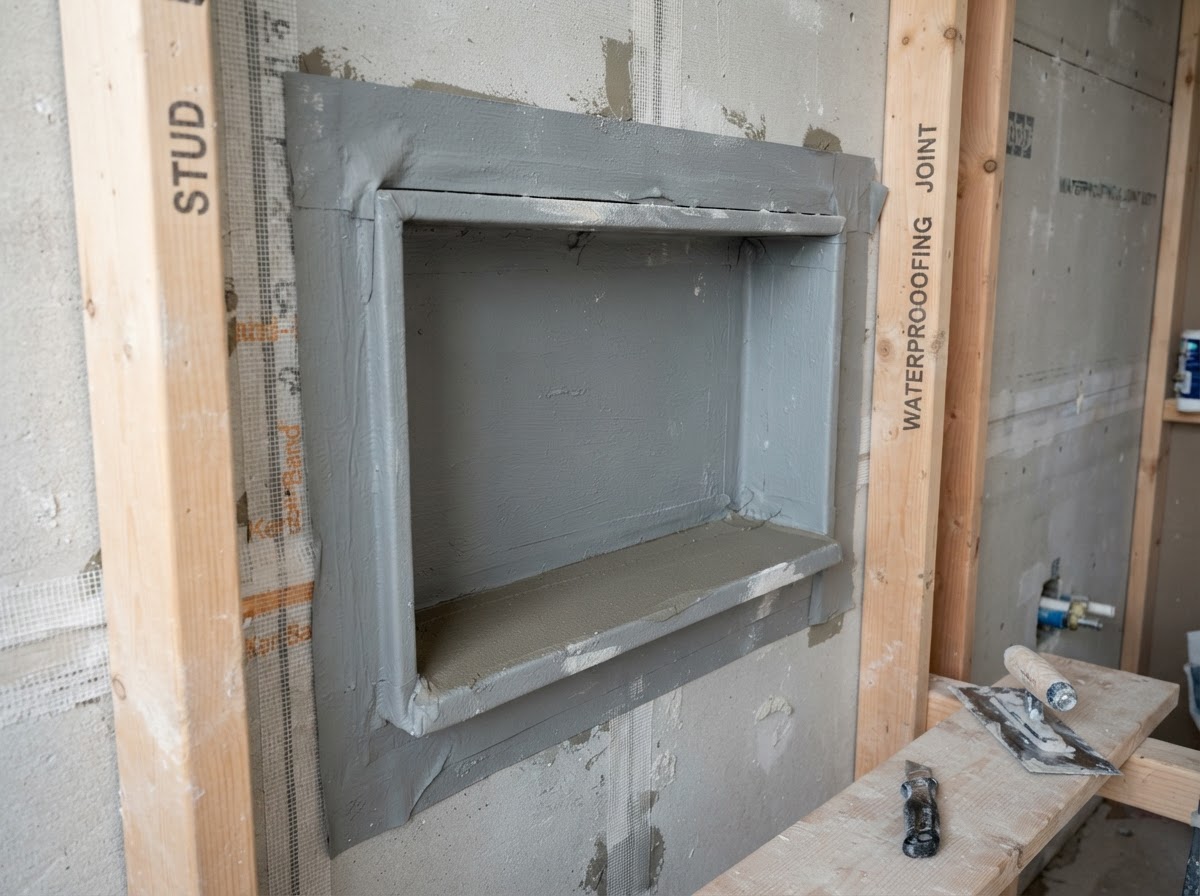
A continuous waterproofing membrane must wrap every surface of the niche—including the inside corners most prone to leaking.
Shower Niche Waterproofing Methods
The contractor should follow the installation requirements of the selected waterproofing manufacturer. The goal is to create a continuous water-management system around the entire niche.
Prefabricated vs. Custom Shower Niches
Prefabricated Shower Niche
Advantages
- Consistent dimensions
- Purpose-designed for wet areas
- Can simplify construction
- Often integrates with specific waterproofing systems
- Available in multiple sizes
Disadvantages
- –Limited dimensions
- –Less design flexibility
- –May not perfectly match unusual shower layouts
Custom Shower Niche
Advantages
- Flexible dimensions
- Custom placement
- Multiple compartments
- Unique shapes
- Better coordination with tile layouts
Disadvantages
- –More labor
- –Requires careful waterproofing
- –More opportunities for installation errors
- –Potentially higher cost
For high-end bathroom remodeling, custom niches are often chosen because they can be designed around the entire shower rather than forcing the shower to fit a manufactured size.
Horizontal vs. Vertical Shower Niche
Horizontal Shower Niche
A wide horizontal niche can work particularly well in larger showers. It can provide room for multiple products and creates a strong horizontal design element.
Best for:
Vertical Shower Niche
A vertical niche is taller and narrower. It can be useful when horizontal wall space is limited.
Best for:
Single vs. Double Shower Niches
If two people regularly use the same shower, a larger niche can provide shared storage. Alternatively, you can create separate compartments—for example, an upper section for shampoo and conditioner and a lower section for soap and smaller products, or a left compartment for one user and a right compartment for another. The choice should be based on actual storage needs rather than simply adding more compartments because they look attractive.
Shower Niche With Shelves
Multiple shelves can increase organization. Common configurations include one large opening, two horizontal shelves, three vertical compartments, asymmetrical compartments, and built-in ledges. Shelves should be designed so that water can drain rather than collect.
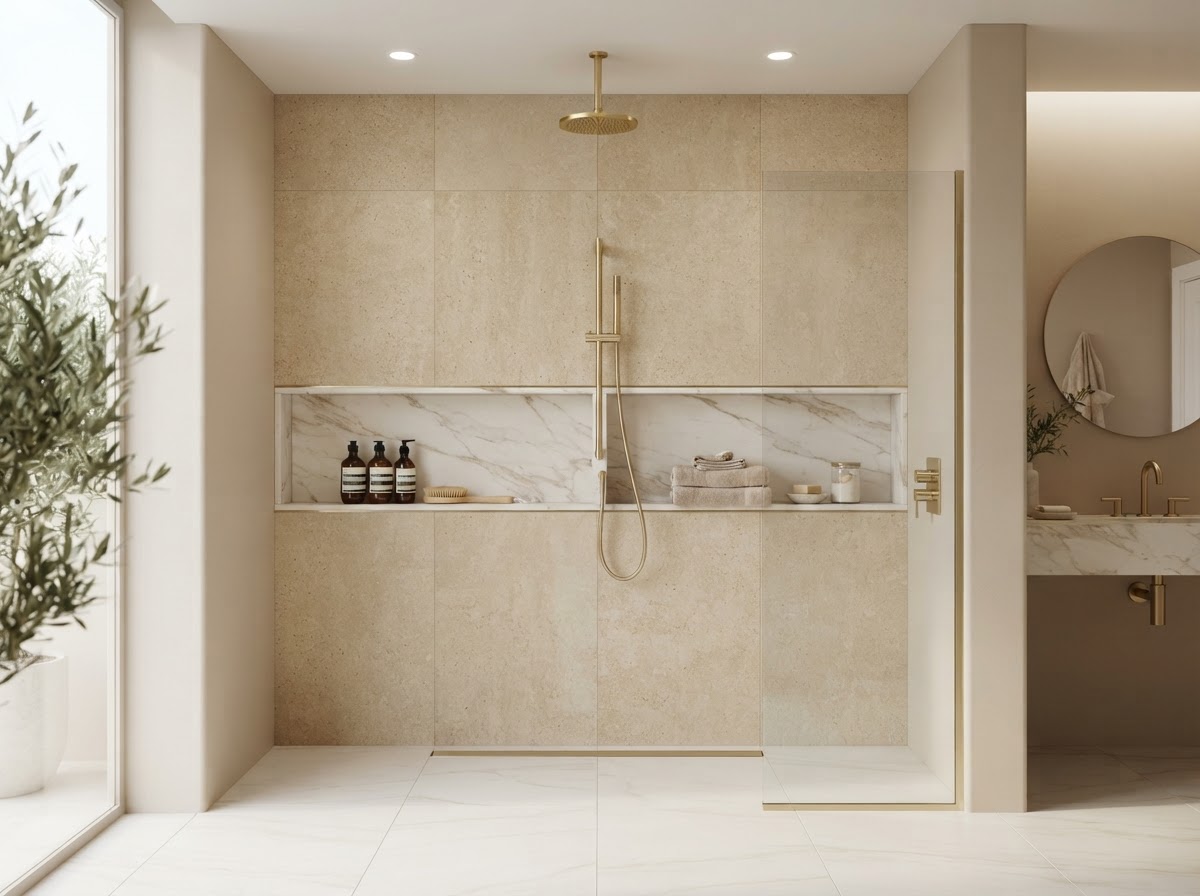
A full-width horizontal niche creates a strong architectural line and generous shared storage.
What Tile Should You Use Inside a Shower Niche?
The niche can use the same tile as the surrounding shower walls or a contrasting material. Both approaches can work.
Matching Tile
Using the same tile creates a seamless appearance. This works particularly well with minimalist bathrooms, large-format porcelain, contemporary designs, and neutral color palettes. The niche blends into the wall.
Contrasting Tile
A contrasting tile turns the niche into an accent feature. Examples include mosaic, marble-look porcelain, patterned tile, glass mosaic, decorative ceramic, and natural stone. This can add visual interest without changing the entire shower.
Using Mosaic Tile in a Shower Niche
Mosaic is popular because the smaller pieces can fit easily within the niche and provide a decorative accent. However, more grout joints mean more grout maintenance. Use a grout and maintenance system appropriate for the selected tile and shower environment.
Large-Format Tile Inside a Niche
Large-format tile can create a cleaner look with fewer grout lines. However, cutting and fitting large-format material inside a niche requires careful planning. The tile layout should ideally be determined before construction.
Natural Stone Shower Niches
Natural stone can create a luxury appearance. Popular options may include marble, travertine, quartzite, and granite. But natural stone can require more maintenance than porcelain or ceramic. Some stones are sensitive to certain cleaners and may require sealing depending on the material.
Can You Use Quartz in a Shower Niche?
Quartz slabs or other engineered surfaces can sometimes be used as niche shelves or surrounds depending on the product and application. This can minimize grout lines and create a high-end appearance. The material should be appropriate for the intended wet-area application and installed according to manufacturer requirements.
Shower Niche Design Ideas
1. Minimalist White Niche
White wall tile with a simple white niche creates a clean, timeless look.
2. Dark Accent Niche
A dark niche against light wall tile creates contrast.
3. Marble-Look Niche
A marble-look porcelain niche adds luxury without necessarily requiring natural marble.
4. Mosaic Accent
A mosaic niche can create a decorative focal point.
5. Matching Stone Shelf
A stone shelf can provide a refined transition between the niche and surrounding tile.
6. Full-Width Niche
A long horizontal niche can create a striking modern design.
7. Double Niche
Two separate compartments can provide organized storage for couples.
8. Vertical Niche
A tall niche can take advantage of narrow wall space.
Should a Shower Niche Have a Door?
Usually, shower niches are open. However, a homeowner could choose an enclosed storage cabinet in some bathroom designs. Open niches are generally more convenient because products can be accessed immediately. The downside is that they are constantly exposed to water and humidity, which makes waterproofing and proper drainage particularly important.
Should You Put the Niche Under the Showerhead?
Generally, this isn't the most convenient location. Products stored under a showerhead can receive constant water exposure. That can increase product waste, create soap buildup, increase cleaning, and make bottles slippery. A location outside the primary shower stream may be preferable.
Shower Niche Placement Near the Shower Valve
The shower valve location should also be considered. You don't want the niche to interfere with valve plumbing, mixing valves, thermostatic valves, shower controls, or access requirements. Your contractor should coordinate these elements during framing.
Shower Niche and Shower Bench Placement
If your shower includes a bench, niche placement should be coordinated with it. For example, a bench below with a niche above can create an efficient storage arrangement. But the niche should remain easy to reach from the shower's usable standing area. Don't position the niche so that users must lean awkwardly across the bench to reach their products.
Shower Niche for Accessibility & Grab Bars
For homeowners planning an accessible bathroom, storage placement becomes especially important. A niche should be reachable without unnecessary bending, stretching, or twisting. Consider user height, mobility, a shower seat, grab bars, entry configuration, controls, and a handheld shower. Accessibility should be considered during the initial design rather than added as an afterthought.
If grab bars may be needed, plan their locations before framing and waterproofing. Don't place a niche where it prevents proper installation of required reinforcement, and don't assume a niche wall can support a grab bar without appropriate structural backing.
Can a Shower Niche Be Added to an Existing Shower?
Sometimes. However, adding a recessed niche to an existing finished shower can be significantly more complicated than installing one during a complete bathroom remodel. The existing shower may already have tile, backer board, waterproofing, plumbing, and framing. Cutting into the wall requires rebuilding and reconnecting the waterproofing system. For this reason, adding a niche is often easiest when the shower is already being opened during a remodel.
How Much Does a Shower Niche Cost?
There is no universal price. The total cost depends on:
Why Shower Niche Costs Vary So Much
Two contractors may quote different prices for what appears to be the same niche. That doesn't necessarily mean one is overcharging. One quote may include only a prefabricated niche; another may include custom framing, waterproofing, specialty tile, stone shelves, additional labor, detailed tile layout, and premium finishing. Always compare the scope of work, not just the number. When comparing estimates, ask whether the quoted price includes framing, waterproofing, tile, shelves, trim, labor, and materials.
Common Shower Niche Mistakes
Mistake #1: Choosing the Location Too Late
Waiting until after the walls are framed creates unnecessary limitations. Plan the niche during the initial shower design.
Mistake #2: Ignoring Plumbing
A beautiful niche isn't useful if it conflicts with plumbing. Inspect the wall cavity before committing to the location.
Mistake #3: Making the Niche Too Small
Designing based on today's products, then discovering larger bottles don't fit. Measure your actual products.
Mistake #4: Making It Too Deep
An excessively deep niche can make products difficult to reach. Design around practical storage requirements.
Mistake #5: Forgetting the Finished Dimensions
Tile, backer, waterproofing, and mortar reduce the finished dimensions. Confirm the finished interior dimensions, not just framing dimensions.
Mistake #6: No Shelf Slope
A flat shelf can hold standing water. Slope horizontal surfaces appropriately toward the shower area.
Mistake #7: Treating Tile as Waterproofing
One of the most serious mistakes. Integrate the niche into the shower's complete waterproofing system.
Mistake #8: Ignoring the Tile Layout
A niche placed randomly can interrupt the tile pattern. Design the niche and tile layout together.
Mistake #9: Placing It Too Close to the Shower Stream
Products can constantly be sprayed. Choose a practical location with reasonable exposure.
How to Plan a Shower Niche Step by Step
Determine what you need to store — list the products used by everyone in the household.
Measure the products — the tallest and widest bottles.
Choose the wall — plumbing, framing, showerhead, controls, door, bench, exterior walls.
Select the niche configuration — horizontal, vertical, single, double, or multi-level.
Coordinate with tile — determine where tile joints and cuts will occur.
Coordinate waterproofing — choose the appropriate waterproofing method.
Confirm finished dimensions — don't rely only on rough framing dimensions.
Build the niche — the contractor should construct it according to the selected system.
Waterproof it — the niche should become part of the continuous shower waterproofing system.
Install tile — according to the selected materials and system.
Install shelves — shelves should be properly supported, sloped, and finished.
How a Shower Niche Should Work With the Tile Layout
A high-quality bathroom remodel considers the tile layout before construction. For example, if your wall uses large-format tile, the niche can be positioned so the tile cuts are balanced around it, reducing awkward slivers and creating a more intentional appearance. With decorative tile, the niche can also become the focal point. The goal is not simply "put a niche somewhere on this wall" but to design the niche as part of the entire wall composition.
Shower Niche Design for Small Bathrooms
Small bathrooms often benefit significantly from recessed storage. A niche can provide storage without consuming floor space. For a compact shower, consider a narrow vertical niche, a small horizontal niche, corner storage, a built-in shelf, or a recessed niche above a bench. Avoid oversized niches that consume unnecessary wall space.
Shower Niche Design for Large Bathrooms
Large primary bathrooms provide more opportunities. A large shower may accommodate a full-width niche, multiple niches, long shelves, double-compartment storage, accent lighting, an integrated bench, and a handheld shower. However, more features aren't automatically better—the design should remain proportional to the shower.
Can You Put Lighting Inside a Shower Niche?
Some high-end bathroom designs incorporate lighting into niches, which can create an attractive architectural effect. However, electrical installations in wet locations are highly regulated and must use appropriately rated equipment and installation methods. Any niche lighting should be designed and installed by qualified professionals in accordance with applicable electrical and building requirements. Don't treat niche lighting as a simple DIY LED-strip project.
Shower Niche vs. Corner Shelf vs. Caddy
| Feature | Shower Niche | Corner Shelf | Freestanding Caddy |
|---|---|---|---|
| Storage | Excellent | Good | Good |
| Uses wall cavity | Yes | Usually no | No |
| Design flexibility | High | Medium | Low |
| Waterproofing complexity | Higher | Lower | None |
| Space efficiency | Excellent | Good | Low |
| Custom appearance | High | Medium | Low |
| Retrofit difficulty | Higher | Lower | None |
A corner shelf or caddy may be better for an existing finished shower. A recessed niche may be preferable during a complete remodel, where it provides a permanent, integrated storage solution.
Is a Shower Niche Worth It?
For many homeowners, yes. A niche can improve organization, appearance, convenience, storage, and resale appeal. But the value depends on proper design and installation. A poorly waterproofed niche is not worth the risk.
What Should You Ask Your Remodeling Contractor?
Where do you recommend placing the niche?
What is behind this wall?
What will the finished niche dimensions be?
How deep will the niche be?
How will the niche be waterproofed?
Will the bottom shelf be sloped?
How will the niche coordinate with my tile layout?
Can we use a prefabricated niche or should it be custom?
Where will the plumbing run?
Will the niche interfere with any electrical or structural components?
Can we add a bench or grab bars later?
Is the niche included in the remodeling estimate?
Are the shelves included?
What material do you recommend for the shelves?
What happens if framing or plumbing prevents the planned niche location?
Shower Niche Trends for 2026
Larger Horizontal Niches
Long horizontal niches provide generous storage while creating a strong architectural line.
Minimalist Trim
Modern showers increasingly favor clean transitions with minimal decorative trim.
Large-Format Porcelain
Large-format tile can create fewer visual interruptions.
Stone-Look Accents
Stone-look porcelain provides a luxury appearance with potentially easier maintenance than some natural stones.
Integrated Shelving
Instead of separate shelves, some designs use continuous stone or solid-surface ledges.
Curbless Showers
Recessed niches pair naturally with contemporary curbless shower designs.
Neutral Color Palettes
Warm whites, beige, gray, taupe, and natural stone-inspired finishes remain popular for timeless bathrooms.
Designing a Shower Niche for Long-Term Use
A bathroom remodel should not only look good on completion day. Think about how the bathroom will work five, ten, or more years from now. Will the homeowners age in the home? Will accessibility become important? Will product sizes change? Will children use the shower? Will two people use the shower? Will maintenance be easy? A good niche design solves today's storage problem without creating tomorrow's maintenance problem.
Shower Niche Planning Checklist
Final Thoughts
A shower niche may be a small part of a bathroom remodel, but it can have a surprisingly large impact on the finished shower. The best niches are not simply decorative boxes cut into the wall—they are carefully integrated into the entire shower system. The ideal design considers storage, height, depth, plumbing, framing, tile, drainage, waterproofing, accessibility, and long-term maintenance.
For homeowners in Orange County and Los Angeles, the right niche will depend on the existing structure, shower configuration, remodeling goals, and materials selected. If you're already planning to replace your shower—whether a tub-to-shower conversion or a curbless shower remodel—this is the ideal time to design the niche. Don't wait until the tile installer arrives. Plan it during the design and framing stage. A beautiful shower niche starts with what happens behind the tile.
Shower Niche FAQ
What is the best size for a shower niche?+
There is no universal best size. The ideal dimensions depend on the shower size, wall construction, products being stored, user height, and overall design.
How high should a shower niche be?+
The niche should be positioned for comfortable access based on the users of the bathroom. Shower controls, benches, plumbing, and accessibility requirements should also be considered.
How deep should a shower niche be?+
The depth should accommodate the products being stored without unnecessarily penetrating the wall cavity. Finished dimensions should be confirmed after accounting for the shower-wall construction and tile.
Does a shower niche need to be waterproofed?+
Yes. A recessed niche is part of the shower wet area and should be properly integrated into the shower's waterproofing system.
Can you install a shower niche on an exterior wall?+
It may be possible, but exterior-wall construction, insulation, structural framing, and building-envelope considerations need to be evaluated first.
Can a shower niche go on a plumbing wall?+
Sometimes, but the wall cavity must be inspected to determine whether plumbing or other components interfere with the proposed niche.
Should the bottom of a shower niche be sloped?+
Horizontal surfaces in a shower niche should be designed to prevent standing water and direct water toward the shower area according to the selected construction system.
What is better: a horizontal or vertical shower niche?+
It depends on the shower layout. Horizontal niches provide more side-to-side storage, while vertical niches can work well where wall width is limited.
Are shower niches expensive?+
The cost varies based on size, construction method, waterproofing, tile, shelves, labor, and whether the niche is prefabricated or custom.
Can you add a shower niche to an existing shower?+
It may be possible, but cutting into a finished shower requires careful reconstruction of the waterproofing system. It is usually easier during a full shower remodel.
Can you tile a shower niche?+
Yes. Shower niches are commonly finished with tile, provided the underlying construction and waterproofing are appropriate for a tiled wet area.
What tile is best for a shower niche?+
Porcelain and ceramic are popular options. Mosaic, large-format tile, natural stone, and other materials can also work when appropriate for the shower environment.
Can a shower niche leak?+
Yes. Poor waterproofing, improper transitions, damaged materials, or installation errors can allow water to reach the wall assembly.
Is a shower niche better than a shower caddy?+
A built-in niche provides a permanent, integrated storage solution, while a caddy is cheaper and easier to add to an existing shower. The best choice depends on the remodel and the homeowner's priorities.
Should a shower niche be placed directly under the showerhead?+
Usually, a location outside the primary water stream is more convenient because it reduces constant water exposure to stored products.
Can a shower niche have multiple shelves?+
Yes. Multiple shelves can divide the niche into separate storage areas, provided the shelves are properly supported, waterproofed, and designed to drain.