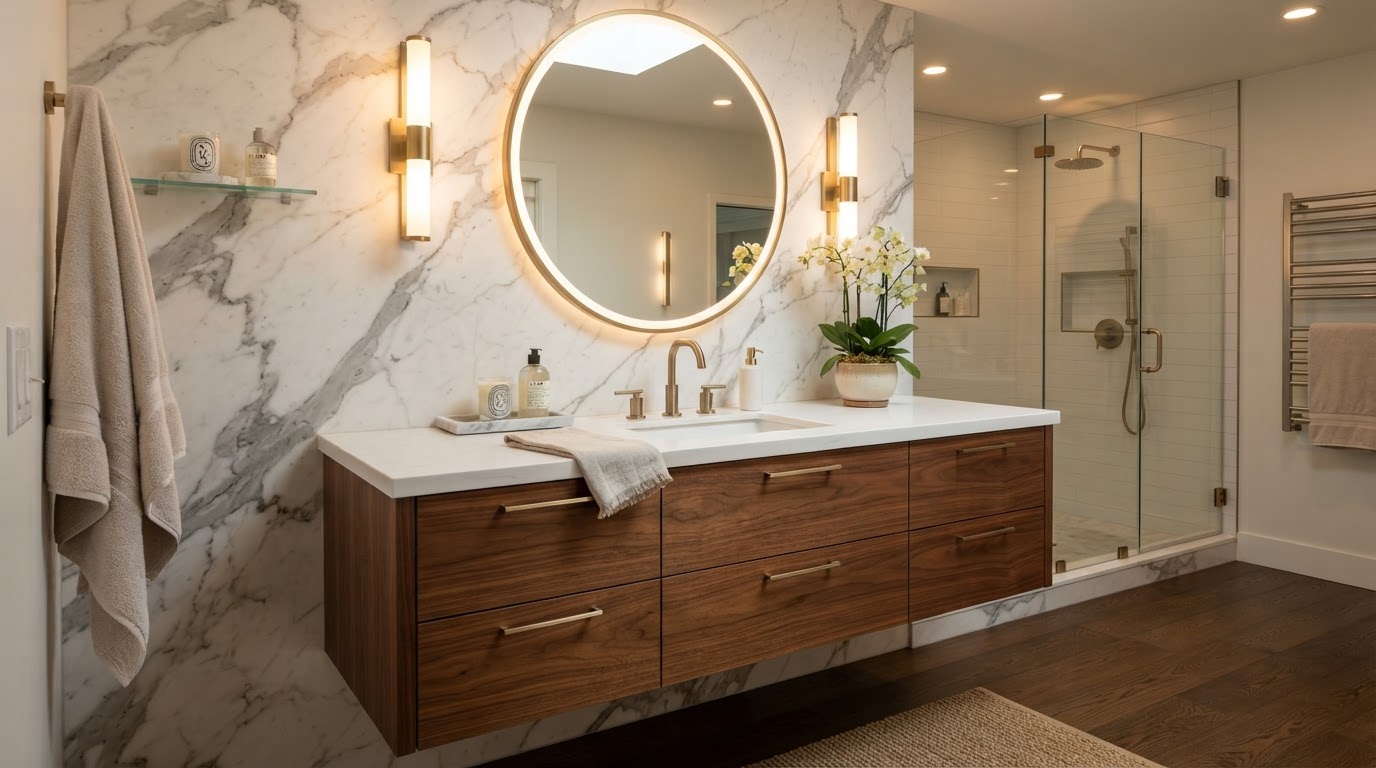
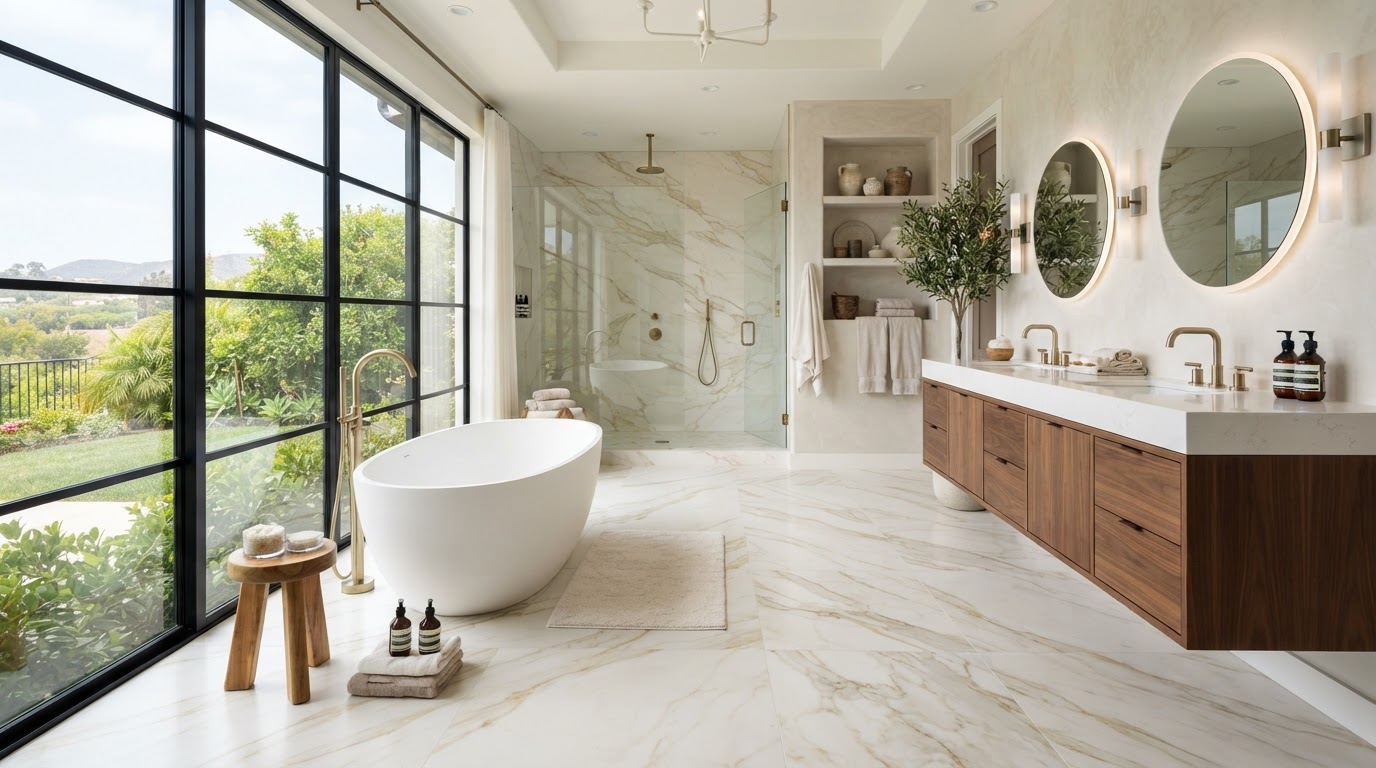
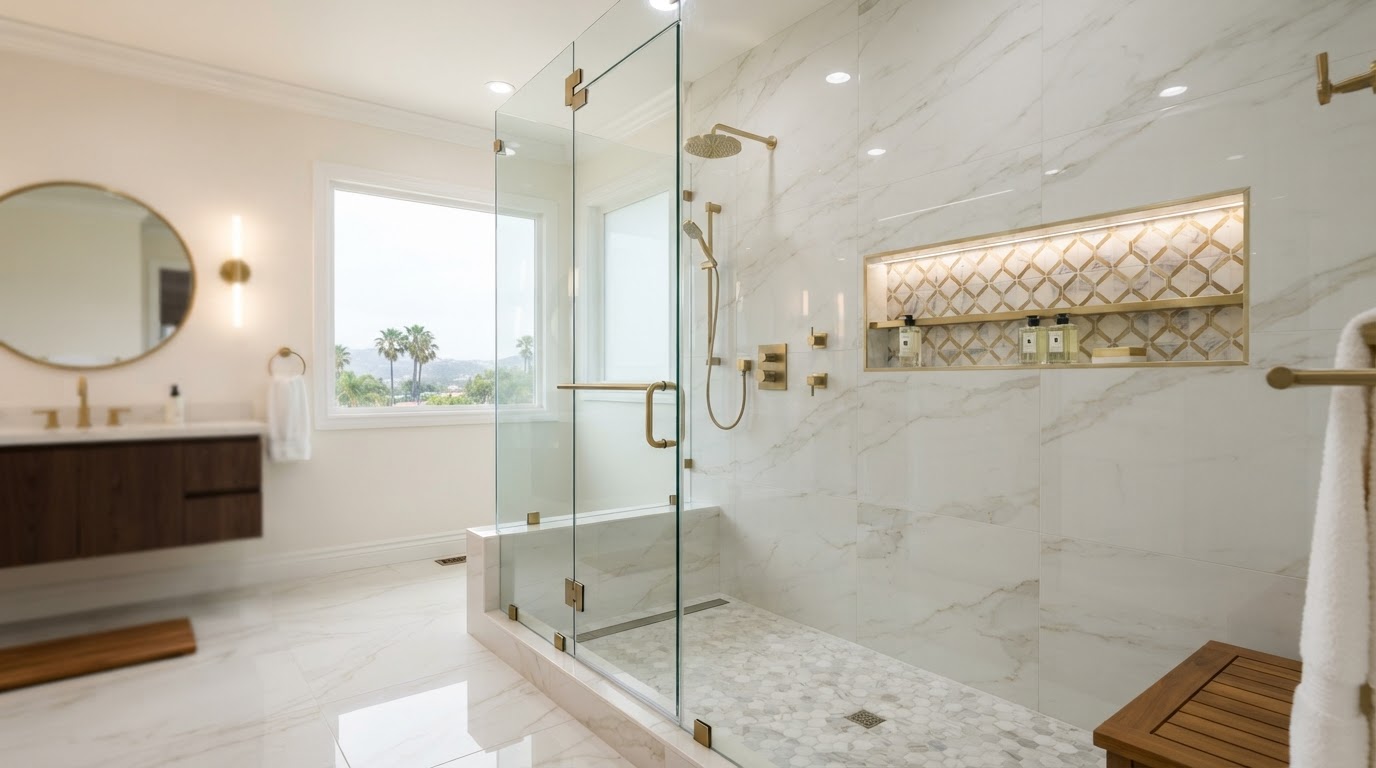
Choosing a bathroom countertop may seem like a small decision compared with selecting a shower, bathtub, flooring, or vanity. But the countertop is one of the most visible surfaces in the bathroom—and one of the surfaces you interact with every day.
It gets exposed to water, toothpaste, soap, cosmetics, skincare products, hair products, cleaning products and everyday wear. In a primary bathroom, that countertop may be used several times a day by multiple people.
So the right countertop needs to do more than look good. It needs to complement your vanity, handle moisture, fit your lifestyle, coordinate with the rest of the bathroom and provide the level of maintenance you're comfortable with.
For homeowners planning a bathroom remodel in Orange County or Los Angeles, three materials frequently make the shortlist: quartz, granite and porcelain. Marble, quartzite, solid surface, laminate and concrete are also viable options, depending on the project.
But which bathroom countertop material is actually best? The answer depends on what you value most. Quartz is often an excellent all-around choice for homeowners who want a polished appearance and relatively low maintenance. Granite is attractive to homeowners who want genuine natural stone and unique slab variation. Porcelain is a strong option for homeowners prioritizing low water absorption, heat resistance, scratch resistance and contemporary design.
There is no universal winner. The best bathroom countertop is the one that balances appearance, durability, maintenance, budget and the way you actually use your bathroom. This guide explains the differences so you can make a more informed decision before ordering your countertop or starting your bathroom renovation.
Quick Answer: What Is the Best Bathroom Countertop Material?
If you want the short version, here's how the most common bathroom countertop materials compare across the factors that matter most.
| Material | Best For | Maintenance | Durability | Appearance |
|---|---|---|---|---|
| Quartz | Low-maintenance everyday bathrooms | Low | Excellent | Consistent and versatile |
| Granite | Natural stone and unique patterns | Moderate | Excellent | Natural and distinctive |
| Porcelain | High-performance modern bathrooms | Low | Excellent | Modern, stone-inspired |
| Marble | Luxury and classic elegance | Higher | Good | Premium and natural |
| Quartzite | Natural stone with high durability | Moderate | Excellent | Luxurious and unique |
| Solid Surface | Seamless, practical designs | Low | Good | Clean and contemporary |
| Laminate | Budget-conscious projects | Low | Moderate | Highly varied |
| Concrete | Custom contemporary bathrooms | Moderate | Good | Architectural and unique |
Choose Quartz
If you want easy maintenance and design flexibility.
Choose Granite
If you want natural stone and don't mind some maintenance.
Choose Porcelain
If you want a highly resistant surface and a modern architectural appearance.
Choose Marble
If luxury aesthetics are more important to you than maintenance.
Choose Quartzite
If you want natural stone with strong performance and distinctive veining.
Choose Solid Surface
If you want a seamless, practical, repairable surface.
What Is a Bathroom Countertop?
A bathroom countertop is the horizontal surface installed over or as part of a bathroom vanity. It typically accommodates one or more sinks and may include faucet openings, sink cutouts, backsplash, side splashes, finished edges, integrated sinks, undermount sinks, vessel sinks, and storage below.
The countertop connects several design elements together. It sits directly above the vanity but also visually interacts with the shower, bathtub, flooring, wall tile, mirrors, lighting, faucets, hardware, paint, and cabinetry. That's why countertop selection should happen as part of the overall bathroom design rather than as an isolated material purchase.
Venguard Construction approaches bathroom remodeling as a coordinated design-build process involving planning, material selection, construction and project management rather than treating individual finishes as disconnected decisions.
What Makes a Good Bathroom Countertop?
Bathrooms create a different environment from kitchens. You aren't usually cutting food or placing hot cookware on the countertop. Instead, the major concerns are water, humidity, cosmetics, cleaning products, staining, scratching, daily use, hair-styling tools, and moisture around sink areas. A good bathroom countertop should offer a combination of:
Moisture resistance
The material should perform well around water and humidity.
Stain resistance
It should resist common bathroom products such as makeup, toothpaste and lotions.
Easy cleaning
You shouldn't need an elaborate maintenance routine every time you clean the vanity.
Durability
The countertop should tolerate normal daily use.
Design compatibility
The material should work with your vanity, tile, fixtures and overall design.
Appropriate cost
A countertop should fit within the overall remodeling budget rather than consuming money better spent on structural or functional improvements.
Professional fabrication
Even an excellent material can produce a poor result if the countertop is measured, cut or installed incorrectly.
Quartz Bathroom Countertops
Quartz is one of the most popular bathroom countertop choices for homeowners who want a combination of appearance, durability and relatively simple maintenance. Engineered quartz is manufactured using quartz mineral content combined with binders and pigments. Because it is manufactured rather than quarried as a finished slab of natural stone, manufacturers can create highly controlled colors and patterns.
You can find quartz that resembles white marble, Calacatta marble, Carrara marble, concrete, limestone, soapstone, granite, solid white, gray stone, warm beige, and dramatic veining. This makes quartz suitable for modern, transitional, traditional and luxury bathrooms.
Advantages of Quartz
- Low routine maintenance — generally does not require sealing
- Excellent stain resistance from its low-porosity surface
- Consistent, predictable color and patterning
- Large design selection of colors, patterns and finishes
- Easy everyday cleaning with mild cleaning products
Disadvantages of Quartz
- Heat sensitivity — don't place hot styling tools directly on the surface
- Can chip or crack from severe impact, especially at edges and sink cutouts
- Professional fabrication and installation are important
- Not a natural stone product
Is quartz good for a bathroom? For many homeowners, yes. If your priorities are low maintenance, consistent appearance, easy cleaning, modern design, and good everyday durability, then quartz is an excellent material to investigate.
Granite Bathroom Countertops
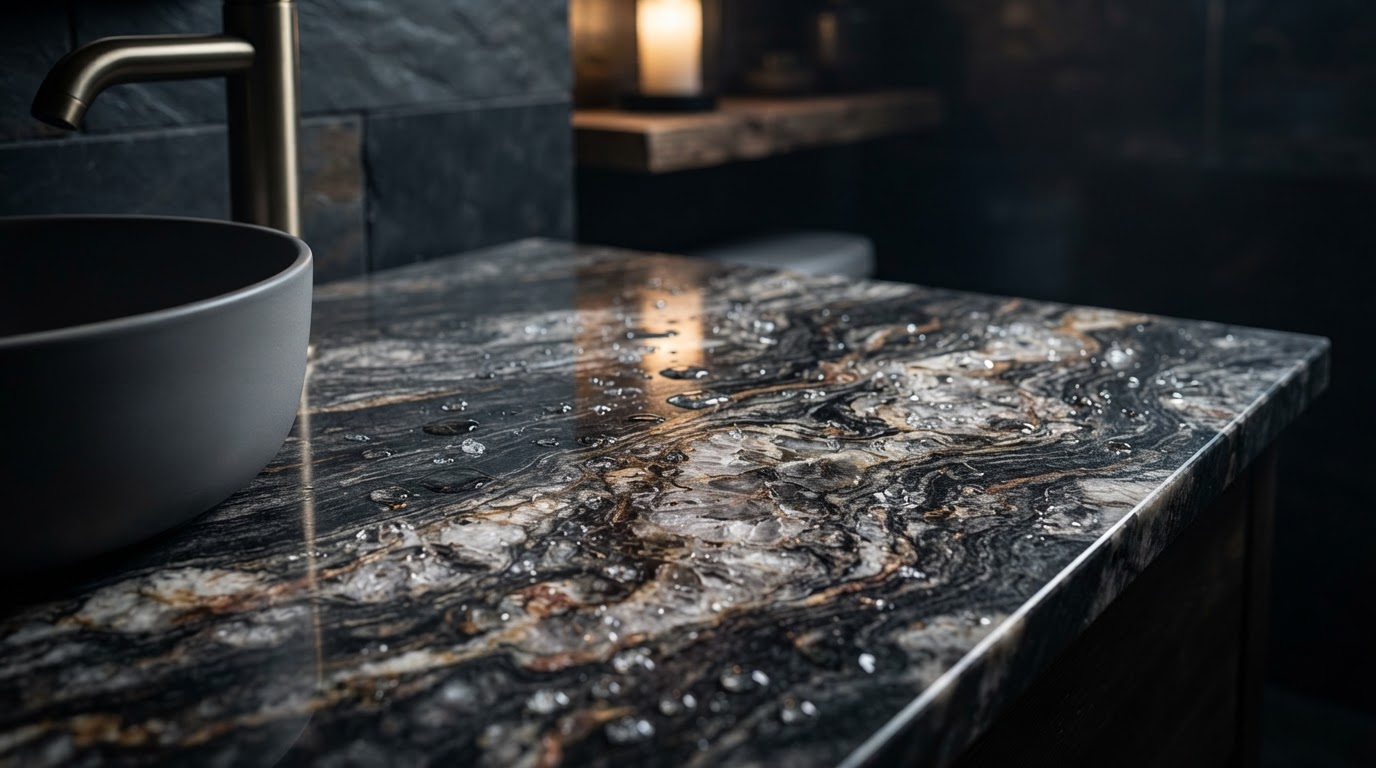
Granite is a natural stone that has been used in residential construction for decades. Unlike engineered quartz, every granite slab is naturally formed. That means no two slabs will necessarily have exactly the same mineral pattern, color variation or veining. For many homeowners, that's the point. Granite provides something manufactured surfaces cannot completely replicate: natural variation. A granite vanity can become a design feature rather than simply a functional surface.
Advantages of Granite
- Natural stone character — every slab has its own geological characteristics
- Strong durability suitable for everyday bathroom use
- Excellent heat resistance, useful around styling tools
- Unique appearance from mineral movement and natural variation
- Long service life when properly selected, fabricated and maintained
Disadvantages of Granite
- Maintenance can be higher — some surfaces require periodic sealing
- Natural variation can make selection more complicated
- Heavy material — the vanity and structure must support it
- More upkeep than quartz or porcelain
Porcelain Bathroom Countertops
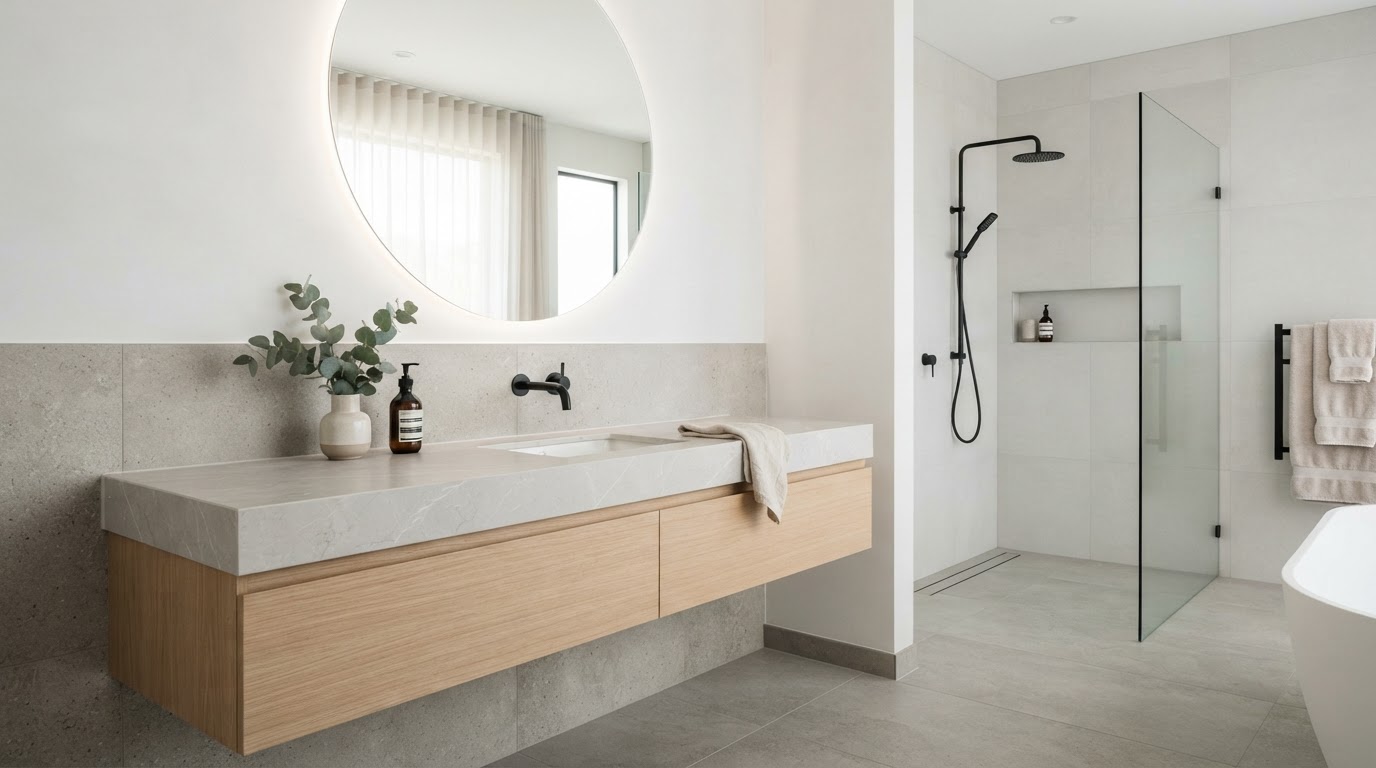
Porcelain is increasingly being used in contemporary residential design. Porcelain slabs are produced from refined clay and mineral materials and fired at very high temperatures. The resulting surface is dense and has very low water absorption, which makes porcelain particularly interesting for bathrooms. It can also reproduce the appearance of natural stone, making it possible to achieve a marble-inspired aesthetic without using actual marble.
Advantages of Porcelain
- Very low water absorption — highly resistant to moisture
- Excellent stain resistance from its dense surface
- High scratch resistance
- Strong heat resistance
- Contemporary, architectural appearance in large-format slabs
- Natural-stone aesthetics replicating marble, granite and more
Disadvantages of Porcelain
- Can be vulnerable to chipping or cracking at edges and cutouts if improperly fabricated
- Requires a skilled fabricator — handling and installation matter significantly
- An excellent product can still fail with poor installation
Quartz vs. Granite vs. Porcelain
| Feature | Quartz | Granite | Porcelain |
|---|---|---|---|
| Material type | Engineered stone | Natural stone | Kiln-fired ceramic |
| Moisture resistance | Excellent | Very good | Excellent |
| Stain resistance | Excellent | Very good with care | Excellent |
| Scratch resistance | Excellent | Excellent | Excellent |
| Heat resistance | Good; protect from high heat | Excellent | Excellent |
| Routine sealing | Generally not required | May be required | Generally not required |
| Maintenance | Low | Moderate | Low |
| Pattern consistency | High | Natural variation | High |
| Natural material | No | Yes | No |
| Edge/chip considerations | Moderate | Moderate | Important |
| Best use | Low-maintenance bathroom | Natural-stone bathroom | High-performance contemporary |
Quartz
Easiest all-around option.
Granite
Natural-stone option.
Porcelain
High-performance modern option.
Quartz vs. Granite vs. Porcelain: Head-to-Head
Quartz vs. Granite
Bathrooms change the equation. Kitchen countertops frequently need excellent heat resistance because of cooking; bathroom countertops generally don't. That means one of granite's biggest advantages is less important in a bathroom, while quartz's low-maintenance characteristics become more valuable.
Choose quartz for minimal maintenance and predictable colors. Choose granite for genuine natural stone and unique slabs.
Quartz vs. Porcelain
Quartz is familiar, widely available and offers an enormous range of designs. Porcelain can provide extremely low water absorption, excellent heat resistance and strong scratch resistance. The biggest consideration with porcelain is fabrication — large-format slabs require appropriate cutting, handling and installation.
Choose quartz for a traditional experience with huge selection. Choose porcelain for sleek, contemporary resistance and very large-format designs.
Other Bathroom Countertop Materials
Quartzite
Not to be confused with quartz — quartzite is natural stone formed from sandstone under heat and pressure. It offers beautiful natural veining with strong durability, and some varieties resemble high-end marble. May require sealing and ongoing care depending on the stone.
Marble
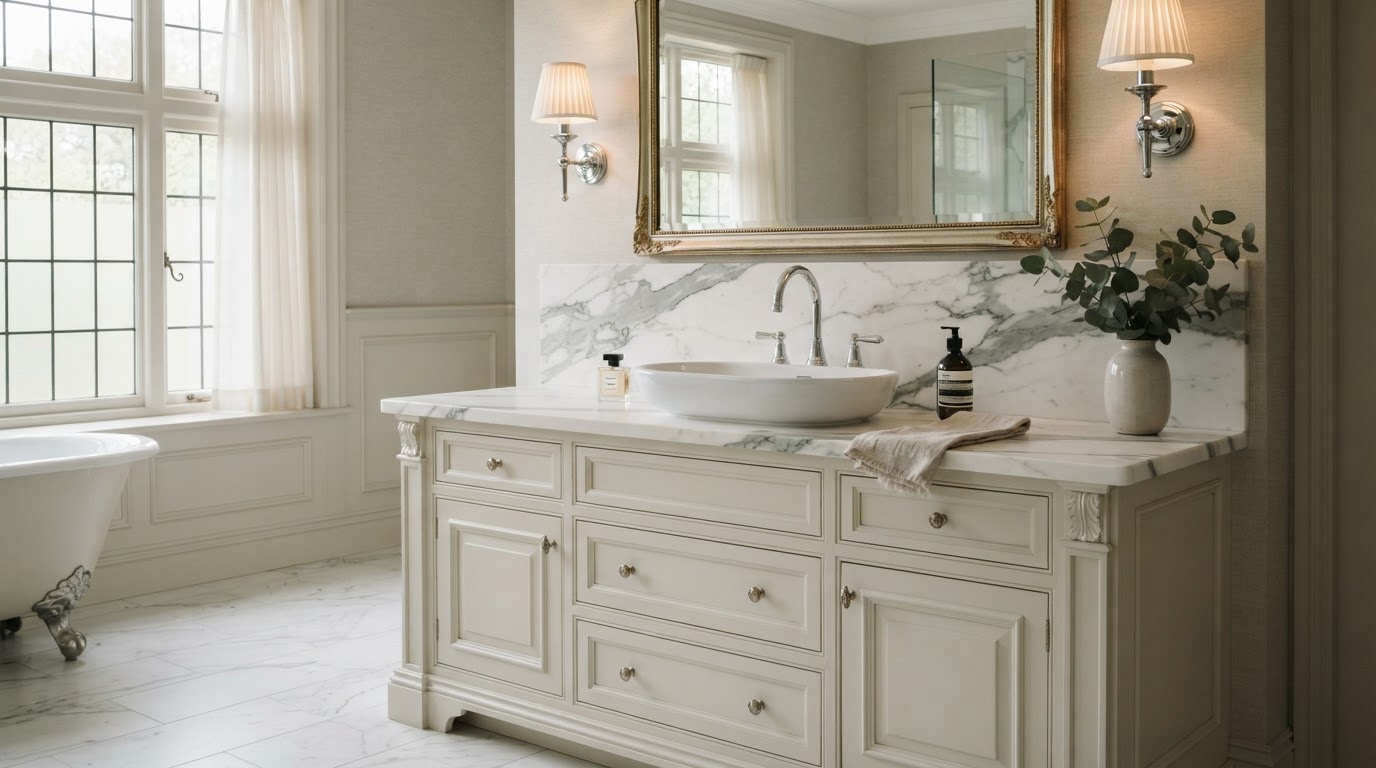
One of the most recognizable luxury materials, with veining and natural character. Not maintenance-free — more susceptible to scratching, staining, etching, and chemical damage. Sealing helps but doesn't make marble immune. Choose it for luxury aesthetics you're willing to maintain.
Solid Surface
A manufactured material that creates a clean, seamless appearance and can be shaped into integrated sink configurations. Some damage can be repaired or refinished. Practical for contemporary, guest, family, and accessible bathrooms where seamless design matters.
Laminate
One of the more affordable materials. Modern products can mimic marble, granite, concrete, wood, and solid colors. Makes sense for a powder room, rental property, or budget-focused renovation. Installation quality is critical around sink areas and exposed edges.
Concrete
Creates a completely different aesthetic for industrial, contemporary, and minimalist bathrooms. Can be pigmented, polished, textured, and customized. Requires more maintenance than quartz or porcelain depending on the finish and sealer, and develops natural variations over time.
Bathroom Countertop Cost in 2026
The cost of a bathroom countertop depends on much more than the material itself. Current 2026 Los Angeles remodeling data illustrates how widely bathroom costs can vary. Angi reports that replacing a bathroom vanity countertop in Los Angeles can average roughly $700–$6,300, including materials and labor, while removal, installation and plumbing adjustments can affect the final cost. National bathroom remodeling data similarly shows that countertop costs can vary substantially depending on whether you're replacing a basic stock surface or installing a custom countertop.
These figures should be treated as planning benchmarks rather than quotes. Your actual countertop investment can change significantly based on:
What You're Actually Paying For
Why cost per square foot can be misleading: A small vanity might need one countertop, one sink cutout, three faucet holes, a simple edge, and minimal installation. Another vanity may require double sinks, multiple cutouts, a custom edge, backsplash, side splashes, wall scribing, custom fabrication, and plumbing modifications. The countertop area may be similar — the project cost may not. A professional estimate should evaluate the complete installation.
Durability & Maintenance
Most Durable Bathroom Countertop
- Quartz: Excellent everyday durability with low maintenance.
- Granite: Excellent durability with natural-stone character.
- Porcelain: Excellent surface resistance; fabrication and edge handling require care.
- Quartzite: Excellent natural-stone durability; maintenance depends on the stone.
- Marble: Durable enough for bathrooms but more vulnerable to scratching and etching.
Least Maintenance
For homeowners who want minimal maintenance, quartz and porcelain are generally among the strongest choices. Both are typically easy to clean and don't generally require routine sealing. Granite and quartzite can also be relatively easy to maintain, but some varieties require sealing. Marble requires more care.
Natural stone should always be evaluated individually because performance can vary significantly between specific stones and finishes.
How Do You Clean Bathroom Countertops?
Your cleaning routine should always follow the countertop manufacturer's recommendations. As a general rule, avoid treating every countertop like the same material. One of the biggest mistakes is assuming that a product that works perfectly on one countertop automatically works on another.
Bathroom Countertop and Vanity: Design Them Together
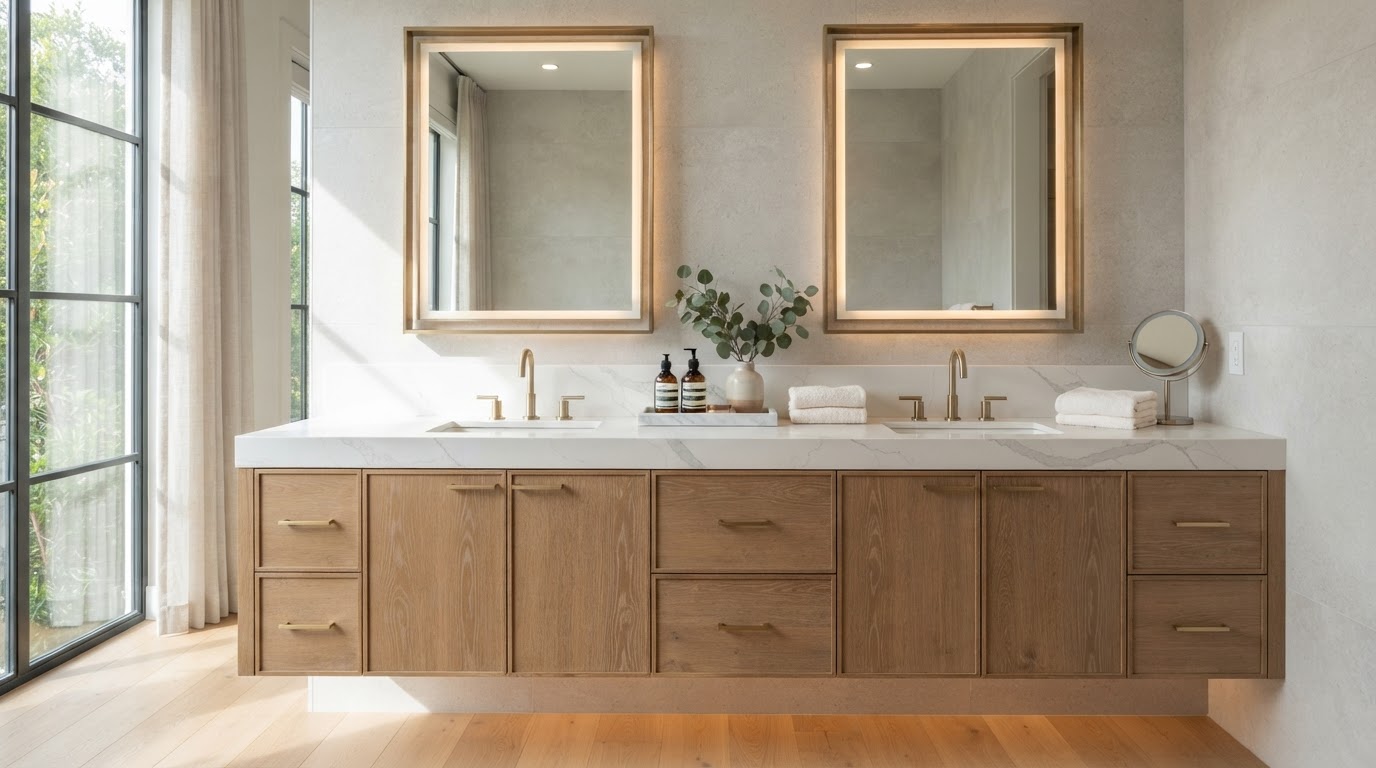
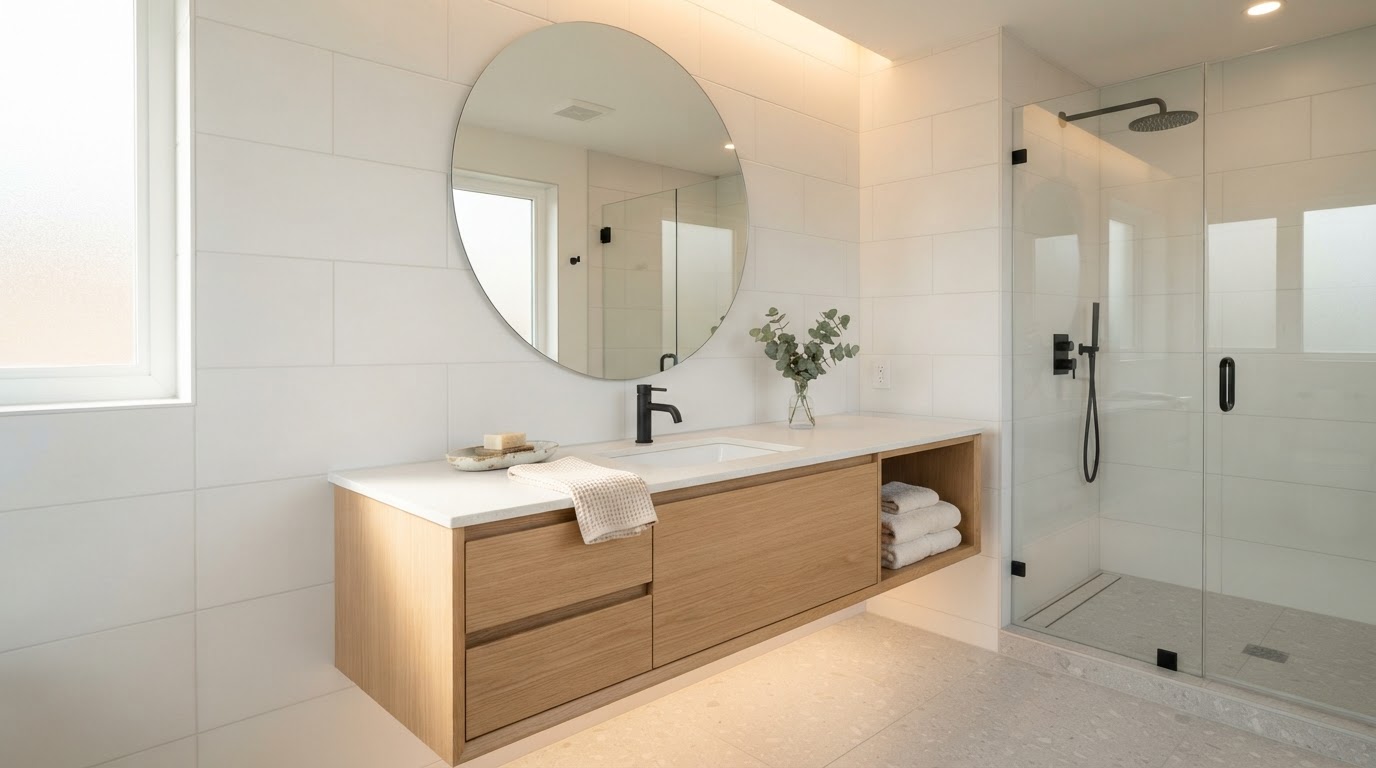
The countertop and vanity should almost always be considered together. A countertop can dramatically change how a vanity looks. The objective isn't necessarily to match every material — the objective is to create visual harmony.
Choosing the Right Countertop for Your Bathroom
Small Bathroom
When there isn't much square footage, every surface becomes visually important. Light colors can help create a brighter environment, minimal patterns avoid overwhelming the room, and pairing a clean countertop with a floating vanity makes the floor area feel more open.
Large-format materials, an integrated sink, and a simple edge profile often work best. Countertop selection should be coordinated with vanity size, lighting, mirrors and tile.
Primary Bathroom
Primary bathrooms provide more opportunity to make the countertop a design feature. Popular combinations include a double vanity, large quartz countertop, undermount sinks, wall-mounted faucets, large mirrors, statement lighting, and custom cabinetry.
Marble-look porcelain, natural quartzite, and high-end granite can all create a spa-like environment when the bathtub is rarely used.
Edge Profiles & Sink Configurations
Countertop Edge Profiles
A simple eased or straight edge usually works well for modern bathrooms; a more decorative edge may complement traditional cabinetry.
Choosing the Right Sink
- Undermount: Installed beneath the countertop for a clean appearance and easy cleanup.
- Vessel: Sits on top — a strong visual feature, but affects vanity height and faucet selection.
- Integrated: Sink and countertop form one continuous surface — seamless and easy to clean.
- Drop-In: Sits into the countertop with a visible rim; useful for certain renovation scenarios.
Common Bathroom Countertop Mistakes
How to Choose: A Simple Decision Framework
Very little → quartz or porcelain. Some maintenance → granite or quartzite. Comfortable with higher maintenance → marble.
Yes → granite, marble or quartzite. No → quartz, porcelain or solid surface.
Modern → quartz, porcelain, solid surface. Traditional → granite, marble, quartz. Luxury → quartzite, marble, premium quartz, porcelain.
If you frequently use hot styling tools, prioritize porcelain and granite, and still use protective measures.
Want every surface unique → natural stone. Want predictable appearance → engineered quartz or porcelain.
Don't select the countertop in isolation — consider vanity, shower, tile, flooring, plumbing, lighting, glass, electrical, labor, permits and waterproofing.
What Should Be Included in a Bathroom Countertop Estimate?
10 Questions to Ask Before Ordering Your Bathroom Countertop
- 1.What material is best suited to my bathroom and lifestyle?
- 2.Does this material require sealing?
- 3.How should it be cleaned?
- 4.How resistant is it to stains?
- 5.How resistant is it to scratches?
- 6.How does it handle heat from styling tools?
- 7.What sink configurations work with it?
- 8.How will the countertop be fabricated?
- 9.What exactly is included in the installation price?
- 10.Who is responsible if the countertop doesn't fit because of measurement or existing-condition issues?
Frequently Asked Questions About Bathroom Countertops
What is the best material for a bathroom countertop?
For many homeowners, quartz is an excellent all-around choice because it combines low maintenance, strong durability and extensive design options. Porcelain is another excellent choice for moisture, heat and scratch resistance. Granite is ideal for those who prefer natural stone and unique slab variation.
Is quartz good for bathroom countertops?
Yes. Quartz is one of the most popular choices for bathroom vanities because it is durable, low maintenance and available in a wide variety of colors and patterns.
Is granite good for bathroom countertops?
Yes. Granite is durable, attractive and available in many natural patterns. Depending on the particular stone, it may require periodic sealing.
Is porcelain good for bathroom countertops?
Yes. Porcelain can provide excellent moisture, stain, scratch and heat resistance. However, fabrication and installation require appropriate experience because edges and cutouts can be vulnerable during handling.
Which is better for a bathroom: quartz or granite?
For homeowners prioritizing low maintenance, quartz is often the more convenient option. For homeowners who prioritize natural stone and unique slab variation, granite can be the better choice.
Which is better: quartz or porcelain countertops?
Both can perform very well in bathrooms. Quartz offers extensive design options and familiar fabrication, while porcelain offers very low water absorption and strong resistance to heat and scratching. The right choice depends on the design and installation requirements.
Do quartz bathroom countertops need to be sealed?
Generally, engineered quartz does not require routine sealing. Always follow the specific manufacturer's care recommendations.
Does granite need to be sealed?
Some granite surfaces benefit from periodic sealing. The exact maintenance schedule depends on the specific stone, finish and sealer.
Does porcelain need to be sealed?
Porcelain countertops generally do not require sealing, although grout and other surrounding materials may have different maintenance requirements.
Is marble a good bathroom countertop?
Marble can be an excellent choice for homeowners who prioritize luxury and natural beauty. However, it is more susceptible to scratching, staining and etching than some alternatives and therefore requires more care.
What is the easiest bathroom countertop to maintain?
Quartz and porcelain are generally among the easiest premium countertop materials to maintain.
What is the most luxurious bathroom countertop material?
There is no single answer. Marble, quartzite, premium quartz and high-end porcelain can all create luxurious results. The overall design, fabrication quality and installation often matter as much as the material itself.
How much does a bathroom countertop cost in Los Angeles?
Current 2026 Los Angeles data indicates that bathroom vanity countertop replacement can range broadly depending on materials and installation requirements, with Angi reporting approximately $700–$6,300 for replacement projects including materials and labor. A custom bathroom remodel can cost substantially more when the countertop is part of a larger renovation.
Should I choose my vanity or countertop first?
Ideally, they should be designed together. The vanity dimensions, sink configuration, countertop dimensions, plumbing and storage requirements all influence one another.
Final Recommendation: Which Bathroom Countertop Should You Choose?
Choose Quartz If You Want
- Low maintenance
- Easy cleaning
- Consistent patterns
- Modern design
- Marble-inspired appearance
- Excellent everyday performance
Choose Granite If You Want
- Natural stone
- Unique patterns
- Strong durability
- Excellent heat resistance
- Traditional or natural aesthetics
Choose Porcelain If You Want
- Very low water absorption
- Excellent heat resistance
- Strong scratch resistance
- Contemporary design
- Large-format possibilities
- Low routine maintenance
Choose Quartzite If You Want
- Natural stone
- Dramatic veining
- High durability
- Luxury aesthetics
Choose Marble If You Want
- Timeless luxury
- Natural variation
- High-end visual character
- And you're comfortable with additional maintenance
Final Thoughts
There is no countertop material that wins every category. The right decision comes down to how you use your bathroom, how much maintenance you're willing to perform, what style you want, and how the countertop fits into the larger remodeling budget.
A beautiful countertop can transform a vanity. But the best bathroom renovations don't treat the countertop as an isolated feature. The vanity, shower, tile, flooring, lighting, plumbing fixtures, ventilation, waterproofing and storage should all work together. A successful bathroom remodel begins with understanding the existing space, establishing priorities, creating a realistic budget, selecting materials intentionally and coordinating the construction process.
If you're planning a bathroom renovation in Orange County, Los Angeles or surrounding Southern California communities, the right countertop can be an important part of the finished space—but it should be selected as part of the complete design.
Bathroom Countertop Buying Checklist
Design
- • Vanity dimensions confirmed
- • Countertop material selected
- • Color and pattern approved
- • Actual slab reviewed where appropriate
- • Edge profile selected
- • Sink style selected
- • Faucet configuration confirmed
- • Backsplash decision made
Performance
- • Moisture resistance considered
- • Stain resistance considered
- • Scratch resistance considered
- • Heat resistance considered
- • Maintenance requirements understood
- • Manufacturer care instructions reviewed
Budget & Installation
- • Material cost confirmed
- • Fabrication included
- • Sink cutout & faucet holes included
- • Edge fabrication included
- • Installation included
- • Removal & disposal included
- • Plumbing included or separately priced
- • Measurements & vanity level verified
- • Final inspection planned
Related Guides
Ready to Plan Your Bathroom Remodel?
If you're considering a new bathroom countertop, vanity, shower, flooring or complete bathroom renovation, start by evaluating the entire space. Venguard Construction offers complimentary consultations for homeowners planning renovation and construction projects throughout Southern California. Your bathroom should not only look beautiful. It should work beautifully.
Schedule a Complimentary Bathroom Remodeling Consultation