A bathroom can have beautiful tile, an expensive vanity, luxurious fixtures and a stunning shower—and still feel completely wrong. Often, the problem is the lighting.
Too much light can make a bathroom feel harsh. Too little light can make it feel dark and cramped. A single ceiling fixture can create shadows across your face. A poorly positioned vanity light can make grooming difficult. And beautiful architectural features can disappear if there isn't enough accent lighting to highlight them.
The solution isn't simply adding more lights. It's creating a lighting plan. A well-designed bathroom lighting system combines different types of illumination so the room works during different activities and different times of day.
For most bathrooms, that means combining ambient lighting, task lighting, vanity lighting, accent lighting, shower lighting, decorative lighting, and natural light where available. The goal is to create a bathroom that is bright when you need it, comfortable when you want it, and visually beautiful all the time.
For homeowners planning a bathroom remodel in Orange County or Los Angeles, lighting should be designed before walls are closed and electrical work is completed—not added as an afterthought. This guide explains how to plan bathroom lighting, where different fixtures work best, how to avoid shadows around the vanity, what to consider inside the shower, and how to create a lighting system that feels intentional rather than randomly assembled.
The Short Answer: What Is the Best Bathroom Lighting?
There isn't one fixture that can properly light an entire bathroom. The best bathroom lighting plan typically combines several layers.
Ambient Lighting
Provides general illumination throughout the room. Common examples: recessed ceiling lights, flush-mount fixtures, architectural ceiling lighting.
Task Lighting
Provides focused illumination for specific activities. Common examples: vanity lights, wall sconces, mirror lighting.
Accent Lighting
Highlights architectural and design features. Examples: LED strips, shower niche lighting, toe-kick lighting, cove lighting, backlit mirrors.
Decorative Lighting
Adds personality and visual interest. Examples: pendants, chandeliers, decorative sconces.
Shower Lighting
Provides appropriate illumination inside or around the shower area using fixtures suitable for the location.
Natural Light
Windows, skylights, and clerestory glazing where available, to make the room feel brighter and more connected to the outdoors.
The strongest bathroom designs combine these layers instead of relying on a single overhead fixture.
Why Bathroom Lighting Matters So Much
Bathroom lighting affects much more than appearance. It affects how you apply makeup, shave, brush your teeth, style your hair, shower, clean the bathroom, choose clothing, get ready in the morning, and relax at night.
It also affects how the room itself looks. Lighting changes how you perceive tile color, countertop color, cabinet finishes, paint, fixtures, mirrors, glass, and architectural details. A warm white tile can look completely different under cool, harsh lighting. A beautiful marble vanity can lose its character if the lighting creates severe shadows. A small bathroom can feel more spacious when light is distributed effectively.
Lighting is therefore both a functional system and a design element. The U.S. Department of Energy's residential lighting guidance similarly emphasizes the importance of task lighting in bathrooms, particularly around the vanity, while noting that larger bathrooms generally require additional lighting beyond the vanity area.
The Three Layers Every Bathroom Should Consider
If you remember only one concept from this article, remember this: Ambient + Task + Accent. These three layers create the foundation of a good bathroom lighting plan.
Ambient Lighting
The general illumination of the room. It allows you to move through the bathroom comfortably and see the overall space. Common options include recessed lights, ceiling fixtures, flush mounts, semi-flush fixtures, and architectural LED lighting. Ambient lighting should provide relatively even illumination rather than creating one extremely bright spot.
Without sufficient ambient lighting, other fixtures have to work too hard. A bathroom with only vanity lighting might have a bright mirror area but dark corners.
Task Lighting
Focused on activities. In a bathroom, the vanity is usually the most important task-lighting location. This is where you shave, apply makeup, brush your teeth, style your hair, wash your face, and perform skincare routines. The lighting needs to illuminate your face rather than simply illuminate the wall or mirror.
A fixture shining directly downward from the ceiling can illuminate the bathroom while still producing unpleasant shadows across your face.
Accent Lighting
Not necessary for basic visibility—it's there to improve the atmosphere and emphasize design. Examples include LED strips beneath floating vanities, lighting inside shower niches, backlit mirrors, toe-kick lighting, wall washing, cabinet lighting, and cove lighting.
Accent lighting can be particularly effective in luxury and spa-inspired bathrooms, and can make a small bathroom feel more sophisticated without requiring additional floor space.
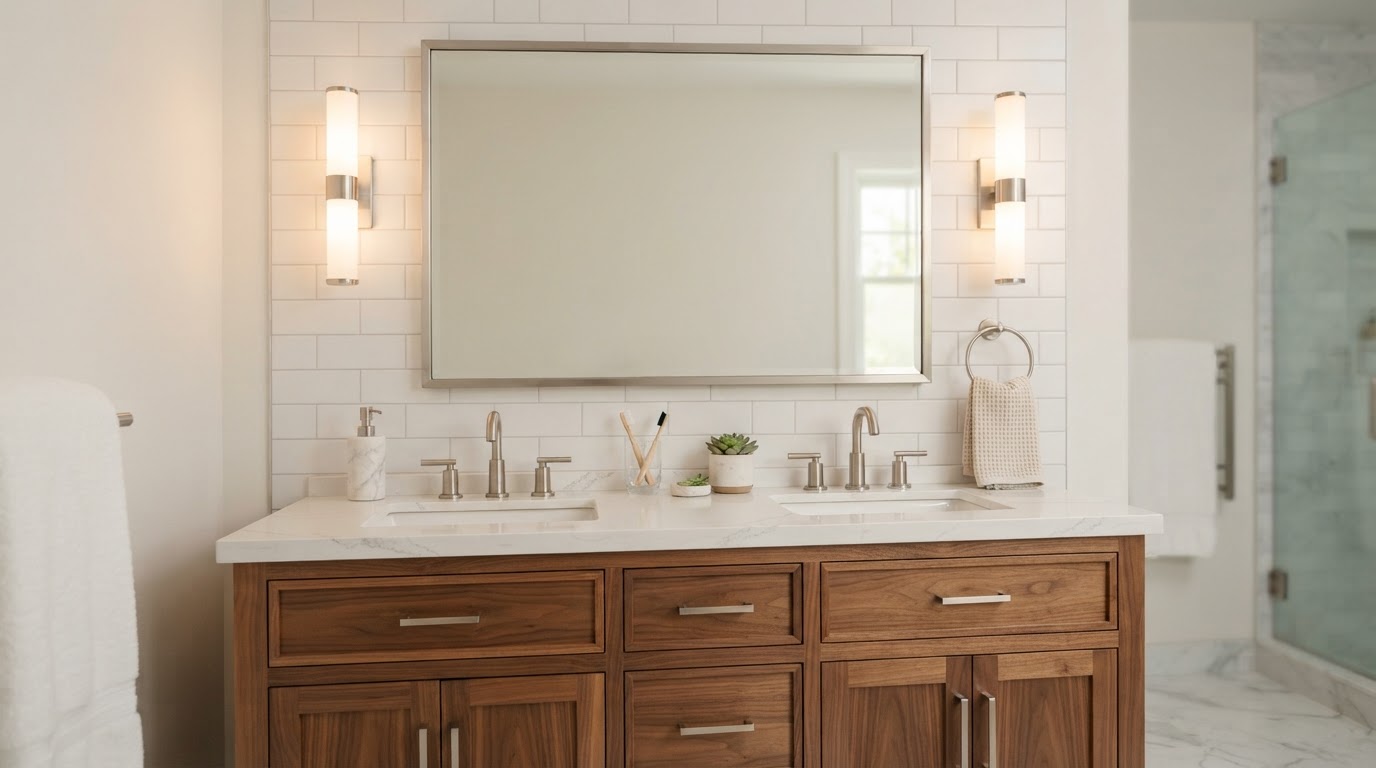
Bathroom Vanity Lighting: The Most Important Light in the Room
If you spend money improving one part of your bathroom lighting plan, pay close attention to the vanity. This is where many homeowners make their biggest lighting mistake: they install a beautiful mirror, then place one light directly above it. The result is shadows—beneath the eyes, nose, chin, and cheeks. That's not ideal when you're trying to shave, apply makeup or get ready for work.
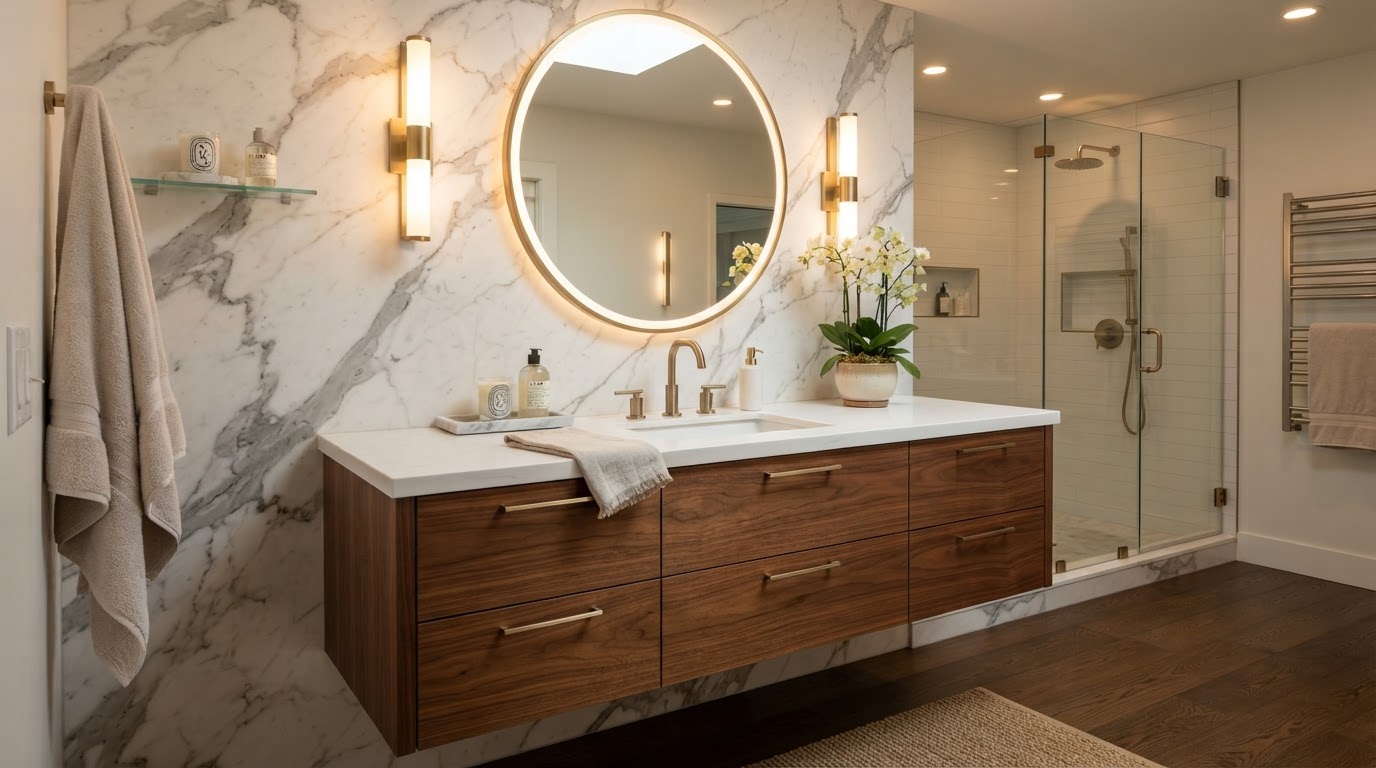
Current bathroom lighting guidance from This Old House recommends placing vertical fixtures or sconces around the sides of the mirror to provide more even illumination across the face.
Sconces on Both Sides of the Mirror
For many bathrooms, side-mounted sconces are one of the best solutions for vanity lighting. A common recommendation is to position sconces approximately at eye level, with around 36–40 inches between them, depending on the vanity and mirror configuration.
The exact dimensions should be adjusted to the specific user, mirror, vanity and architectural conditions. The objective is simple: illuminate the person—not just the mirror.
What If You Can't Install Side Sconces?
Sometimes the bathroom layout doesn't allow it—the mirror is too wide, there isn't enough wall space, cabinets are nearby, a window interrupts the wall, or a medicine cabinet occupies the space. In that case, an appropriately designed fixture above the mirror can work.
The fixture should distribute light evenly across the face rather than producing a concentrated beam directly downward.
Backlit Mirrors & LED Bathroom Lighting
Backlit Bathroom Mirrors
Backlit mirrors combine mirror and lighting into one feature, creating a sleek, minimalist appearance and attractive ambient or accent illumination.
But be careful about using a backlit mirror as the only source of vanity lighting. Depending on the design, the light may illuminate the area around the mirror without providing enough frontal illumination for detailed grooming. For a primary bathroom, consider combining a backlit mirror with additional task lighting.
LED Bathroom Lighting
LED fixtures can provide energy efficiency, long service life, flexible fixture designs, multiple color temperatures, dimming options, and integrated lighting.
LED technology also makes it possible to incorporate lighting into mirrors, vanity toe kicks, shower niches, cabinet interiors, shelves, ceilings, and architectural details.
Color Temperature & CRI
What Color Temperature Should Bathroom Lighting Be?
Color temperature is measured in Kelvin (K). Warm light (lower Kelvin) creates a warmer, softer atmosphere. Neutral / warm white provides a balance between warmth and clarity. Cool light (higher Kelvin) creates a brighter, cooler appearance.
Many homeowners prefer a neutral-to-warm appearance because extremely cool lighting can make a residential bathroom feel clinical. Your tile, paint, cabinetry, countertop and natural light all affect how the final result looks.
What Is CRI and Why Does It Matter?
CRI (Color Rendering Index) describes how accurately a light source renders colors compared with a reference light source. This matters in bathrooms because you're looking at your skin, makeup, clothing, hair, tile, and countertops.
A higher-quality light source with good color rendering can make colors appear more natural—especially important around the vanity. Consider fixtures with strong color-rendering performance rather than selecting solely based on brightness.
Recessed Bathroom Lighting
Recessed lighting is one of the most popular forms of bathroom ambient lighting. The fixture sits within the ceiling, creating a clean appearance with minimal visual bulk. Recessed lights work especially well in modern, contemporary, small, minimalist, and low-ceiling bathrooms. They can provide excellent general illumination when properly positioned.
The Major Limitation
Recessed lighting should not automatically replace vanity lighting. A recessed light positioned directly over the person standing at the vanity can cast shadows on the face. Instead, recessed lighting should generally be coordinated with task lighting around the mirror.
How Many Recessed Lights Does a Bathroom Need?
There is no universal number. The answer depends on bathroom size, ceiling height, fixture output, beam angle, layout, wall colors, natural light, vanity location, and shower configuration.
Instead of asking "How many lights do I need?" ask "Where do I need light?" You may need illumination at the vanity, shower, toilet, tub, entry, storage, and general circulation areas.
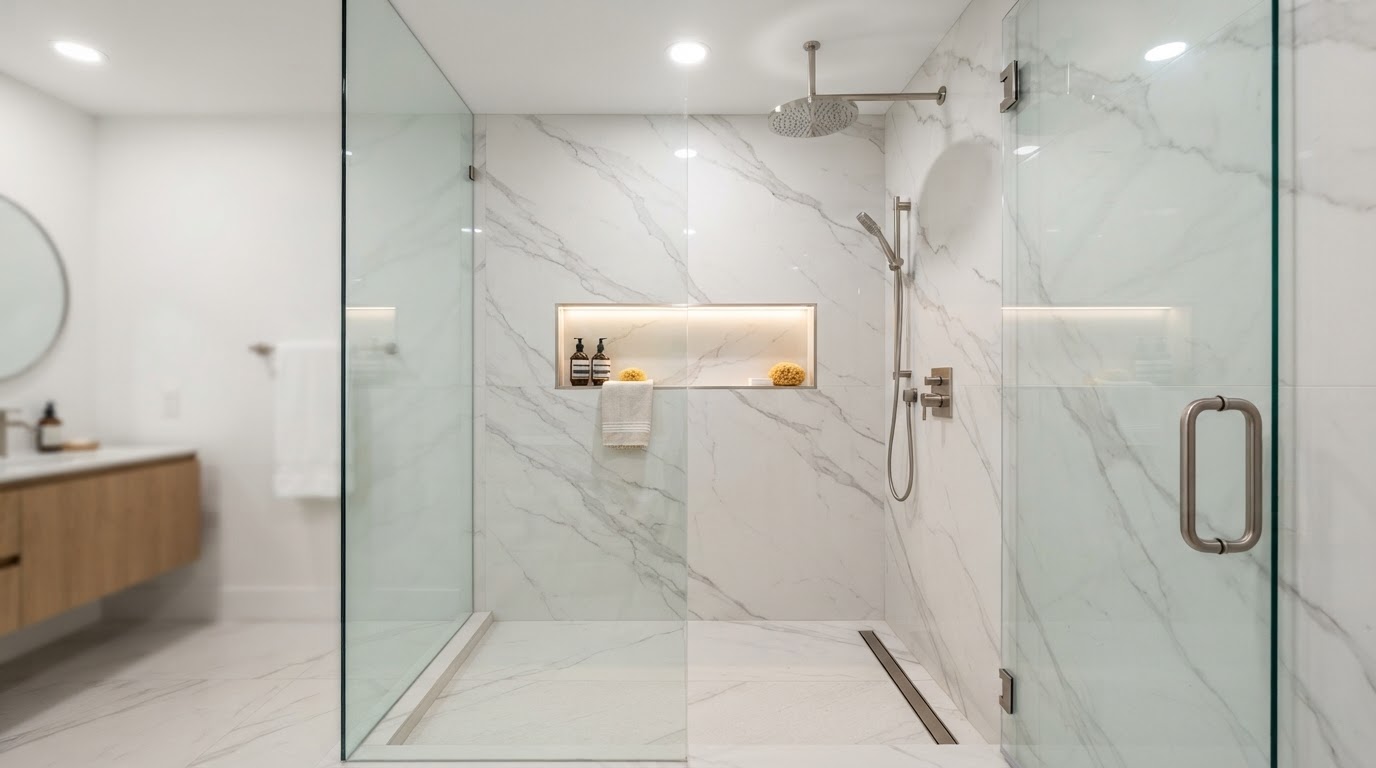
Shower Lighting & Wet-Rated Fixtures
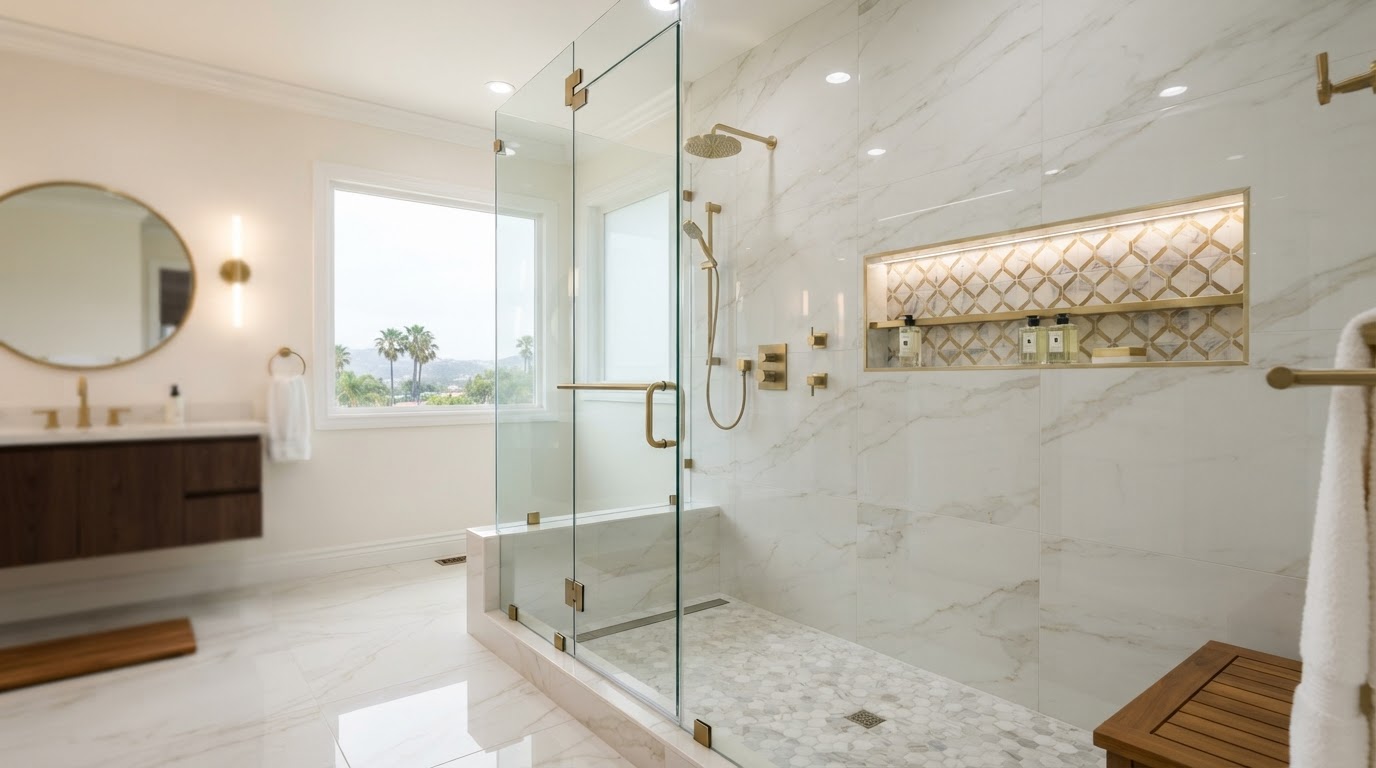
The shower is one of the most important areas to consider from a safety standpoint. A dark shower can be uncomfortable and difficult to use. A dedicated shower light can provide better visibility and highlight the tile or architectural design. Recessed lighting is commonly used in shower ceilings—but not every recessed light is appropriate for a shower. The fixture must be appropriately rated for the location.
Damp Rated vs. Wet Rated
- Damp Rated: Designed for locations exposed to humidity or moisture but not direct water exposure.
- Wet Rated: Designed for locations where the fixture may be exposed to water.
A shower environment can require more protection than a typical humid bathroom area. Don't assume a fixture is safe simply because the packaging says "bathroom." Check the actual listing and intended location.
Lighting Above a Freestanding Tub
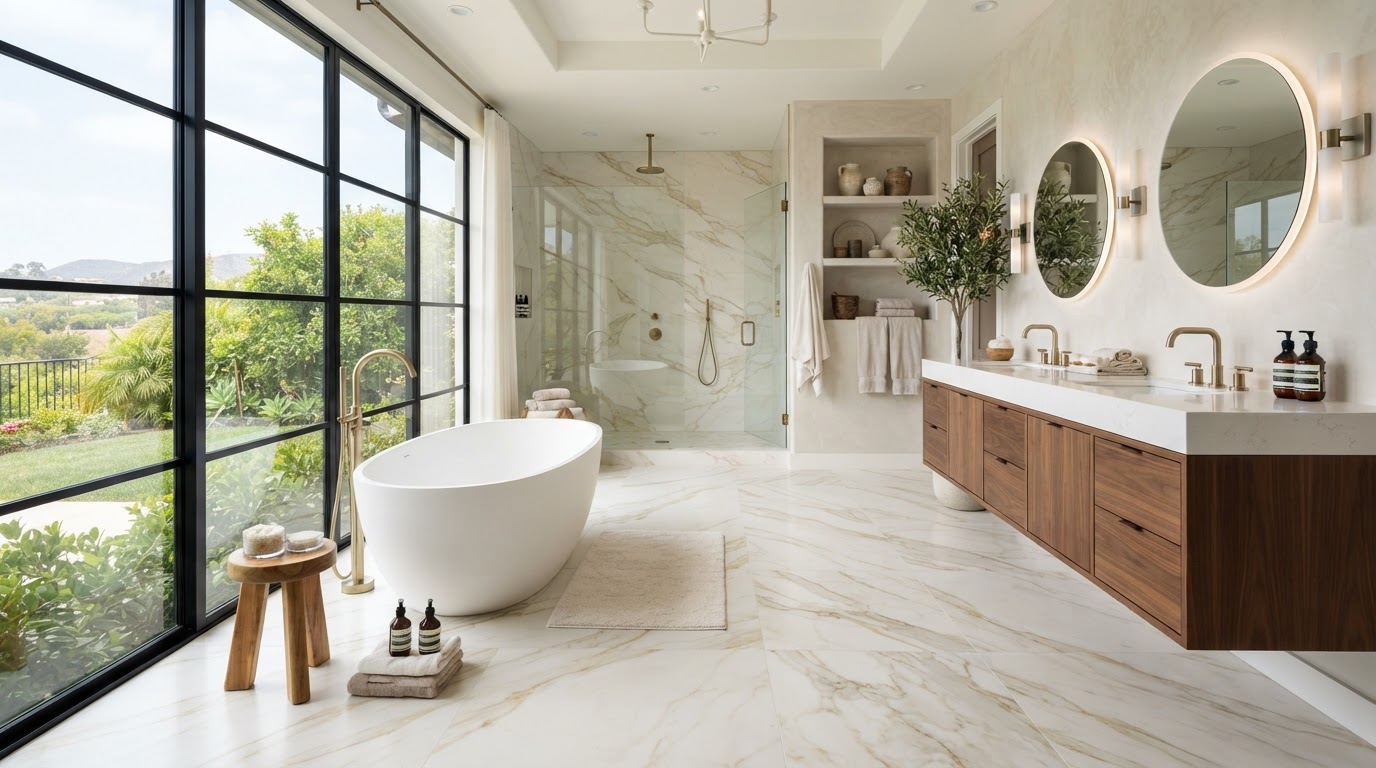
A freestanding bathtub can become one of the focal points of a bathroom. Lighting can reinforce that feature with recessed lighting, a decorative pendant, chandelier, wall sconces, or architectural lighting.
But decorative lighting above or near a tub needs careful consideration of location and electrical safety requirements. Electrical codes establish requirements for fixtures around bathtubs and showers.
Bathroom Pendant Lights & Chandeliers
Bathroom Pendant Lights
Pendant lights can create a beautiful luxury look, particularly when the bathroom has high ceilings, there is adequate space, the design is contemporary or transitional, and the pendant complements the vanity.
Consider ceiling height, head clearance, water exposure, fixture rating, visual scale, electrical requirements, and maintenance access—don't choose a pendant simply because it looks attractive in a photograph.
Bathroom Chandeliers
A chandelier can create a dramatic statement in a large primary bathroom, working particularly well with freestanding tubs, high ceilings, large windows, luxury finishes, and spacious floor plans.
But aesthetics should come after safety. The specific location of the fixture matters, and electrical codes establish requirements for fixtures around bathtubs and showers.
Accent Lighting for a Luxury Bathroom
Accent lighting is where a bathroom can start to feel like a high-end spa. Consider illuminating shower niches, floating vanities, architectural walls, shelves, and toe kicks.
Toe-Kick Lighting: One of the Best Bathroom Upgrades
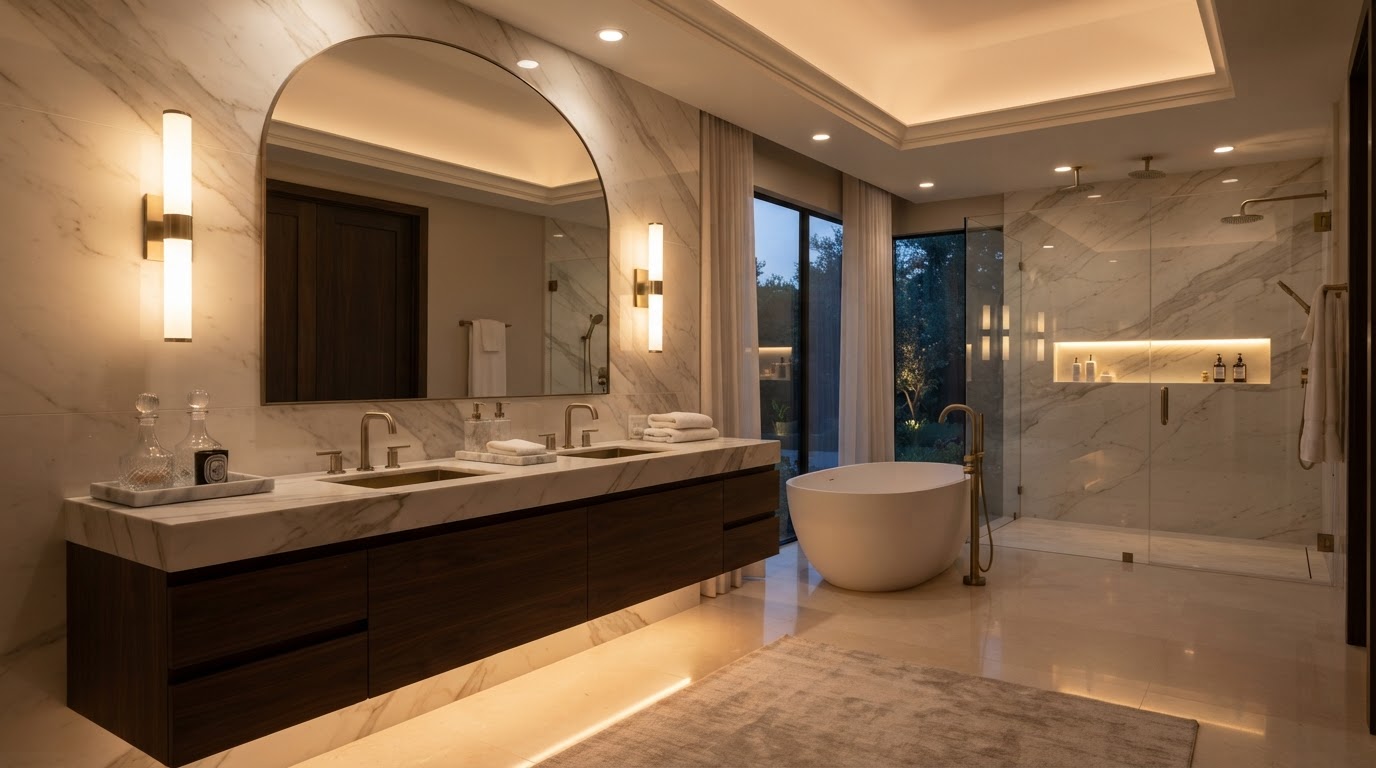
If you're installing a floating vanity, consider adding LED lighting beneath it. During the day, it creates a subtle architectural effect. At night, it can provide enough illumination to navigate the bathroom without turning on bright overhead lights—particularly useful for primary bathrooms, guest bathrooms, children's bathrooms, and bathrooms used during nighttime. It's a relatively small design detail that can have a significant effect on the overall experience.
Dimmers & Smart Bathroom Lighting
Dimmers: The Upgrade Many Homeowners Forget
A bathroom shouldn't necessarily have the same lighting intensity at 6:00 AM and 10:00 PM. Bright lighting can be ideal when shaving, applying makeup, cleaning, and getting ready. Lower lighting can be preferable when taking a bath, relaxing, or using the bathroom at night.
Separate lighting zones with dimming capability can give the homeowner substantially more control.
Smart Bathroom Lighting
Depending on the system, homeowners may be able to control brightness, color temperature, lighting scenes, timers, motion activation, and voice control.
- Morning Scene: Bright neutral lighting.
- Evening Scene: Warm, dimmed lighting.
- Night Scene: Low-level toe-kick lighting.
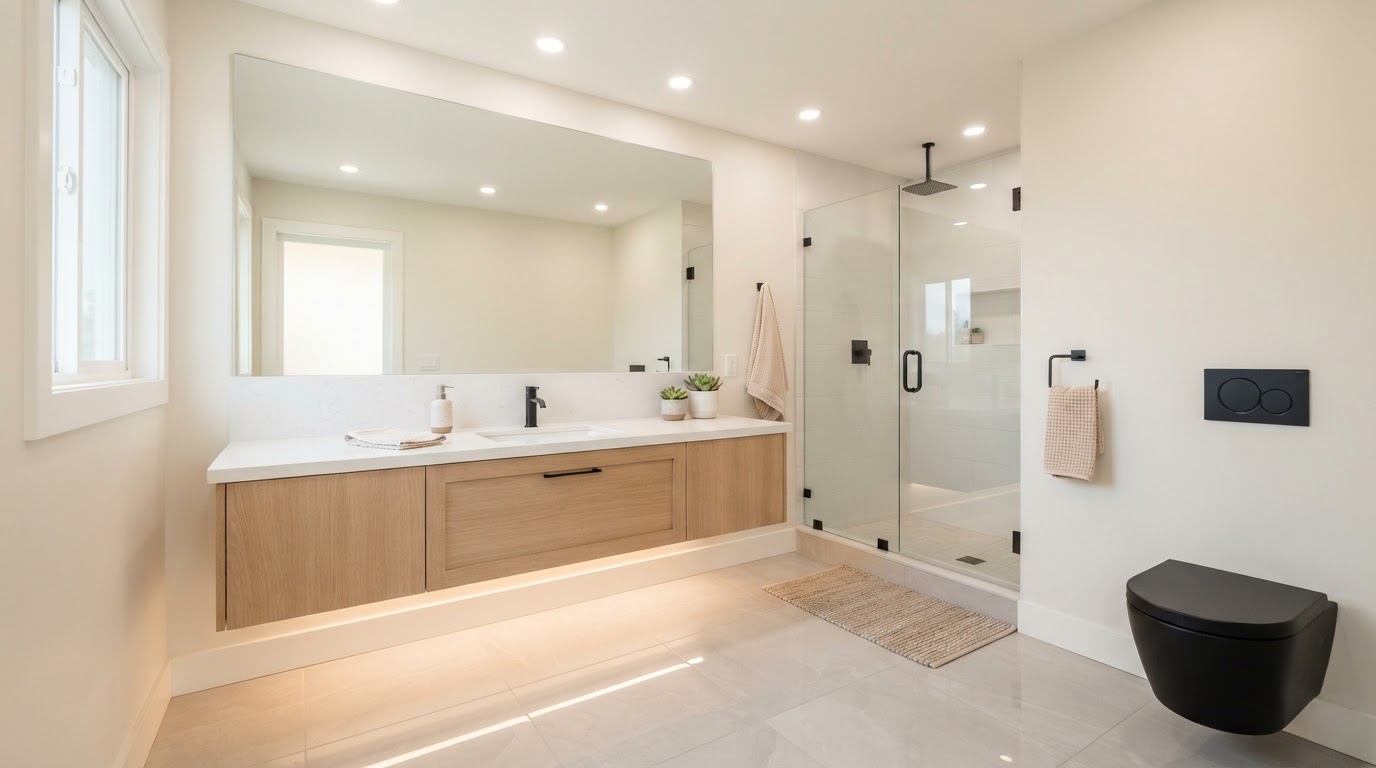
Small Bathroom Lighting Ideas
Small bathrooms benefit enormously from good lighting. Because there is less physical space, poor lighting can make the room feel even smaller. Here are some strategies.
Use Recessed Ceiling Lighting
Recessed fixtures keep the ceiling visually clean.
Add Side Vanity Lighting
This prevents the mirror area from becoming a dark or shadowy zone.
Use a Large Mirror
A larger mirror can reflect light and increase the visual depth of the room.
Add Under-Vanity Lighting
A soft glow beneath a floating vanity can visually open up the floor.
Avoid One Extremely Bright Fixture
One harsh light source can create dramatic contrast between bright and dark areas.
Illuminate Dark Corners
Dark corners can make a small bathroom feel smaller.
Current small-bathroom guidance from Venguard also emphasizes improved lighting, larger mirrors, floating vanities and visually continuous materials as ways to make compact bathrooms feel more open.
Bathroom Lighting for a Primary Bathroom
Primary bathrooms often benefit from a more sophisticated lighting system. A well-designed primary bathroom might include:
The goal is to allow the homeowner to control different parts of the room independently.
Double Vanity Lighting
Double vanities introduce another design challenge: you need to illuminate two grooming areas rather than one. The exact arrangement should be based on vanity dimensions and mirror configuration.
Bathroom Mirror and Lighting: Design Them Together
One of the most common remodeling mistakes is choosing the mirror first and figuring out lighting later. Instead, coordinate them. Consider mirror width and height, sconce placement, electrical box locations, medicine cabinet dimensions, faucet location, vanity width, ceiling lighting, and mirror frame. This becomes especially important with custom or integrated LED mirrors—the electrical planning needs to happen before installation.
Lighting Around a Medicine Cabinet
Medicine cabinets can create additional challenges. A recessed medicine cabinet may occupy the exact wall space where you intended to install a sconce. Before electrical work begins, coordinate:
Natural Light in the Bathroom
Artificial lighting isn't the only source of illumination. Natural light can dramatically improve a bathroom. Possible sources include windows, skylights, clerestory windows, transom windows, frosted glass, and privacy glass. Natural light can make a bathroom feel brighter, larger, more relaxing, and more connected to the outdoors. But privacy matters, so the right solution depends on the property's layout and the location of the bathroom.
How Bathroom Lighting Changes Materials
Lighting should be selected after considering the materials you're installing. Highly reflective surfaces can bounce light around the room. Matte surfaces absorb more light. Dark tile can require stronger or more strategically placed illumination. Light-colored tile can help reflect light. Glossy surfaces can produce glare if fixtures are positioned incorrectly. This is why lighting and material selection should happen together.
Lighting and Bathroom Tile
- Large-format stone-look tile: Use grazing or directional light to emphasize subtle texture.
- Textured tile: Wall washing can create shadows and depth.
- Mosaic tile: Accent lighting can emphasize pattern.
- Marble: Directional lighting can reveal natural movement and veining.
- Dark tile: Additional illumination may be necessary to prevent the room from feeling visually heavy.
Lighting and Bathroom Countertops
Your countertop also interacts with lighting. A polished countertop can reflect light. A matte countertop absorbs more light. A dramatically veined surface can become a focal point under appropriate illumination—especially important with materials such as quartz, granite, marble, quartzite, and porcelain.
For more information about selecting a countertop, see our guide to Bathroom Countertops: Quartz vs. Granite vs. Porcelain.
How Much Does Bathroom Lighting Cost?
Bathroom lighting costs vary considerably because a lighting project can mean very different things. A simple fixture replacement is completely different from rewiring a bathroom during a full renovation. During a full remodel, lighting costs should be evaluated as part of the overall electrical scope rather than as a standalone fixture purchase.
Venguard's broader bathroom remodeling guidance notes that electrical planning can include new outlets, GFCI protection, exhaust fans, heated floors and other electrical upgrades, reinforcing why electrical decisions should be coordinated during the design stage.
Why Bathroom Lighting Should Be Planned Before Construction
Lighting isn't something you want to decide after the drywall is finished. The electrical plan needs to account for fixture locations, switch locations, dimmer locations, wiring, electrical boxes, ceiling conditions, wall framing, vanity dimensions, mirror dimensions, shower layout, tub location, medicine cabinets, and exhaust fans. Moving electrical components after finishes are installed can create unnecessary labor and repair work. That's why lighting should be part of the design and electrical plan before construction begins.
Bathroom Lighting Zones
A useful strategy is to divide the bathroom into zones. This gives you much more control than putting every light on one switch.
Separate Switches Make a Big Difference
Imagine entering your bathroom at 2:00 AM. Do you really want every recessed light, vanity light and decorative fixture turning on at full brightness? Probably not. Consider separate controls for vanity, ambient, shower, accent, and night lighting. This lets the homeowner choose the appropriate lighting for the situation.
Common Bathroom Lighting Mistakes
A Simple Bathroom Lighting Formula
If you're starting from scratch, use this framework:
Install appropriate ambient lighting.
Add vanity task lighting.
Provide appropriate illumination using fixtures suitable for the location.
Highlight niches, cabinetry or architectural details.
Use separate switches and dimmers where appropriate.
Make sure the color temperature and color rendering work with your materials and daily routine.
Make sure there are no major dark spots or harsh glare points.
Example Lighting Plans
Small Guest Bathroom
- 1–2 recessed ambient lights
- 2 vanity sconces
- 1 exhaust fan/light if appropriate
- Optional mirror lighting
- Optional toe-kick lighting
Medium Bathroom
- Multiple recessed ceiling lights
- Two vanity sconces
- Dedicated shower light
- Accent lighting
- Exhaust fan
- Dimmers
Large Primary Bathroom
- Zoned recessed lighting
- Double vanity task lighting
- Shower lighting
- Tub lighting
- Toe-kick & cabinet lighting
- Multiple dimmer zones
- Smart controls if desired
The exact number and placement should be designed around the actual floor plan.
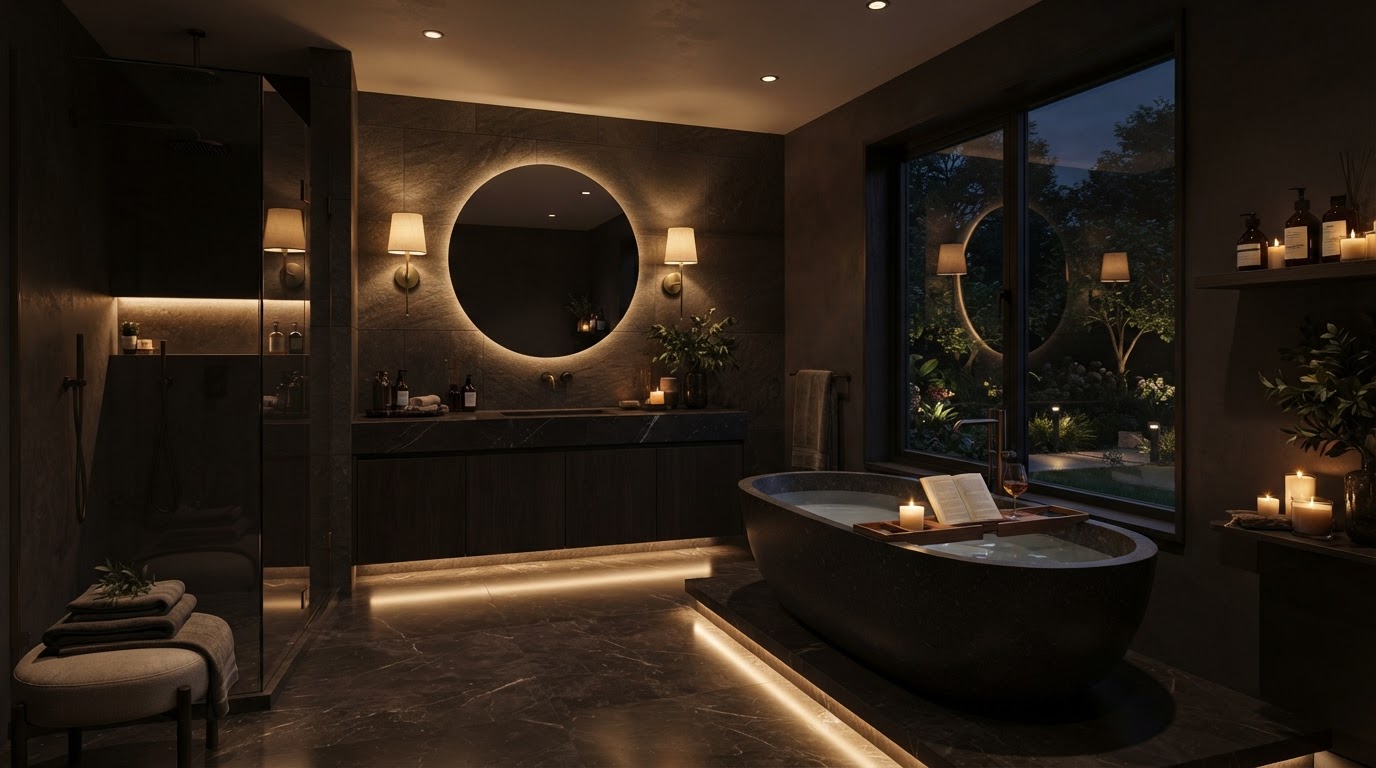
How to Create a Spa-Like Bathroom With Lighting
You don't need an enormous bathroom to create a spa-like atmosphere. Focus on layering. The bathroom then becomes a space that responds to your routine rather than a room that operates at one brightness level.
Bathroom Lighting by Design Style
Modern Designs
Recessed LED lighting, linear fixtures, minimal sconces, backlit mirrors, under-vanity lighting, clean architectural lines, and dimmable zones. The goal is visual simplicity—fixtures should support the architecture rather than overwhelm it.
Traditional Designs
Decorative sconces, lantern-inspired fixtures, chandeliers where appropriate, warm lighting, framed mirrors, and decorative vanity fixtures. The lighting can become part of the room's decorative language.
Transitional Designs
Sits between traditional and modern, creating considerable flexibility. Simple brass sconces, recessed ambient lighting, a large framed mirror, warm LED lighting, and subtle accent lighting can create a timeless rather than trend-dependent appearance.
Luxury Designs
Usually about layers rather than brightness. Architectural ceiling lighting, decorative sconces, backlit mirrors, shower lighting, under-vanity lighting, accent lighting, tub lighting, dimmers, and smart controls. The result is more sophisticated because the homeowner can control the atmosphere.
Bathroom Lighting, Ventilation & Electrical Safety
Bathroom Lighting and Ventilation
Lighting isn't the only electrical consideration in a bathroom. Ventilation is equally important. Bathrooms produce significant moisture from showers and baths. A properly designed exhaust system helps manage humidity and protect finishes and building materials. Lighting, exhaust fans and electrical systems should therefore be coordinated during the planning stage.
Electrical Safety Matters
Bathroom lighting isn't a DIY design exercise when new wiring or fixtures are involved. Bathrooms contain water, plumbing, electrical systems, wet and damp locations, metal fixtures, and appliances. The applicable electrical code determines requirements based on the fixture and its location.
A qualified electrician should evaluate the specific installation, particularly when adding new circuits, moving switches, installing shower lights, adding heated floors, or remodeling an older bathroom.
Bathroom Lighting Checklist
Before construction begins, confirm:
General
- • Ambient lighting planned
- • Task lighting planned
- • Accent lighting considered
- • Shower lighting planned
- • Decorative lighting considered
- • Natural light evaluated
Vanity
- • Mirror dimensions confirmed
- • Vanity dimensions confirmed
- • Sconce locations confirmed
- • Electrical boxes coordinated
- • Faucet location confirmed
- • Medicine cabinet accounted for
Shower
- • Appropriate fixture selected
- • Fixture rating confirmed
- • Location reviewed for code
- • Wiring planned
- • Switch location confirmed
Controls & Design
- • Separate switches considered
- • Dimmers considered
- • Smart controls considered
- • Night lighting considered
- • Color temperature selected
- • Color rendering considered
- • Fixtures scaled appropriately
- • Materials reviewed under planned lighting
Frequently Asked Questions About Bathroom Lighting
What is the best lighting for a bathroom?
The best bathroom lighting combines ambient, task and accent lighting. Recessed lights can provide general illumination, while sconces or appropriately designed vanity fixtures provide task lighting around the mirror.
Should bathroom lights be warm or cool?
It depends on the desired atmosphere and the materials in the room. Many homeowners prefer warm-to-neutral lighting for bathrooms because it creates a more comfortable residential environment. The specific color temperature should also be considered alongside the countertop, tile, paint and natural light.
Are recessed lights good for bathrooms?
Yes. Recessed lights are excellent for general illumination and can also work in showers when the fixture is specifically suitable for the location. They should not necessarily be the only lighting around the vanity because overhead-only lighting can create facial shadows.
Should bathroom vanity lights be above or beside the mirror?
Side lighting is often preferred because it can illuminate the face more evenly and reduce shadows. When side sconces aren't practical, an appropriately designed fixture above the mirror can be used.
How high should bathroom sconces be?
A common starting point is approximately eye level. Current design guidance often places vanity sconces around 60–70 inches above the finished floor, depending on the users and specific bathroom configuration. The final position should be adjusted to the mirror, vanity, fixture and homeowner.
How far apart should bathroom sconces be?
A commonly cited starting point is approximately 36–40 inches apart, measured between fixture centers, but the correct spacing depends on the mirror and vanity dimensions.
Do shower lights need to be wet-rated?
Fixtures installed in shower areas need to be appropriately listed for their specific location and exposure. Wet and damp locations have different requirements. Have a qualified electrician verify the fixture and installation.
Are LED lights good for bathrooms?
Yes. LED lighting is widely used in bathrooms because it can provide efficient, long-lasting illumination and is available in many fixture styles, color temperatures and configurations.
Should bathroom lights have dimmers?
Dimmers can be extremely useful because they allow homeowners to adjust lighting for different activities and times of day.
How many lights should a bathroom have?
There is no universal number. The required lighting depends on room size, layout, fixture output, ceiling height, natural light and the locations where task lighting is needed.
What is the best lighting for a small bathroom?
A combination of recessed or ceiling ambient lighting, properly positioned vanity lighting and potentially accent or under-vanity lighting can work well. Large mirrors and good light distribution can also make the room feel more spacious.
Should bathroom lighting match the fixtures?
It doesn't have to match perfectly, but the finishes should work together. For example, a brass faucet with brass sconces, or matte black fixtures with black architectural lighting. Mixing metals can also work when done intentionally.
Bathroom Lighting in Orange County and Los Angeles
Southern California bathrooms can vary dramatically. An older Los Angeles home may have limited electrical capacity, outdated wiring or a bathroom layout that wasn't designed for modern lighting. A newer Orange County home may have different constraints. Coastal properties, compact bathrooms, large primary suites and older remodels can all require different approaches. That's why homeowners should avoid treating an online lighting diagram as a universal installation plan.
Venguard Construction serves homeowners throughout Southern California and lists communities including Irvine, Newport Beach, Costa Mesa, Huntington Beach, Anaheim, Santa Ana, Laguna Beach, Mission Viejo, Tustin and Lake Forest among its service areas. For local projects, the design should account for the property's existing construction, the applicable jurisdiction and the overall remodeling scope.
Final Thoughts: Design the Lighting Before You Design the Atmosphere
A beautiful bathroom needs more than beautiful fixtures. It needs the right light. The most successful bathroom lighting plans typically combine ambient lighting for general visibility, task lighting for grooming, vanity lighting for the face and mirror, shower lighting for visibility in wet areas, accent lighting for architectural details, decorative lighting for personality, dimmers and controls for flexibility, and when possible, natural light to make the room feel brighter and more connected to the outdoors.
The biggest mistake is thinking that bathroom lighting means choosing a fixture. It doesn't. It means designing how light moves through the room. When the layout, materials, electrical work and lighting are designed together, the final bathroom doesn't just look better—it works better.
Related Guides
Ready to Plan Your Bathroom Remodel?
If you're remodeling a bathroom in Orange County or Los Angeles, lighting should be considered alongside your layout, vanity, countertop, shower, flooring, plumbing and electrical systems. At Venguard Construction, bathroom remodeling is approached as a coordinated design-build project—from understanding the existing space and developing the design to selecting materials, coordinating construction and completing the final walkthrough.
Schedule a Complimentary Bathroom Remodeling Consultation