Tile is one of the most important decisions in a bathroom remodel. It protects surfaces from everyday moisture, defines the visual style of the room, and can dramatically influence how large, bright, luxurious or comfortable a bathroom feels.
But choosing bathroom tile isn't as simple as picking a color you like. You also need to consider where the tile will be installed, how much water the surface will encounter, tile material, tile size, tile shape, surface finish, slip characteristics, grout requirements, maintenance, installation complexity, waterproofing, budget, and how the tile works with the rest of the bathroom.
And that's where homeowners often get stuck. Should you choose classic subway tile? Would large-format porcelain make the room look bigger? Are mosaics better for a shower floor? Is natural stone worth the additional maintenance? Can the same tile be used on the floor, shower walls and bathroom walls? The answer depends on the application.
This guide breaks down the most popular bathroom tile options in 2026 and explains how to choose the right combination for your bathroom remodel in Orange County, Los Angeles and surrounding Southern California communities.
Quick Answer: What Is the Best Tile for a Bathroom?
There isn't one tile that is best for every bathroom. For many homeowners, porcelain tile is one of the most versatile choices because it can be used in many bathroom applications, offers extensive design options and generally requires relatively little maintenance. But other tile types can be better for specific situations.
| Tile Type | Best For | Maintenance | Design Style | Typical Use |
|---|---|---|---|---|
| Porcelain | Versatility & durability | Low | Modern, traditional, luxury | Floors, walls, showers |
| Ceramic | Value & design flexibility | Low | Almost any style | Walls, floors, showers when rated |
| Subway Tile | Timeless wall design | Low | Classic, transitional | Walls & shower walls |
| Large-Format | Minimal grout lines | Low | Modern, luxury | Floors, walls, showers |
| Mosaic Tile | Detail & shower floors | Moderate | Decorative | Shower floors, niches, accents |
| Natural Stone | Luxury & character | Moderate–High | Organic, luxury | Floors, walls, showers |
| Glass Tile | Accent & light reflection | Moderate | Contemporary | Accents, walls, niches |
| Cement/Encaustic | Pattern | Moderate–High | Mediterranean, vintage | Floors & feature walls |
The key is choosing tile based on where and how it will be used, not simply which material looks best in a showroom.
Why Bathroom Tile Matters
Bathroom tile performs both a practical and aesthetic role. It can protect surfaces—tile provides a durable finished surface for floors, shower walls, tub surrounds and bathroom walls. It manages everyday moisture—tile is commonly used in wet areas, but it should always be part of an appropriately designed moisture-management system. And it defines the design—tile often becomes the visual foundation of the bathroom.
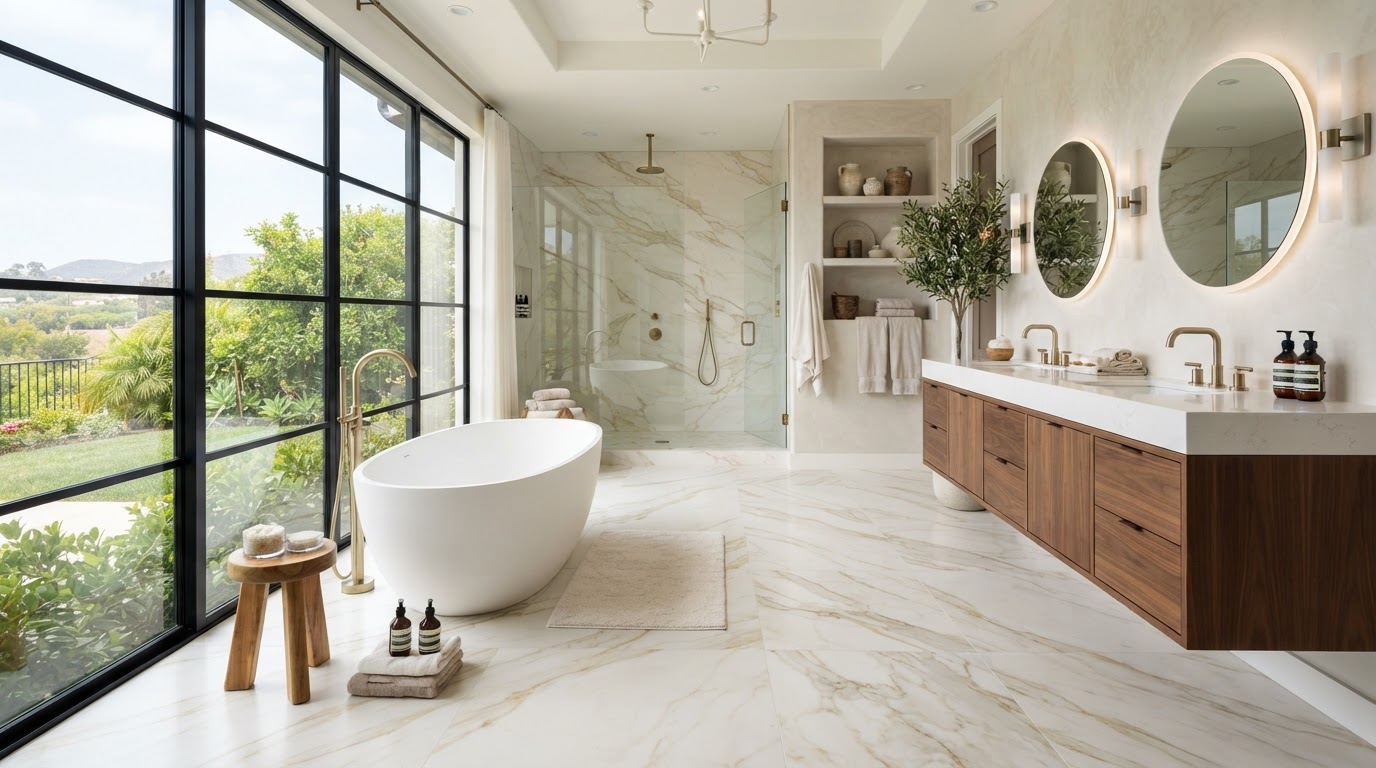
A simple white subway tile can create a timeless look. Large-format marble-look porcelain can create a luxury contemporary bathroom. Small mosaics can add texture and detail. Natural stone can create an organic, spa-like environment. Tile scale and layout can also influence visual perception—large-format tile can reduce the number of grout lines and create a more continuous appearance, making a bathroom feel larger.
Venguard's current bathroom remodeling guidance similarly identifies large-format porcelain, marble, subway tile, mosaic tile, glass tile, cement tile and natural stone among the major bathroom tile options homeowners can consider.
The Most Important Rule: Choose Tile Based on the Application
Before choosing tile, determine where it will go. A bathroom may contain several different tile applications: bathroom floor, shower floor, shower walls, tub surround, bathroom walls, vanity backsplash, shower niche, feature wall, accent strip, and ceiling in certain wet-area applications. The best tile for one application may not be the best choice for another.
For example, a large-format tile may work beautifully on a shower wall but be difficult to use on a shower floor with a conventional point drain because the floor needs to slope toward the drain. By contrast, smaller mosaic tiles can more easily follow multiple changes in slope. Drain configuration can also change the equation—a point drain typically requires slopes from multiple directions, while certain linear-drain configurations can allow a single-plane slope and make larger-format shower-floor tile more practical.
Application comes before aesthetics.
Porcelain Bathroom Tile
Porcelain is one of the most versatile tile materials available for bathroom remodeling. Its dense composition and low water absorption make it particularly useful in moisture-prone applications. It is also available in an enormous variety of designs—modern porcelain can imitate marble, travertine, limestone, slate, concrete, terrazzo, wood, fabric and natural stone. That means you can achieve a high-end appearance without necessarily choosing actual natural stone.
Advantages
- • Excellent durability
- • Low water absorption
- • Low maintenance
- • Large selection of colors and patterns
- • Available in large formats
- • Suitable for many floors and walls
- • Can replicate natural materials
- • Works well with modern bathroom designs
Potential Disadvantages
- • Can be more difficult to cut
- • Large-format versions require careful installation
- • Premium products can be expensive
- • Heavy pieces require appropriate handling
- • Poor substrate preparation can create installation problems
Porcelain works well for bathroom floors, shower walls, shower floors when appropriately rated and installed, tub surrounds, feature walls, large-format applications, and marble-look or wood-look designs.
Ceramic Bathroom Tile
Ceramic tile remains one of the most practical choices for bathroom remodeling. Ceramic and porcelain are both ceramic tile products, but porcelain is generally distinguished by its lower water absorption and denser body. A quality ceramic tile that is specifically rated for its intended application can still perform very well in a bathroom. Ceramic offers a broad design selection, is often more affordable than premium porcelain, and is suitable for many wall applications, floors when specifically rated, traditional and modern designs.
Subway Tile: The Timeless Bathroom Classic
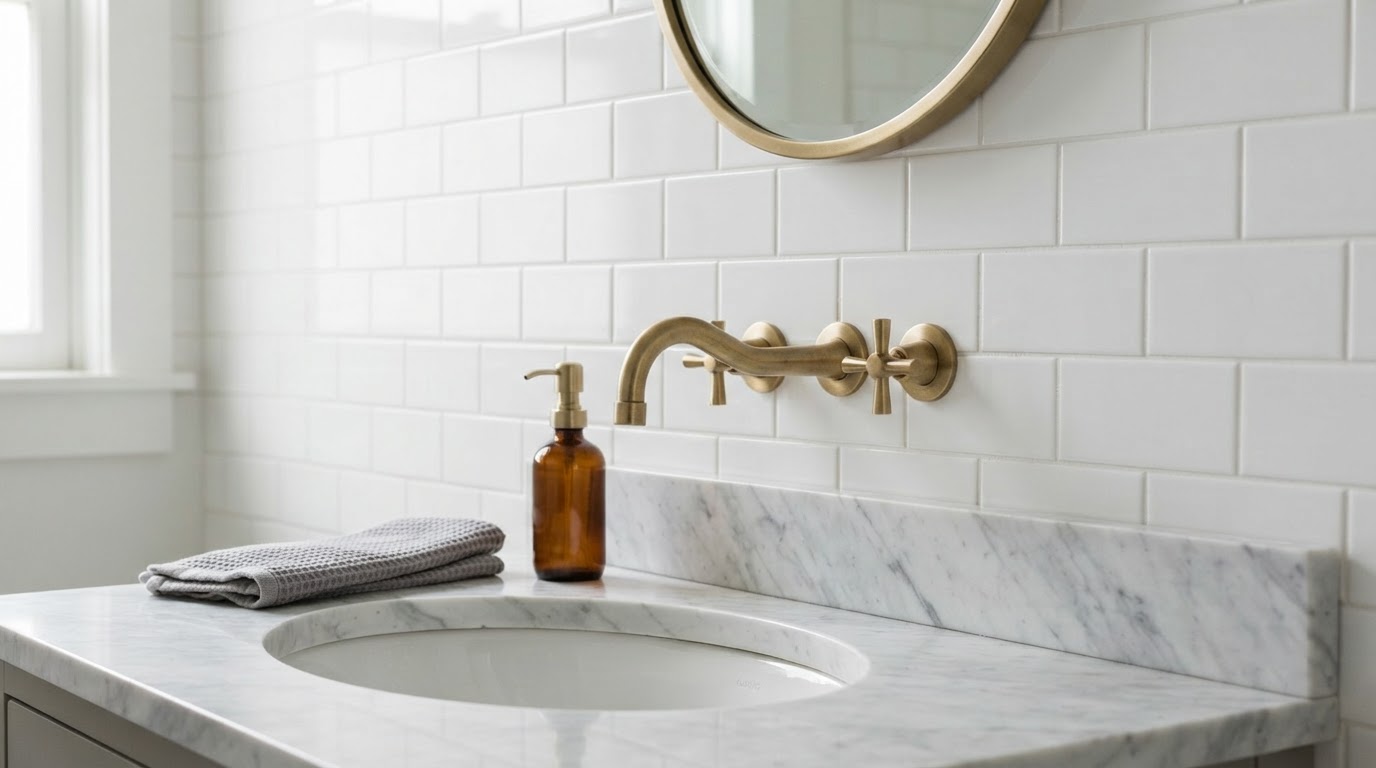
Subway tile is one of the most recognizable bathroom tile styles. Traditional subway tile is rectangular, often with a classic proportion such as 3 × 6 inches, although today's market includes many variations. You can find subway tile in white, cream, gray, green, blue, black, beige, handmade finishes, glossy finishes, matte finishes and textured surfaces. The simplicity of the shape is what makes it so versatile.
Subway tile still works in 2026 because trends change but subway tile doesn't have to. It works in traditional bathrooms (with classic vanity cabinetry, chrome fixtures, marble countertops), transitional bathrooms (with modern lighting, Shaker cabinetry, natural stone, brushed metal hardware), modern bathrooms (oversized subway tile, dark grout, minimal grout lines, matte finishes, contemporary fixtures), and farmhouse-inspired bathrooms (white subway tile with warm wood, black hardware, natural textures).
Subway Tile Layouts
Large-Format Bathroom Tile
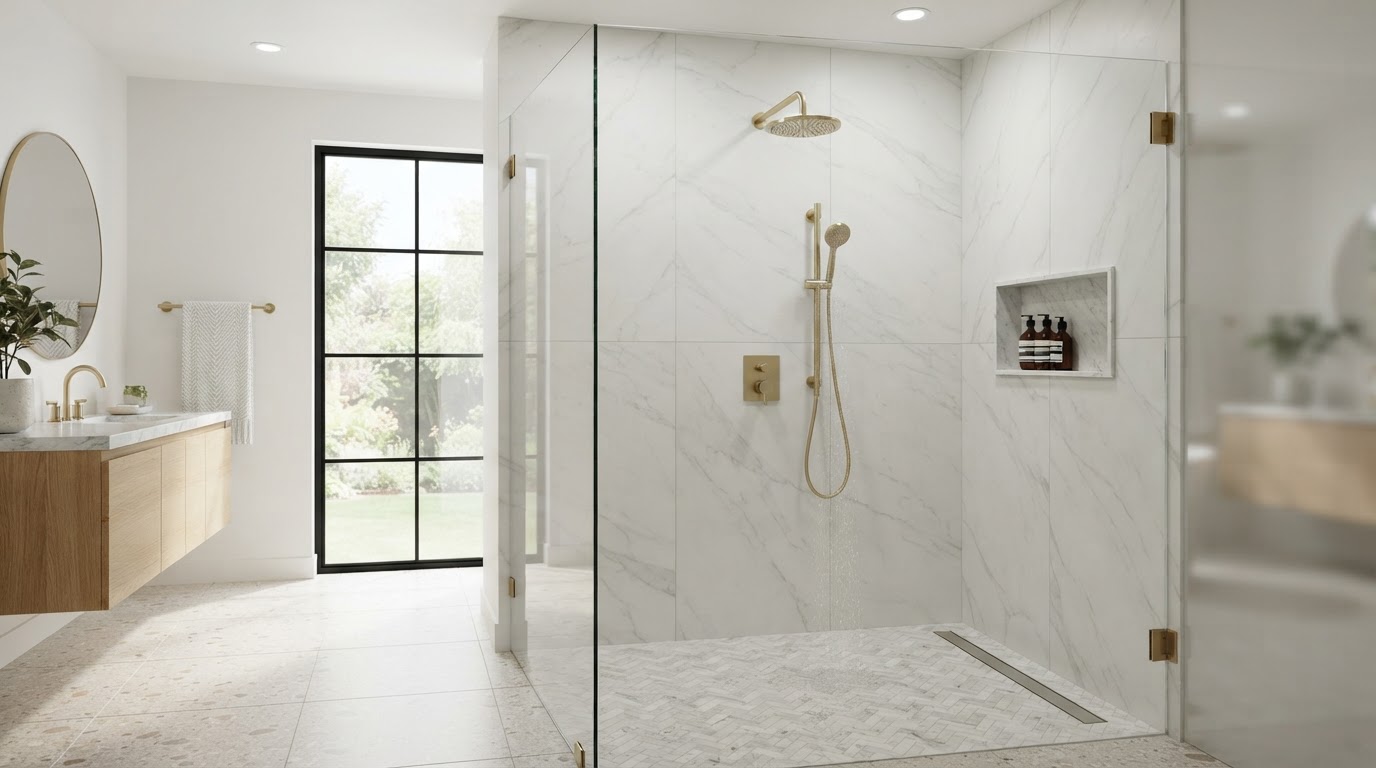
Large-format tile is one of the strongest contemporary bathroom design directions. Instead of many small tiles and grout joints, large-format tile creates broad visual surfaces. Common examples include 12 × 24 inches, 24 × 24 inches, 24 × 48 inches, and larger slab-like porcelain panels. The exact sizes available vary by manufacturer.
Large-Format Tile in Small Bathrooms
This is one of the most useful applications. Many homeowners assume small bathrooms need small tile. That's not necessarily true. Large-format tile can reduce the number of grout lines and create a more continuous visual field. Instead of 12 × 12 tile with numerous grout lines, consider 24 × 48 porcelain or another appropriately scaled format when the room, layout and installation conditions allow it. Venguard's current small-bathroom guidance specifically recommends large-format tile as one strategy for creating a cleaner, more continuous appearance in compact bathrooms.
The Challenge With Large-Format Tile
Large tile isn't automatically easier to install—it can actually be more demanding. The substrate needs to be sufficiently flat, and installers need to carefully manage tile alignment, lippage, cuts, transitions, setting materials, movement, handling and layout. A large-format tile can make substrate imperfections more noticeable. This is one area where professional installation can make a substantial difference.
Mosaic Bathroom Tile
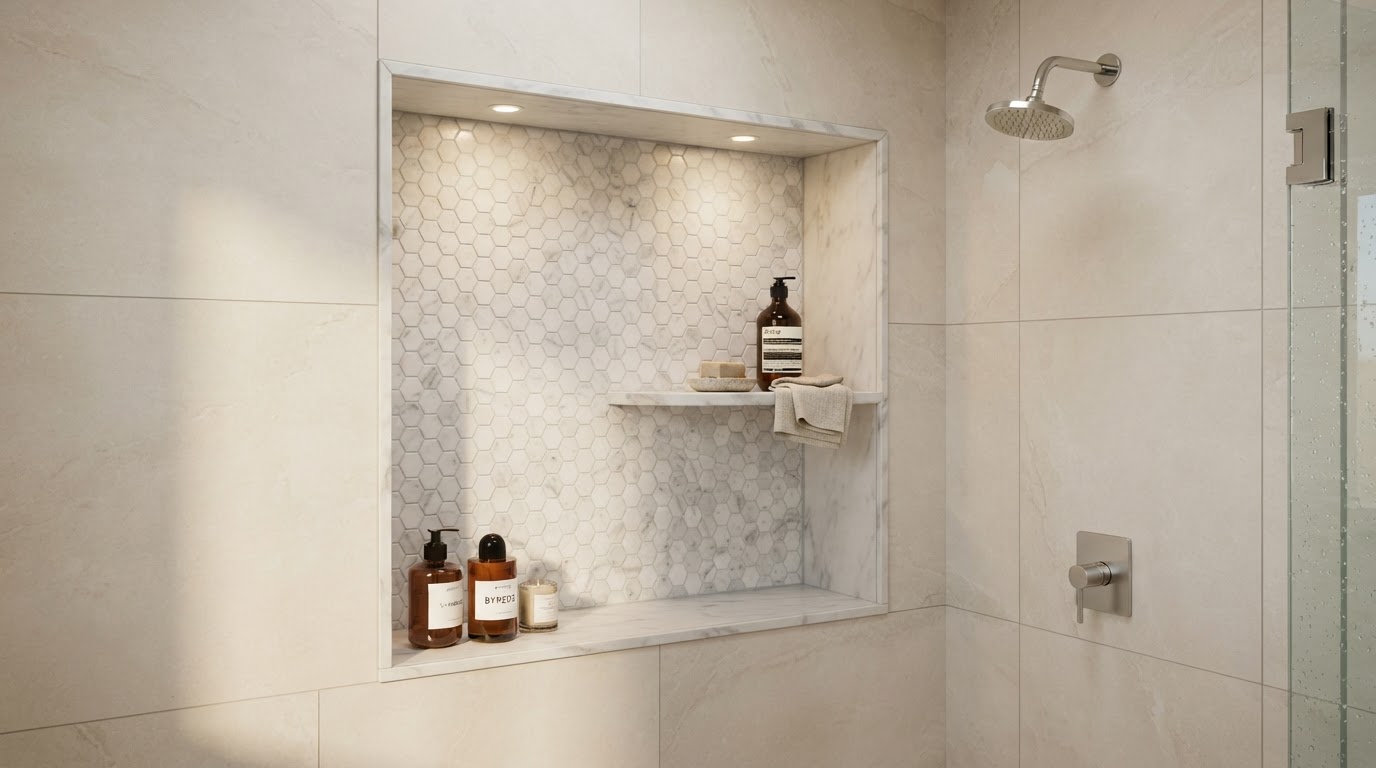
Mosaic tile consists of smaller individual pieces, often mounted on sheets. Common mosaic styles include penny rounds, hexagons, squares, rectangles, arabesque shapes, pebbles and small geometric patterns. Mosaic tile is especially useful when you want detail, texture or a more decorative surface.
Where Mosaic Works Well
- • Shower floors: small pieces can follow the slope toward a drain more easily.
- • Shower niches: makes a niche stand out without overwhelming the bathroom.
- • Accent walls: a small mosaic can become a design feature.
- • Borders: a decorative mosaic can create a visual transition between larger tile surfaces.
Mosaic Disadvantages
Mosaic tile also means more grout. More grout can mean more cleaning, more visual lines, more installation work, and more opportunities for inconsistent joints. So mosaic isn't necessarily the best choice when your primary goal is minimal maintenance.
Natural Stone Bathroom Tile
Natural stone gives bathrooms something manufactured tile can't fully replicate: natural variation. Every stone can have differences in veining, color, texture, pattern and mineral composition. Popular natural stone choices include marble, travertine, slate, limestone, granite and quartzite.
Marble
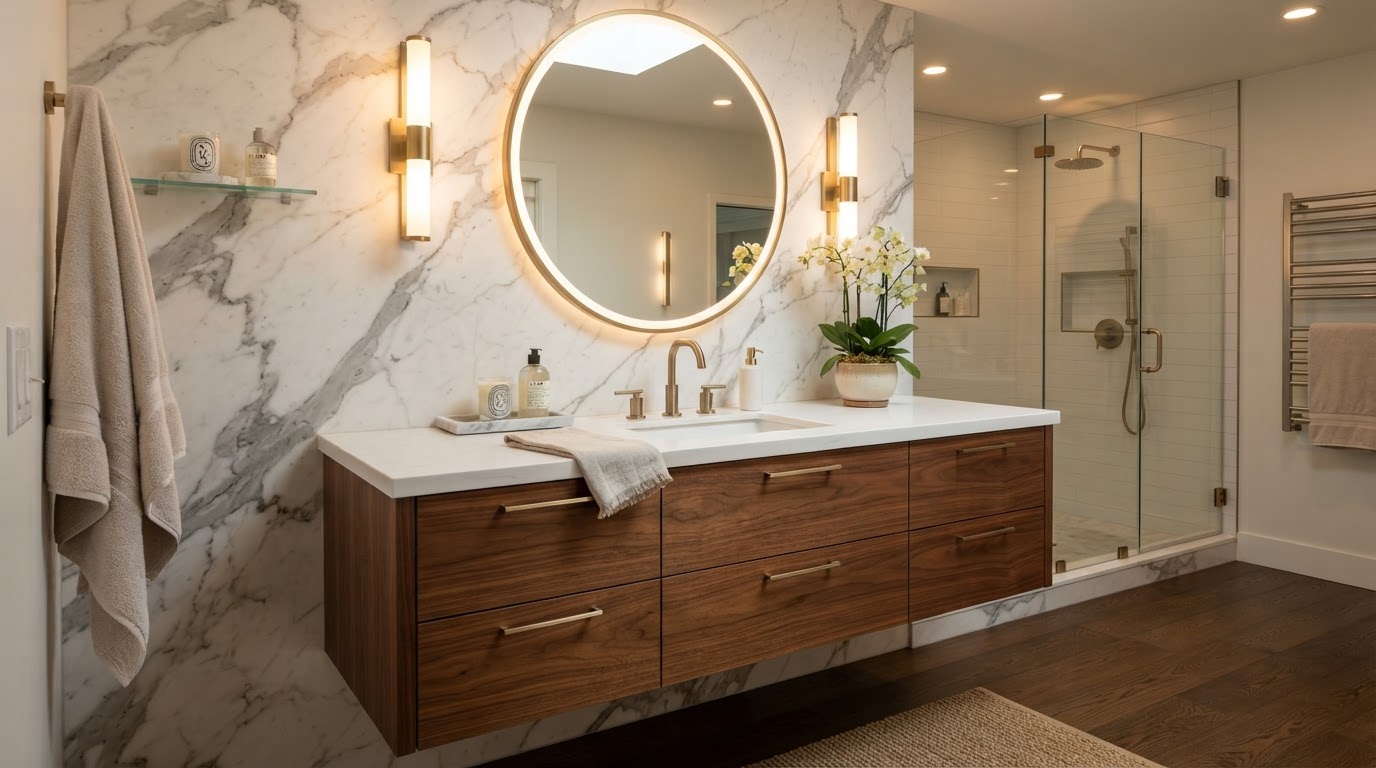
A classic luxury material for shower walls, floors, feature walls, tub surrounds and niches. Natural veining creates a dramatic visual effect, but it requires more maintenance consideration—sealing, appropriate cleaning products, stain prevention and etching.
Travertine
A warmer, more earthy appearance that works with natural wood, warm whites, beige, cream, bronze and brass. Creates a relaxed, resort-inspired bathroom, but its porous nature means maintenance and sealing need to be considered.
Slate
Provides a more textured and dramatic appearance for rustic, organic modern, spa-inspired and contemporary natural designs. Its natural texture can influence cleaning and underfoot feel.
Limestone
A softer appearance that creates a calm, understated bathroom when paired with warm neutral cabinetry, light countertops, brass fixtures and natural wood. Relatively porous, so proper maintenance planning is important.
Granite
A hard, durable natural stone with distinctive mineral movement, suitable for floors, walls and vanity applications where natural character is desired.
Quartzite
Natural stone formed from sandstone under heat and pressure, offering beautiful veining that can resemble high-end marble with strong durability. May require sealing depending on the stone.
Venguard's current bathroom portfolio and remodeling content include marble walk-in showers and other marble-focused designs, making it a particularly relevant option for luxury bathroom projects.
Other Bathroom Tile Options
Glass Tile
Often used as an accent rather than the primary flooring material. It interacts with light differently from opaque ceramic and porcelain, making it particularly effective in smaller bathrooms where reflected light can help create a brighter feeling. Popular applications include shower niches, accent walls, borders, backsplashes and decorative strips.
Cement & Encaustic Tile
Can add strong visual personality with geometric patterns, Mediterranean motifs, floral designs, vintage patterns and contemporary graphics. Works well as feature floors, accent walls and powder-room floors. But homeowners should understand the product's maintenance requirements before choosing it.
Penny Tile
A small-format mosaic made of circular pieces with a distinctive vintage appearance that can also work in contemporary bathrooms. Especially good for shower floors, small bathroom floors, niches and accent areas. Its main tradeoff is grout—a penny-tile floor contains significantly more grout than a large-format floor.
Hexagon Tile
Continues to be a popular way to introduce geometric detail without an overly complicated pattern. It can be small or large, matte or glossy, plain or patterned, and porcelain, ceramic or natural stone. Small hexagons create a classic appearance; large hexagons feel much more contemporary.
How Tile Size Changes the Look of a Bathroom
Tile size is a design tool.
Small Tile
Creates more visual detail, more grout, traditional or decorative character, and more flexibility around curves and slopes.
Medium Tile
Creates balanced proportions, versatility, and traditional-to-contemporary flexibility.
Large Tile
Creates fewer grout lines, visual continuity, a modern appearance and strong architectural surfaces.
The "best" size depends on the room.
Large Tile vs. Small Tile
| Feature | Large-Format | Small/Mosaic |
|---|---|---|
| Grout lines | Fewer | More |
| Visual appearance | Clean, continuous | Detailed |
| Small shower slopes | More challenging | Often easier |
| Installation | More demanding | More pieces |
| Cleaning | Fewer joints | More grout |
| Design | Modern | Decorative |
| Best application | Walls, floors, large surfaces | Shower floors, accents |
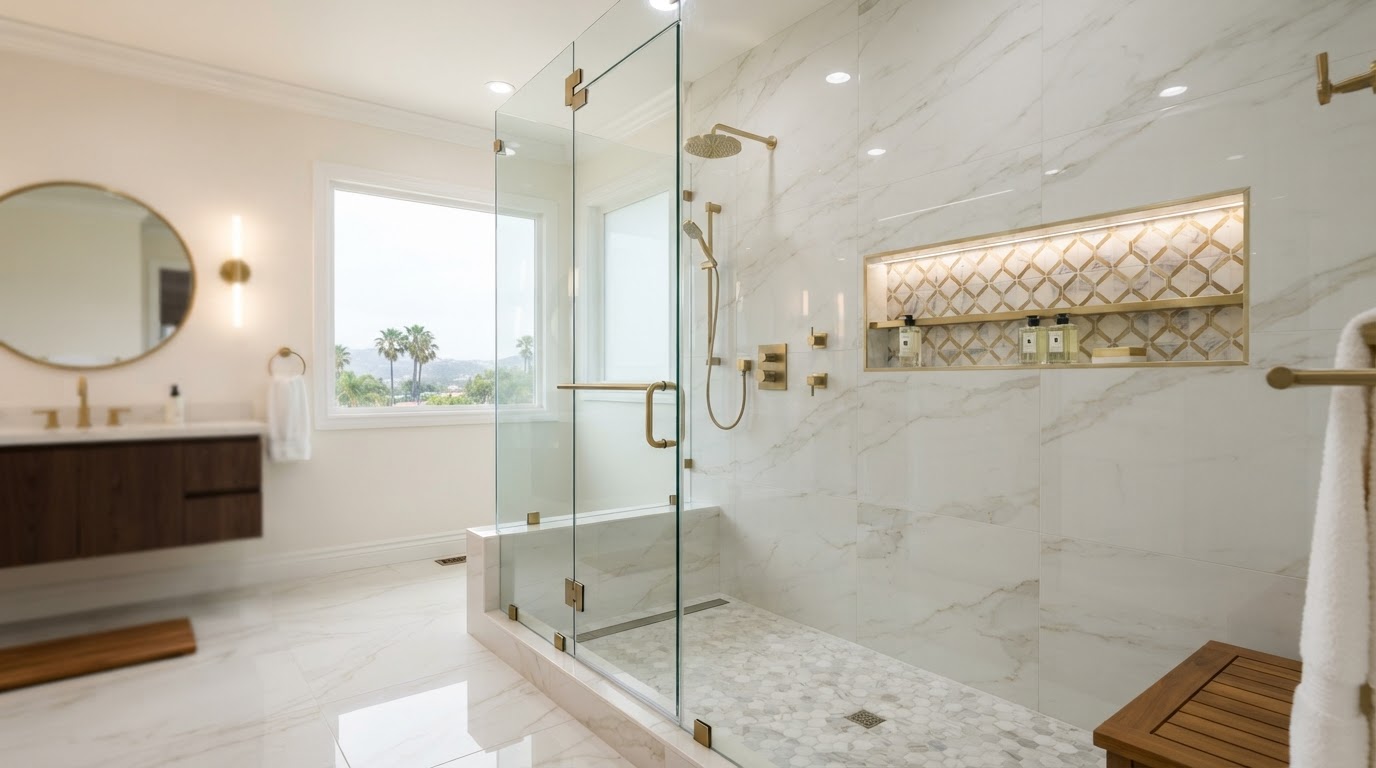
This is why many high-end bathrooms combine both. For example, large-format porcelain on shower walls + mosaic shower floor can provide both visual continuity and practical flexibility.
Should Bathroom Wall Tile Match the Floor?
It can, but matching everything exactly isn't required. There are three common approaches.
1. Match
Use the same tile throughout the room. This creates a highly cohesive appearance—same porcelain on floor, same porcelain on shower walls, matching shower floor mosaic.
2. Coordinate
Use different tiles with related colors and textures. For example: warm beige porcelain floor, cream subway shower walls, beige mosaic shower floor.
3. Contrast
Use one material as the visual feature. For example: neutral floor, dramatic marble shower wall, simple white vanity.
Should Shower Wall Tile Match the Shower Floor?
Not necessarily. In fact, using different tile sizes can improve the design. For example, 24 × 48 marble-look porcelain on the shower walls and 2 × 2 textured porcelain mosaic on the shower floor. The materials can share the same color family while serving different functional purposes.
The Best Tile for a Shower Floor
A shower floor needs special consideration. It should be evaluated for wet-area suitability, slip characteristics, size, texture, drain configuration, slope, cleaning, grout and the waterproofing system. A common choice is small-format mosaic tile because small pieces can follow the slope toward a conventional point drain more easily than a very large rigid tile. However, the drain design matters—some linear-drain systems can permit large-format shower-floor tile by allowing a single-plane slope. The tile and drain should therefore be designed together.
Bathroom Tile and Slip Resistance
A beautiful tile can still be the wrong tile if its surface isn't appropriate for the application. This matters most for bathroom floors, shower floors, entry areas, and homes where accessibility is a major consideration. Don't assume matte means slip-proof, or that textured means automatically safe. Instead, review the manufacturer's technical information and intended-use recommendations.
Tile testing may use wet Dynamic Coefficient of Friction (DCOF) measurements, but a single test value should not be treated as a guarantee that a floor will never become slippery. The entire installation matters.
Bathroom Tile Finish: Matte vs. Glossy vs. Polished
Matte Tile
Generally has a softer, less reflective appearance. Works well for modern bathrooms, natural designs, floors and minimalist interiors. Easier to use visually when you don't want reflections dominating the room.
Glossy Tile
Reflects light, which works particularly well for shower walls, small bathrooms, accent walls and subway tile. It can make a space feel brighter. However, glossy finishes are not automatically the best choice for floors.
Polished Tile
Can create a luxury appearance for feature walls, luxury shower walls, marble-look porcelain and decorative applications. But be cautious about polished surfaces in areas where wet-foot traction is a concern.
Grout: The Detail That Changes Everything
Grout isn't just a technical necessity—it is a design element. Consider the difference between white tile + white grout (continuous appearance) and white tile + charcoal grout (emphasizes every tile).
Matching Grout
Best for minimalist bathrooms, large-format tile, seamless appearance and reducing visual clutter.
Contrasting Grout
Best for subway tile, geometric patterns, decorative designs and emphasizing tile layout. A strong grout contrast can make a simple tile look much more graphic.
Grout maintenance: the more grout you have, the more grout you have to maintain. That's one reason large-format tile can be attractive to homeowners who want a lower-maintenance bathroom. But don't choose giant tile purely to avoid cleaning—the correct tile size still depends on room dimensions, drainage, layout, design, installation and product availability.
Is Bathroom Tile Waterproof?
This is one of the most important misconceptions to correct. Tile and grout are not the waterproofing system. Even tile installations designed for wet environments can allow moisture through grout joints and other interfaces. The waterproofing system behind the tile protects moisture-sensitive construction materials. That means a successful shower isn't simply backer board → tile → grout—it needs an appropriately designed assembly that manages water.
Depending on the construction method, this can involve waterproof membranes, sloped shower bases, proper drains, sealed transitions, appropriate substrates, waterproof corners, properly treated penetrations, and correct integration between floor and wall systems. Industry guidance on tiled showers emphasizes that the tile covering itself is not inherently waterproof and should be installed as part of a properly designed moisture-management system.
Bathroom Tile Patterns
The same tile can create completely different results depending on the layout.
Herringbone vs. Chevron
These two patterns are often confused. Herringbone uses rectangular pieces installed in a staggered zigzag pattern. Chevron ends are typically cut so they meet in continuous points, creating a sharper, more directional appearance. Both require careful layout and installation.
Bathroom Tile for Small Bathrooms
Tile selection can make a major difference in a small bathroom.
Venguard's current small-bathroom recommendations include large-format tile and coordinated floor-to-shower materials as ways to create greater visual continuity.
Bathroom Tile for Primary Bathrooms
Primary bathrooms offer more opportunities for dramatic material combinations. A luxury primary bathroom might combine a large-format warm porcelain floor, marble-look porcelain shower walls, a small-format mosaic shower floor, a decorative mosaic niche, a large-format stone-look slab vanity wall, and a natural wood accent. The result doesn't require every surface to match—it requires the surfaces to relate.
Bathroom Tile Ideas by Design Style
Modern Bathroom
Large-format porcelain, concrete-look tile, minimal grout, neutral colors, matte finishes, straight-stack patterns.
Transitional Bathroom
Subway tile, marble, soft neutral porcelain, herringbone accents, Shaker cabinetry, brushed metal fixtures.
Luxury Bathroom
Marble, large-format porcelain, statement mosaics, stone-look slabs, frameless glass, custom patterns.
Organic Bathroom
Travertine, limestone, slate, warm stone-look porcelain, natural wood, earth tones.
Contemporary Bathroom
Oversized tile, geometric mosaics, textured surfaces, bold accent tile, warm neutrals, black or brass hardware.
Bathroom Tile Cost in Orange County and Los Angeles
Bathroom tile pricing varies substantially. You're paying for more than the tile itself—the total project can include tile material, demolition, surface preparation, waterproofing, setting materials, grout, trim, labor, cutting, layout, disposal and specialty installation.
Current 2026 Los Angeles data shows shower tiling alone can range from roughly $455 to $5,320, depending heavily on shower size, materials and project conditions. That range demonstrates why a simple "price per square foot" isn't always enough to estimate a bathroom tile project. A straightforward ceramic installation is fundamentally different from large-format porcelain, natural stone, intricate mosaic, herringbone, chevron, custom niches, multiple tile transitions, or waterproofing repairs. Venguard's current bathroom cost guidance similarly identifies tile material and installation complexity as major contributors to overall remodeling cost.
What Makes Bathroom Tile More Expensive?
Should You Tile the Entire Bathroom?
Not necessarily. Full tile (floor, shower walls, tub surround, major bathroom walls) creates a highly finished appearance. Partial tile (floor, shower, tub surround only, with painted remaining walls) can reduce cost and simplify maintenance. A feature wall uses decorative tile on one wall to create a focal point without covering every surface. Tile wainscot uses tile on the lower portion of the walls, working particularly well in traditional and transitional bathrooms.
How High Should Bathroom Wall Tile Go?
There isn't one universal height. Full height (floor to ceiling) works especially well in showers, luxury bathrooms and modern designs. Shower-only concentrates tile in wet areas. Half height can create a traditional wainscot appearance. Vanity-height tile is used behind the vanity or sink area. The right choice depends on the design and moisture exposure.
Bathroom Tile and Ceiling Height
Tile layout can influence how tall the bathroom feels. Vertical patterns can draw the eye upward, and full-height tile can create uninterrupted vertical surfaces. For example, vertical subway tile + full-height installation can make a shower feel taller.
How to Choose the Right Bathroom Tile Color
Don't choose tile color in isolation. Consider the room's natural light, artificial lighting, vanity color, countertop, hardware, shower glass, flooring and wall color. A warm beige tile may look very different under cool LED lighting compared with warm lighting. Always evaluate physical samples whenever possible.
Warm
Includes cream, beige, taupe, warm white, sand and brown. Creates a comfortable, organic, relaxed, spa-inspired atmosphere.
Cool
Includes blue-gray, cool gray, white and charcoal. Creates a crisp, contemporary, minimal, clean appearance.
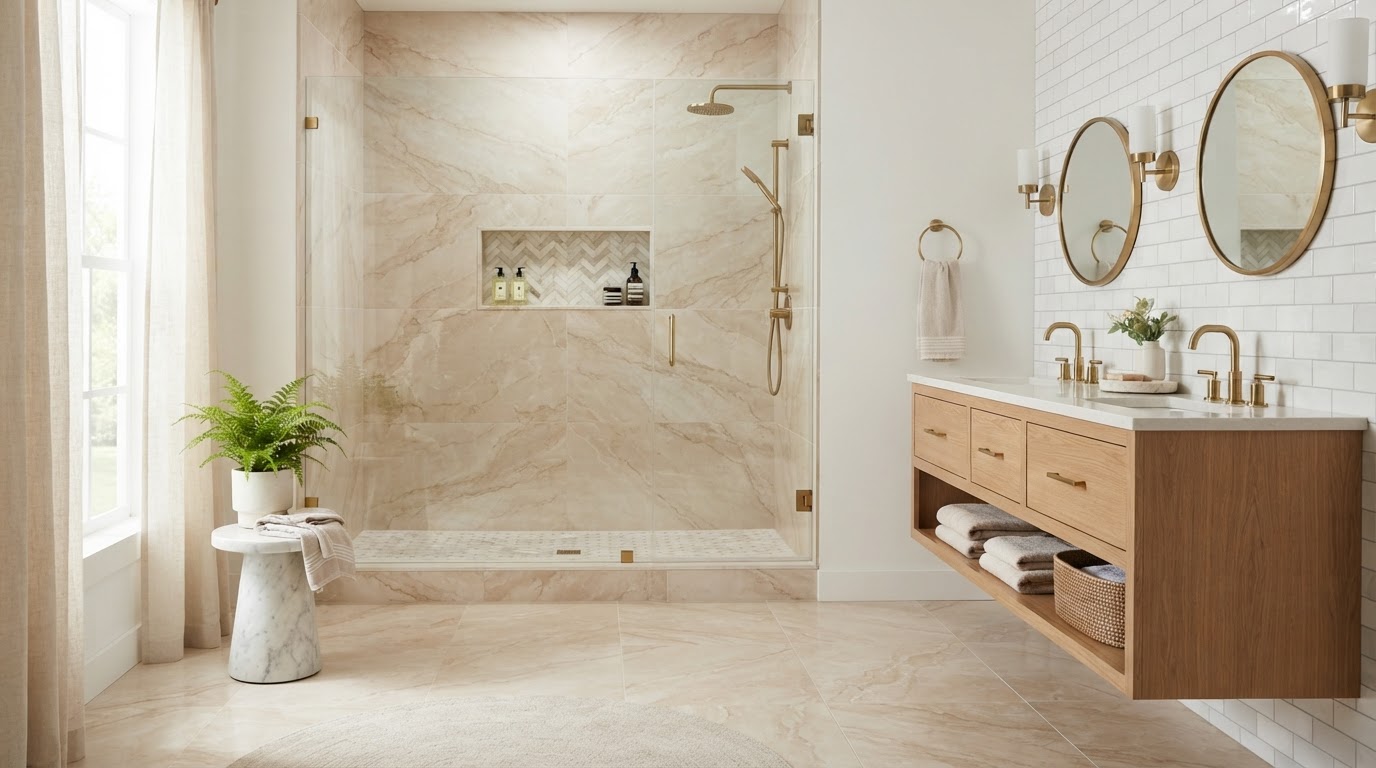
Neither is inherently better. The important thing is consistency. Many successful bathroom designs use a controlled palette—for example, a warm beige porcelain base, a white subway tile secondary, a brushed brass accent, and a light oak vanity natural element. This creates variation without visual chaos.
Bathroom Tile Mistakes to Avoid
A Simple Bathroom Tile Formula
If you're overwhelmed by choices, try this:
Usually the largest surface. Example: warm neutral porcelain.
Adds contrast. Example: white subway tile.
Adds personality. Example: mosaic niche.
Coordinate or contrast intentionally.
Match the overall temperature and style.
This creates a hierarchy rather than a collection of unrelated products.
Bathroom Tile Selection Checklist
Application
- • Rated for intended location?
- • Suitable for wet areas?
- • Appropriate for shower floor?
- • Surface appropriate for traffic?
Design
- • Coordinates with vanity?
- • Works with countertop?
- • Complements lighting?
- • Size fits the room?
- • Pattern supports design?
Installation
- • Substrate prepared?
- • Specialized installation?
- • Large-format considered?
- • Drain config works with size?
- • Transitions planned?
Maintenance & Budget
- • Requires sealing?
- • How much grout?
- • Cleaning products?
- • Tile + installation cost?
- • Waterproofing required?
- • Waste material ordered?
Bathroom Tile Design Ideas for 2026
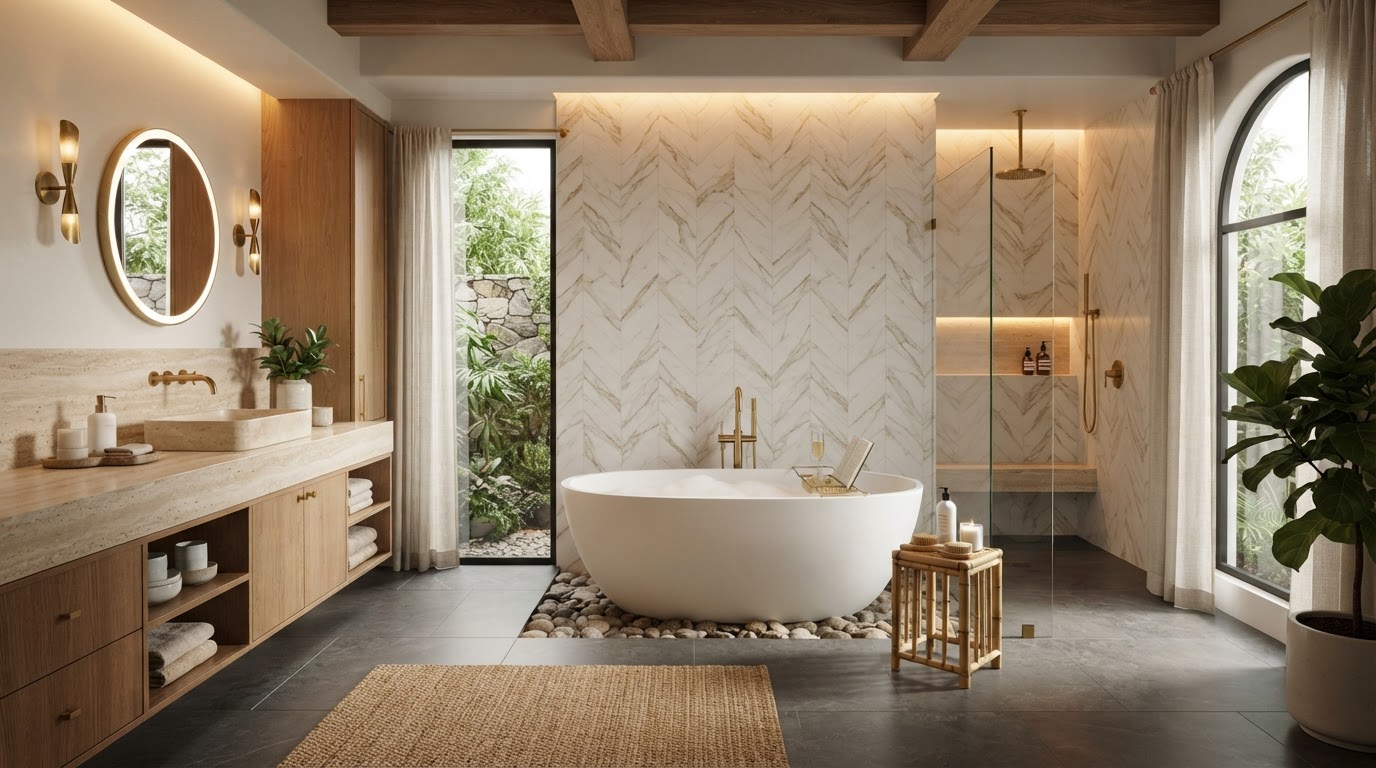
1. Warm Neutral Porcelain
Cream, beige and taupe porcelain creates a timeless foundation.
2. Marble-Look Large-Format Tile
Provides a luxury appearance while reducing grout lines.
3. Oversized Subway Tile
Keeps the classic subway shape while making the room feel more contemporary.
4. Mosaic Accent Niches
Adds detail without overwhelming the entire bathroom.
5. Natural Stone Accents
Use real stone selectively where its unique character has the greatest visual impact.
6. Floor-to-Shower Continuity
Using complementary materials between floor and shower can make the bathroom feel more cohesive.
Venguard's current bathroom remodeling content similarly emphasizes large-format tile, natural materials, warm neutrals, modern minimalism and coordinated surfaces as major directions in contemporary bathroom design.
Bathroom Tile Trends vs. Timeless Design
One of the biggest mistakes homeowners can make is designing a bathroom entirely around a short-lived trend. Instead, consider timeless base + current accents. For example, a timeless base of neutral porcelain, simple subway tile, natural wood and classic hardware, paired with trend-driven accents like a decorative niche, statement mosaic, unique lighting or a bold accent wall. This makes it easier to update the bathroom later without replacing the entire tile installation.
Bathroom Tile and Resale Value
Tile can contribute to how buyers perceive a bathroom, but expensive tile does not automatically create a better return. A bathroom with good proportions, quality installation, appropriate materials, timeless design, good lighting, functional storage and clean detailing can feel significantly more valuable than a bathroom filled with expensive but mismatched materials. The objective should be quality and coherence, not simply the highest-priced tile.
Bathroom Tile Installation: Why Precision Matters
Tile is one of the most visible parts of a bathroom, and small installation issues can become obvious. Potential problems include uneven grout joints, lippage, misaligned patterns, poor corners, uneven cuts, incorrect transitions, poorly aligned niches, improper slope, cracked grout and loose tile. Large-format tile can make substrate imperfections particularly noticeable. Intricate patterns also require careful layout before installation begins. Professional installation is therefore an important part of the tile decision.
Bathroom Tile and Waterproofing Are a System
This deserves repeating: the tile is the finish, and the waterproofing system protects what is behind it. A properly constructed tiled shower needs moisture management that addresses the complete assembly—shower base, walls, drain, corners, curbs, niches, benches, plumbing penetrations and wall-to-floor transitions.
So when comparing contractors, don't ask only "What tile will you use?" Also ask "How will the shower be waterproofed?" That question can be much more important to the long-term performance of the bathroom.
Which Bathroom Tile Is Best for You?
Choose Porcelain
If you want versatility, durability, low maintenance, stone-look options, large-format options and modern design flexibility.
Choose Ceramic
If you want value, a broad design selection, easy maintenance, classic bathroom styles and wall tile flexibility.
Choose Subway Tile
If you want timeless style, easy coordination, classic design and traditional or transitional character.
Choose Large-Format Tile
If you want fewer grout lines, a contemporary appearance, visual continuity and a luxury look.
Choose Mosaic
If you want decorative detail, shower-floor flexibility, accent areas, niches and patterns.
Choose Natural Stone
If you want authentic natural variation, luxury, organic character and unique surfaces—and are comfortable with additional maintenance.
Final Verdict: What Is the Best Bathroom Tile?
There is no single winner. The best bathroom tile depends on where it will be installed, how the bathroom will be used, how much maintenance you're willing to perform and what design you want to create. If you want the most versatile all-around material, porcelain. If you want a classic wall treatment, subway tile. If you want a clean, contemporary appearance, large-format tile. If you want detail and flexibility around shower floors and accents, mosaic tile. If you want authentic luxury and natural variation, natural stone.
And in many of the best bathroom designs, the answer isn't one material. It's a combination—for example, large-format porcelain walls + mosaic shower floor + natural-stone accent + simple grout can provide durability, visual interest and a sophisticated appearance without making every surface compete for attention.
Frequently Asked Questions About Bathroom Tile
What is the best tile for a bathroom?
Porcelain is one of the most versatile choices for many bathroom applications because of its durability, low water absorption and wide range of designs. However, ceramic, natural stone, subway tile and mosaics can all be excellent choices depending on the application.
Is porcelain better than ceramic for bathroom tile?
Porcelain generally has lower water absorption and is denser than conventional ceramic tile. However, a properly rated ceramic tile can perform very well in many bathroom applications.
Is subway tile still popular in 2026?
Yes. Subway tile remains a highly versatile choice because its simple rectangular shape works with traditional, transitional and modern bathroom designs.
Is large-format tile good for a small bathroom?
Yes. Large-format tile can reduce grout lines and create a more continuous visual appearance. However, the room's dimensions and installation conditions need to support the tile size.
Is mosaic tile good for shower floors?
Mosaic tile is commonly used on shower floors because smaller pieces can accommodate the slope toward a drain more easily than large rigid tiles. The specific tile still needs to be appropriate for the wet application.
Can large-format tile be used on a shower floor?
Sometimes. The answer depends on the shower's drainage design, slope and tile system. Conventional point drains often require slopes from multiple directions, making smaller tile easier to use. Certain linear-drain configurations can accommodate larger-format tile by creating a single-plane slope.
Is natural stone good for bathrooms?
Yes. Marble, travertine, slate and other stones can create beautiful bathrooms. However, many natural stones require more maintenance and careful cleaning than porcelain.
Does bathroom tile need to be sealed?
It depends on the material. Many porcelain and glazed ceramic tiles do not require the same sealing routine as porous natural stone. Natural stone may require sealing depending on the specific material, finish and application. Always follow the manufacturer's recommendations.
Is grout waterproof?
No. Grout should not be treated as the waterproofing system. Proper moisture management beneath and around the tile is particularly important in showers and other wet areas.
How much does bathroom tile installation cost in Los Angeles?
There is no single price because the total depends on material, area, demolition, preparation, waterproofing, tile pattern, labor and complexity. For example, current 2026 Los Angeles data estimates shower tiling at approximately $455–$5,320 depending on project conditions. A full bathroom remodel will cost considerably more because it can include plumbing, electrical, cabinetry, fixtures, waterproofing and other work.
How much extra tile should I buy?
A common starting point is around 10% extra material, although complex layouts and patterns may require more. Your installer should calculate the final quantity based on the actual design.
Should bathroom floor tile match shower tile?
It doesn't have to. Matching tile can create continuity, while coordinating different tiles can add depth and visual interest.
Bathroom Tile for Orange County and Los Angeles Homes
Bathroom remodeling in Orange County and Los Angeles can involve homes of very different ages and construction conditions. Some bathrooms may have older tile assemblies, outdated waterproofing, uneven walls, damaged subfloors, previous water damage, outdated plumbing, existing layout limitations, or multiple previous remodels. That's why the existing bathroom should be evaluated before choosing materials.
A homeowner may fall in love with a 24 × 48 porcelain tile only to discover that the existing walls require significant preparation before that format can be installed properly. Similarly, a homeowner may choose a luxury natural stone without realizing the additional maintenance it will require. A professional evaluation can identify these issues early. Venguard Construction approaches bathroom remodeling through a coordinated design-build process that includes consultation, site evaluation, estimating, design, material selection, planning, construction and final walkthrough—so major material selections are made before construction begins rather than during installation.
Related Guides
Planning a Bathroom Remodel in Orange County or Los Angeles?
If you're considering new tile as part of a larger bathroom renovation, Venguard Construction provides design-build remodeling services throughout Southern California. A professional bathroom remodel can coordinate tile selection with the layout, waterproofing, plumbing, lighting, cabinetry, flooring and construction schedule. The right tile can transform a bathroom—but the right system is what makes the transformation last.
Schedule a Complimentary Bathroom Remodeling Consultation